
Stereotactic brain radiosurgery is a modern non-surgical treatment in neurology and oncology that uses highly focused radiation beams to target specific brain regions and treat tumors or vascular malformations without requiring a surgical incision.
This advanced technique is increasingly recognized for its ability to destroy diseased cells with millimeter-level accuracy, while sparing healthy tissue, making it a safe and effective alternative to conventional surgery and traditional radiation therapy.
What is stereotactic brain radiosurgery?
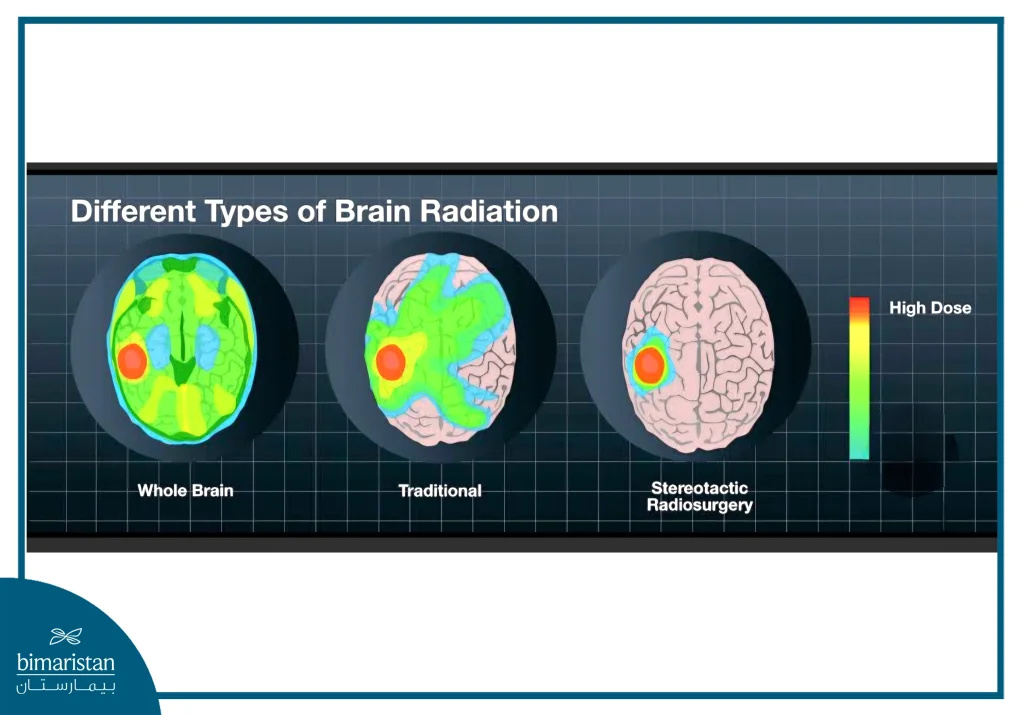
Stereotactic brain radiosurgery is an advanced form of non-invasive radiation therapy used to remove small tumors or functional abnormalities in the brain with extreme precision. In one or several limited sessions of high-dose radiation, focused beams are directed at the target with millimeter precision, thereby preserving surrounding healthy tissue and reducing complications compared with conventional radiation therapy.
Stereotactic brain radiosurgery works in the same way as conventional therapeutic radiation therapy. The beams of radiation damage the DNA of abnormal cells, preventing them from reproducing and growing; as a result, they gradually lose their activity and begin to shrink. This technique does not require any incision or surgical intervention.
The technology is not limited to the brain; it can also be applied to spinal lesions and other body sites, using a robotic arm that rotates around the patient to precisely direct radiation from multiple angles.
When is stereotactic brain radiosurgery used?
Stereotactic brain radiosurgery is often safer than conventional brain surgery, also known as neurosurgery. Conventional surgery requires incisions in the scalp, skull, and membranes surrounding the brain, as well as an incision into the brain tissue itself. This type of radiation therapy is usually performed when:
- When a tumor or other brain abnormality is too difficult to reach with standard neurosurgery
- When a person is not healthy enough for standard surgery
- When a person prefers a less invasive treatment
Radiation oncologists and neurosurgeons use stereotactic brain radiosurgery to treat benign and malignant tumors, including:
- Glioma
- Cordoma
- Meningioma
- Craniopharyngoma
- Glioblastoma
- Hemangioma
- Acoustic neuroma
- Metastatic brain tumors
- Pineoblastoma
- Pituitary adenoma
- Trigeminal neuralgia
- Arteriovenous malformation
Features and benefits of stereotactic brain radiosurgery
Stereotactic brain radiosurgery is one of the most advanced and safe treatments for brain tumors and vascular malformations, due to its high precision and minimal complications. Some of its most notable features include the following:
- Non-invasive and safe technique: Stereotactic brain radiosurgery requires no incision or surgical intervention, significantly reducing the risk of bleeding, infection, and inflammation associated with conventional procedures.
- Millimeter-level accuracy in targeting the tumor: The technology employs advanced guidance systems and 3D imaging to precisely locate the tumor, enabling destruction of abnormal cells without compromising surrounding healthy tissue.
- Limited treatment sessions: Treatment is often given in one or several short sessions with high doses of radiation, minimizing the need for repeat visits as in conventional radiation therapy.
- Short recovery time and rapid return to activity: Because the treatment does not involve surgery or general anesthesia, the patient can leave the hospital the same day and resume normal activity within a very short period.
- Effective and durable treatment outcomes: Studies show that stereotactic radiosurgery achieves high rates of tumor growth control and reduces the risk of recurrence, particularly for benign or small tumors.
- Lower risk of side effects: Due to the specific radiation dose, the risk of affecting healthy brain tissue or developing neurological complications is much lower than with wide-field radiation therapy.
Types of devices or techniques used in stereotactic brain radiosurgery
Stereotactic radiosurgery of the brain and body is based on different techniques:
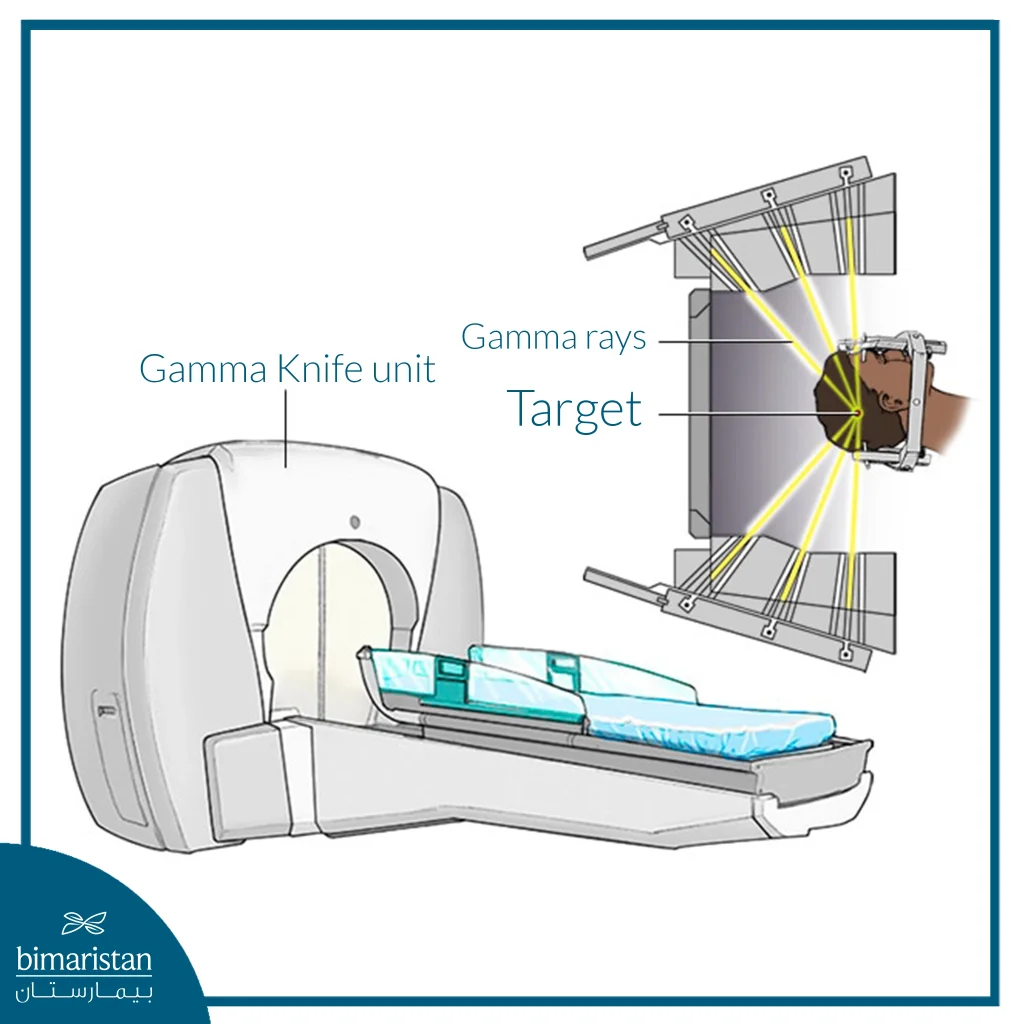
- Gamma knife: The Gamma Knife is used to deliver precise radiation beams to the tumor without surgery. The head is fixed within a specialized frame or mask while the patient lies on the treatment table. The table slides inside the radiation unit so that only the head is inside the device, and the beams are directed from multiple angles to target the tumor with high precision.
- Linear Accelerator (LINAC): A robotic arm that rotates around the patient while lying on the table, directing X-rays to the tumor from different angles, allowing the dose to be delivered precisely to the targeted area while minimizing the impact on healthy tissue.
- Proton therapy: High-energy particles known as protons are used to deliver concentrated radiation doses directly to the tumor. This technique is among the newest and least common methods, owing to its high cost and limited availability.
Risks and side effects of stereotactic brain radiosurgery
Stereotactic brain radiosurgery results in fewer and less severe side effects compared to conventional radiation treatments that target larger areas and may impact healthy tissue. The following side effects are typically temporary and improve within a few weeks:
- Headache
- Skin irritation at the treatment site
- Hair loss at the treatment site
- Digestive symptoms such as nausea or vomiting
- Neurological symptoms such as seizures, numbness, or weakness
- Fatigue, fatigue may occur in the first few weeks after radiosurgery
- Swelling of the brain at or near the treatment site can cause a range of symptoms, depending on which brain regions are affected. If post-treatment swelling occurs, symptoms typically appear approximately six months after treatment rather than immediately after the procedure, as in conventional surgery.
What can a patient expect before and after treatment with stereotactic brain radiosurgery?
During the procedure, a lightweight frame is fixed to the head using four pins to maintain stability during radiation therapy. In some cases, pins are not used. The frame not only secures the head but also serves as a precise reference point for directing radiation beams toward the targeted area. Hair is not shaved; instead, the forehead and back of the head are cleaned with antiseptic alcohol to ensure the frame is comfortably and accurately positioned.
Subsequently, the scalp is injected with local anesthetic at the pin sites, two on the forehead and two at the back of the head, to minimize discomfort during the procedure and ensure the head remains stable throughout treatment. Once the frame is secured, brain imaging is performed to identify the tumor or any other target being treated. The type of imaging used depends on the condition being addressed:
- In the case of tumors: Computerized tomography (CT) or magnetic resonance imaging (MRI) may be used. CT uses X-rays to produce detailed images of the brain, whereas MRI uses a magnetic field and radio waves to produce high-resolution images. In some cases, a contrast agent may be injected into a blood vessel to further visualize the vasculature.
- Arteriovenous malformations (AVMs): MRI and cerebral angiography are usually used. During cerebral angiography, a small tube is inserted through the blood vessels in the groin to the brain, and a dye is then injected to make the vessels visible on X-rays.
- In the case of trigeminal neuralgia: An MRI is used to take precise images of nerve fibers in the brain and identify the area targeted for pain treatment.
The results of these scans are entered into a computer, where specialized planning software helps the radiosurgery team determine which areas to treat and the radiation doses required. This planning process usually takes less than an hour, during which time you can relax in another room. However, the frame must remain fixed in your head at all times. Children are given medications to induce a sleep-like state during tests and treatment, whereas adults remain awake but may be given medications to help them relax.
During the procedure
The patient lies on a bed that slides into the machine, where the head-mounted frame is securely attached to a helmet inside the machine. The patient is connected to an intravenous tube that delivers fluids into the bloodstream, helping to prevent dehydration during the procedure. A needle at the end of the tube is inserted into a vein in the arm. The duration of the procedure can vary, ranging from less than an hour to approximately four hours, depending on the size and shape of the target area. During the procedure:
- The patient does not feel the radiation
- The device makes less noise compared to other devices
- The patient can talk to the healthcare team through a microphone
- Most patients receive treatment in one session, but in the case of fractional therapy, it is divided into 3-5 sessions with smaller doses
After the operation
After the procedure, you can expect the following: Removal of the head frame and the ability to eat and drink normally. There may be slight bleeding or a painful sensation when touching the area where the pins were placed. If headache, nausea, or vomiting occur after the procedure, appropriate medications will be given to relieve these symptoms.
Comparison between conventional surgery and stereotactic brain radiosurgery
The following table shows a comparison between conventional surgery and stereotactic brain radiosurgery:
| Criterion | Conventional surgery | Stereotactic radiosurgery |
|---|---|---|
| Surgical procedure | Requires a surgical incision to reach the target area | A non-invasive technique that uses focused radiation beams through the skin |
| Recovery period | A long period of time that can take weeks to months, depending on the type of surgery | A short recovery period, you can return to daily activities quickly |
| Risks and complications | Bleeding, infection, and complications from anesthesia | Mild side effects such as fatigue or nausea, which often disappear within days |
| Accuracy of treatment | May be less accurate in some cases | High-precision, millimeter-accurate beam steering |
| Cost | High cost due to the need for hospitalization, surgical instruments, and anesthesia | Lower cost since the treatment does not require surgery or long stays |
| Use | Used for large tumors or cases that require surgery | Used for small tumors or conditions that are difficult to treat surgically |
Outcomes and effectiveness of stereotactic brain radiosurgery
Stereotactic brain radiosurgery (SRS) is among the most effective treatment options for brain tumors and vascular malformations, offering promising therapeutic outcomes due to its high precision in tumor targeting while minimizing damage to surrounding healthy tissue. Studies have shown that stereotactic brain radiosurgery significantly contributes to controlling tumor growth or even reducing tumor size, particularly in small tumors that are difficult to reach with conventional surgery.
Stereotactic brain radiosurgery is an effective alternative to conventional radiation therapy, achieving equal or superior results in treating small brain tumors. It reduces tumor growth rates and minimizes damage to surrounding healthy tissue. Clinical studies highlight its ability to deliver precise and safe treatment with shorter recovery times than whole‑brain radiation therapy (WBRT), making it a suitable option for many patients.
As an advanced, non‑invasive technique, stereotactic brain radiosurgery provides a reliable solution for brain tumors and vascular malformations, often preferred in complex cases. With its high precision, it offers hope for patients with small tumors or those located in difficult‑to‑reach areas. Patients diagnosed with brain tumors or vascular malformations should consult specialized doctors to determine whether stereotactic brain radiosurgery is the most suitable treatment based on tumor type and location.
Sources: