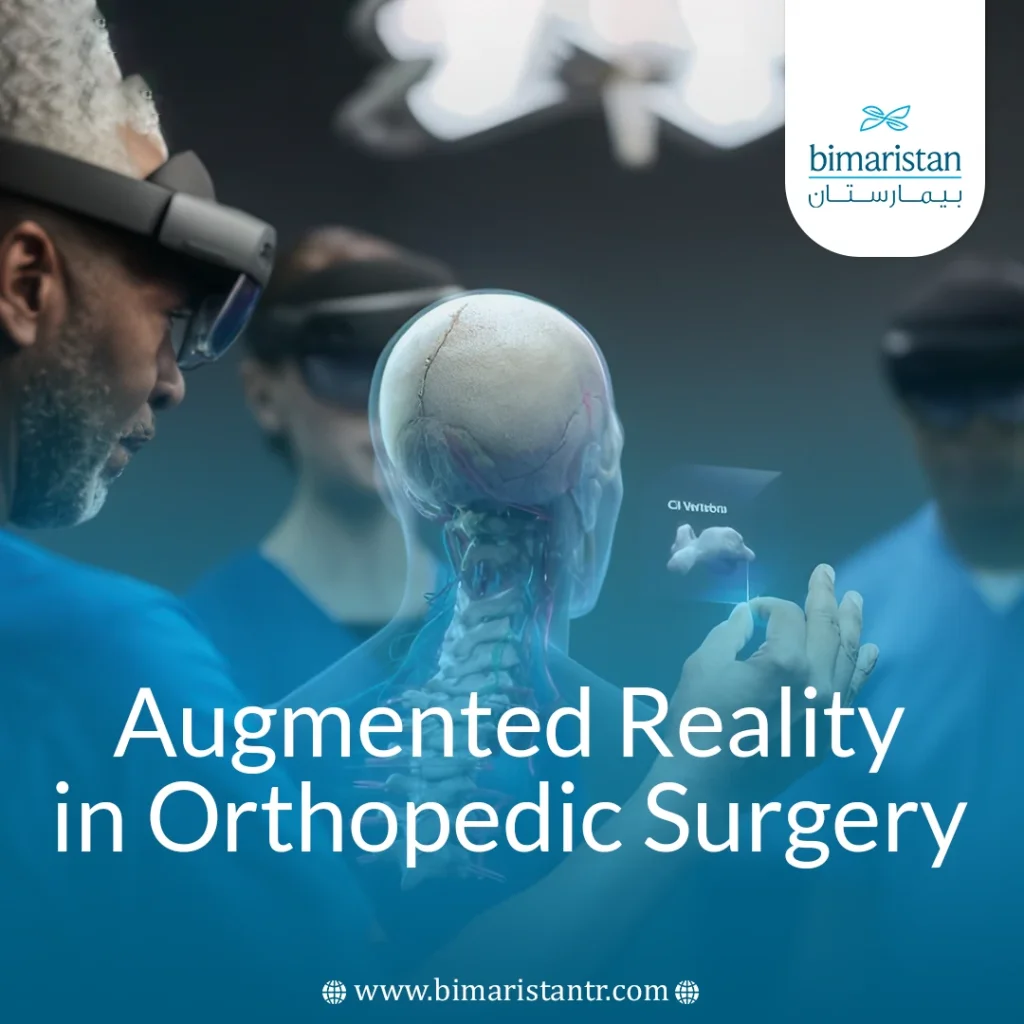



With the rapid advancement of global medical technologies, augmented reality has emerged as a revolutionary tool in the healthcare sector. Augmented Reality in Orthopedic Surgery has significantly enhanced surgical precision and minimized risks, leading to better treatment outcomes and faster recovery. Among the most cutting-edge innovations, augmented reality technologies in orthopedic surgery have played a vital role in numerous procedures worldwide.
What is augmented reality, and how does it work in the medical field?
Augmented Reality (AR) in orthopedic surgery is a technology that overlays digital information, such as images, text, and 3D models, onto the real world in real-time. This integration allows data to be projected directly onto the actual surgical scene without replacing it, unlike virtual reality, which fully substitutes reality. AR enhances the surgeon’s visual perception of the operating environment with interactive, computer-assisted content.
Augmented reality in the medical field works on four main fronts:
- Medical data collection: Including imaging scans such as computed tomography (CT) and magnetic resonance imaging (MRI). It converts this data into digital 3D models.
- Registration: The process of correlating anatomical data, such as a radiology image, with the real patient’s body with high accuracy, and uses non-marker-based registration algorithms to achieve accurate alignment.
- Tracking: It tracks the location and orientation of surgical instruments, the surgeon’s head, or the surgical area using cameras, optical sensors, or positioning systems.
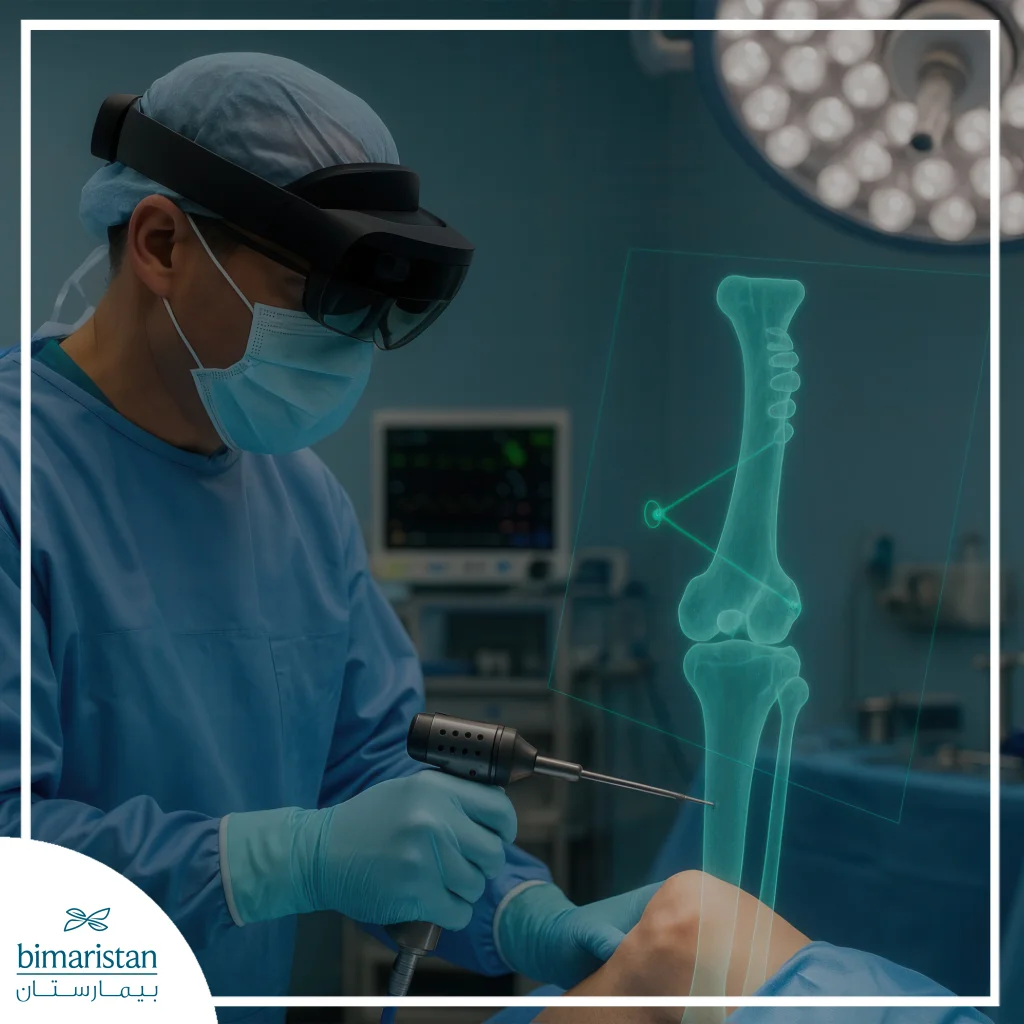
- Visualization: 3D digital models are projected onto the patient’s body either via head-mounted displays, smart glasses, or conventional monitors. This allows the surgeon to visualize anatomical structures, such as bones, vessels, and nerves, that are hidden under the skin without the need for a wide surgical incision.
Augmented reality in orthopedic surgery: Applications
The applications of augmented reality in orthopedic surgery are numerous, primarily aiming to enhance the accuracy of surgery, minimize surgical intervention, and create a safer environment for both the surgeon and the patient. The most important applications include the following:
- Surgical guidance: By displaying 3D models of bones during surgery, it can be used to precisely position screws or implants.
- Preoperative planning: Surgical procedures can be simulated on a digital model of the patient, which improves the accuracy of planning for cutting or bone correction.
- Reduce reliance on radiation: By minimizing repeated intraoperative imaging, the surgeon and patient’s exposure to radiation is reduced.
- Intraoperative evaluation: The doctor can immediately check the alignment of bones or implants, which is essential in knee joint replacement and correction of deformities.
- Education and training: By training surgeons using realistic simulations, it is a safe and effective method for teaching complex procedures.
- Minimally invasive surgery: precisely guiding instruments without the need for a large incision, as seen in arthroscopy and micro-interventions.
The advantages of augmented reality in orthopedic surgery
Augmented reality in orthopedic surgery is characterized by the following:
- Higher accuracy in operations
- Minimize surgical time
- Minimize complications
- Reduce reliance on radiation
- Training doctors
- Better visualization of anatomical structures
Challenges and limitations of using augmented reality in orthopedic surgery
Although augmented reality in orthopedic surgery has many advantages, it has some difficulties and limitations:
- High cost: AR devices and accompanying equipment are expensive
- Difficult to register and track: Accurately aligning 3D images with the patient’s body is a scientific challenge
- Complexity of use: Some systems require extensive training and may not be suitable for all surgeons
- Visual impairment issues: Some tools may obscure some virtual signs or models
- Poor compatibility with the surgical environment: Including blood, instruments, and changes in patient positioning that affect system performance
- Scarcity of clinical evidence: Most studies are still in experimental or preclinical stages
The difference between AR and VR in the medical field
Augmented Reality in orthopedic surgery (AR) and Virtual Reality (VR) are two advanced technologies used to integrate digital information into the medical experience, but they differ fundamentally in several aspects. AR overlays digital elements, such as images and 3D models, onto the real environment in real time, allowing the user to see the actual surgical field enhanced with additional data. It is used in surgeries and medical education, enabling interaction with both the real world and digital content without isolating them from each other.
On the other hand, VR creates a completely digital environment that is disconnected from reality. It immerses the user in a simulated experience through specialized headsets and is commonly used for training, gaming, and high-fidelity medical simulations.
The future of augmented reality in orthopedic surgery
The future of augmented reality in orthopedic surgery is very promising, with a growing trend towards integrating this technology into modern operating rooms. It is expected to be more widely used in surgical guidance, improving the insertion of screws and implants to correct bone deformities, thereby reducing the need for repeated radiography and minimizing radiation exposure to both the patient and the surgeon.
With the continued development of registration and tracking algorithms, the use of AR will become more accurate and reliable, even in complex surgical environments. Additionally, it is expected that AI technologies will integrate with AR to provide automated and personalized guidance during surgery.
Augmented reality in orthopedic surgery marks a transformative leap in enhancing surgical precision and clinical outcomes. By merging digital data with real-time surgical environments, AR improves visualization, supports intraoperative decision-making, and strengthens surgical training. Its potential to reduce errors and optimize patient care positions it as a vital tool in the future of orthopedic medicine.
Sources:
- Shahzad, H., Bhatti, T., Khan, S., &Phillips, F. M. (2023). Applications of Augmented Reality in Orthopaedic Spine Surgery. Journal of the American Academy of Orthopaedic Surgeons, 31(17), e601-e609.
- U.S. Food and Drug Administration. (2024, September 6). Augmented Reality and Virtual Reality in Medical Devices. Digital Health Center of Excellence.