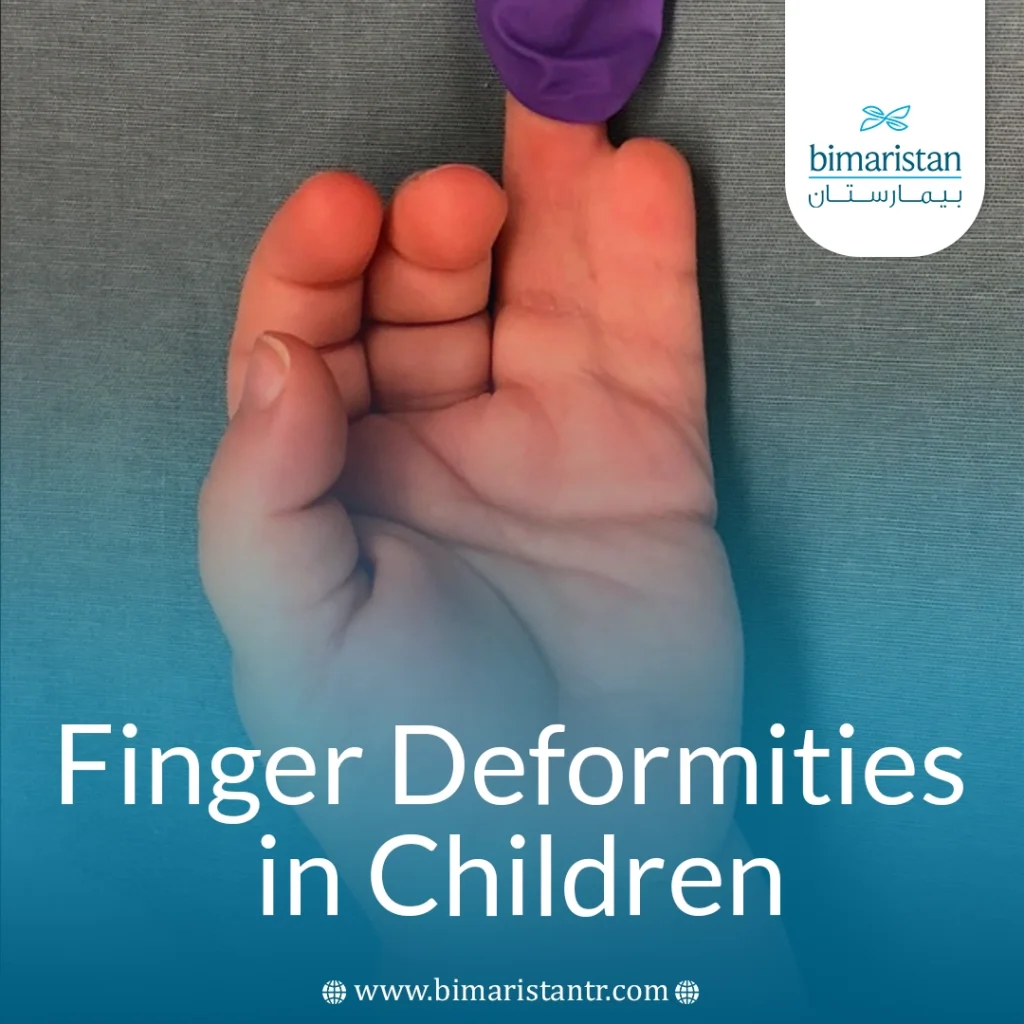
Finger deformities in children are among the most common congenital anatomical abnormalities seen in newborns. They may appear as the fusion of two or more fingers (fused fingers) or the presence of an extra finger on the hand or foot (extra fingers). These deformities usually result from genetic or developmental disorders during fetal growth in the womb, and their severity ranges from mild cases that do not affect movement to complex conditions that can limit normal limb function.
Statistics indicate that finger deformities in children occur in about one out of every thousand births, making them one of the most frequent congenital hand abnormalities. Early diagnosis is crucial to identify the type of deformity and its impact on the child’s motor development. This enables doctors to design an accurate treatment plan, which may involve surgery or physical rehabilitation. Timely intervention helps restore the normal appearance and function of the hand or foot, enhancing the child’s quality of life and supporting healthy motor development.
What are finger deformities in children?
Finger and toe deformities are congenital disorders that affect the formation of the hands or feet in the fetus. These conditions can result in alterations in the shape, number, or functionality of the fingers and toes. These deformities may appear as finger fusions, extra fingers, missing fingers, or shortened or crooked bones and limbs.
These conditions arise from abnormalities in the development of bones or tissues during the fetal stage, often related to genetic factors or mutations. Still, sometimes they may occur without a clear cause. These abnormalities affect, to varying degrees, the aesthetic appearance and motor ability. They are considered one of the most congenital disorders that require early surgical or rehabilitative intervention to improve the function of the hand or foot and ensure normal development of the child.
Common types of finger deformities in children
Some of the most common types of finger deformities in children include crooked fingers, extra fingers, and other deformities.
Conjoined fingers (Syndactyly)
Conjoined fingers (Syndactyly) is a birth defect that means two or more fingers or toes are fused. It’s relatively common and easy to treat. If you have a family history of finger or toe syndactyly, you may consider genetic testing for the gene mutation that causes the condition.
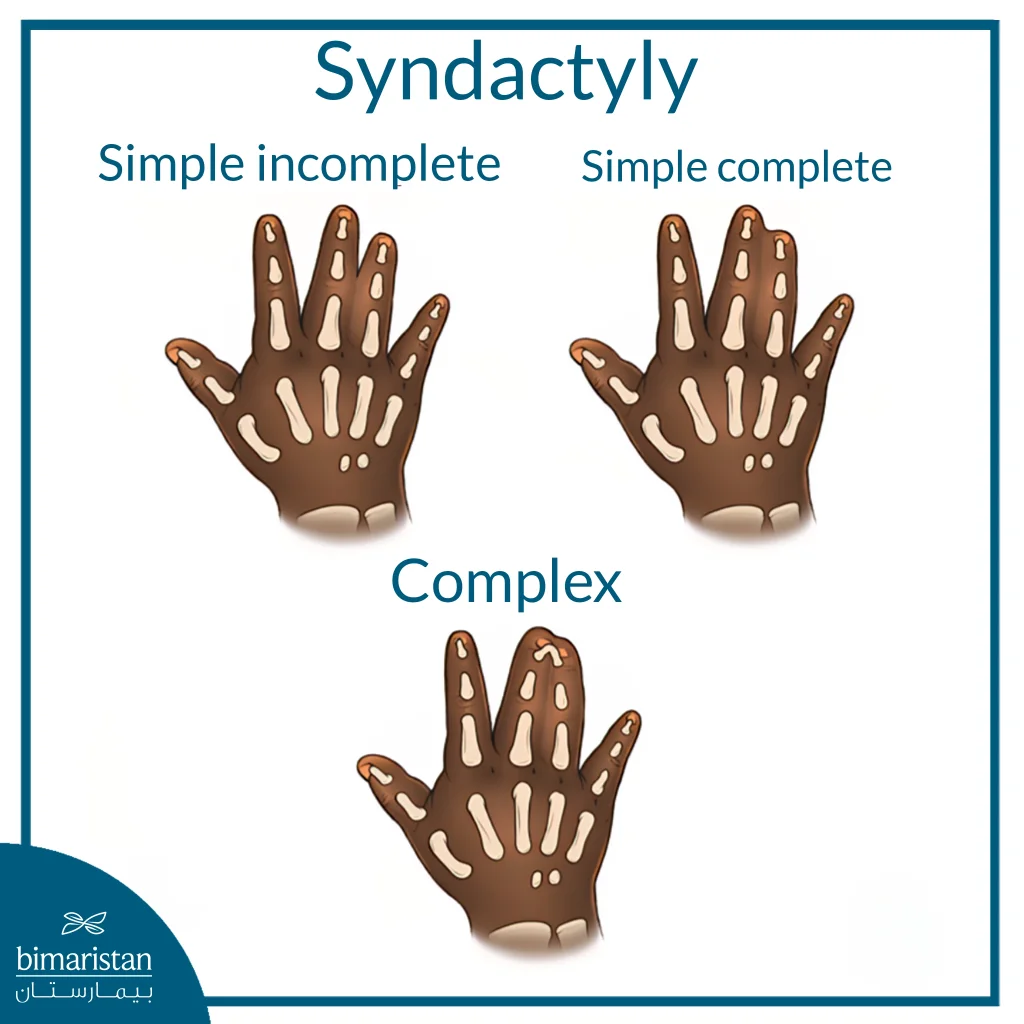
Types of conjoined fingers (Syndactyly)
Your doctor may use some terms to describe the condition of your child’s conjoined fingers or toes, such as:
- Simple fusion: The fusion involves only the skin and soft tissues.
- Complex fusion: This means that the baby’s bones, nerves, and blood vessels are also fused, along with the skin and soft tissues.
- Complete fusion: This means that the entire length of the fingers or toes is fully fused from the base to the end of the nail.
- Incomplete fusion: The fusion extends only part of the length of the two fingers.
Accessory fingers (Polydactyly)
Accessory fingers (Polydactyly) occur when a child is born with an additional number of fingers or toes, often on only one hand or foot, and the extra finger is small and underdeveloped. It may not function as normally as the rest of the fingers. Also known as hyperdactyly, this condition is among the most common congenital limb malformations. Accessory fingers on the hand are a congenital variation, while extra toes on the foot are the most common deformity of the front of the foot.
Types of accessory fingers (Polydactyly)
The type of condition depends on the location of the extra finger, and is divided into three main types:
- Postaxial accessory fingers: The most common type, occurring in about 1 in 3,000 births, the extra finger may be:
- Extra pinky finger
- Extra little toe
- Preaxial accessory fingers: Occurring in about 1 in 7,000 births, the extra finger may appear as:
- Extra big toe
- Extra thumb
- Central accessory fingers: One or more fingers between the thumb and pinky on the hand, or between the big and little toe, is the rarest type.
Some fingers may be partially fused, giving a membrane-like appearance between the fingers.
Less common finger deformities in children
There are also less common abnormalities, including:
- Hypodactyly: A congenital malformation in which a child is born with fewer than normal fingers or toes, caused by the failure of one of the fingers to form during fetal development.
- Partial fusion between bones or joints: This is an abnormal fusion between the bones or joints of the fingers that restricts the movement of the finger, and can sometimes be associated with external skin fusion.
- A deviated or twisted finger: It is a deviation or tilt of a finger inward or outward due to an abnormal bone shape, often affecting the little finger of the hand.
Causes and factors leading to finger deformities in children
The process of forming hands and fingers in the womb begins around the fourth week of pregnancy, as embryonic cells begin to differentiate to form bones and tissues, and any increase or decrease in the activity of the genes responsible for this process may lead to a developmental defect, causing fusion between fingers or an increase in their number. This occurs as a result of a genetic disorder during fetal development, as genes are the genetic code that transmits traits from parents to children and controls the formation and growth of cells. Any malfunction in their work may lead to birth defects of varying severity.
Genetic and environmental factors during pregnancy, such as certain medications, infections, or radiation, can also interfere with these genes and affect limb formation. In some cases, finger deformities in children are associated with known genetic syndromes. In contrast, in other cases, the exact cause remains undetermined, and some of the known genetic syndromes that are associated with finger deformities in children include:
- Craniofacial abnormalities such as Carpenter’s syndrome
- Chondroectodermal dysplasia
- Thoracic outlet syndrome
- Smith-Lemel-Opitz syndrome
- Rubinstein-Taybi syndrome
- Diamond-Blackfan anemia
- Lawrence-Moon syndrome
- Fanconi anemia
- Trisomy 13
- VACTERL association
- Down syndrome
Ethnic and gender factors may play a role in the development of the condition:
- Black males are ten times more likely to be infected than white males
- The condition is 22 times more common in black females than in white females
How to diagnose finger deformities in children
In most cases, an extra finger is discovered during a prenatal ultrasound or a non-invasive prenatal testing, where the doctor can observe an extra finger on the fetus’s hand or foot. If it is not detected during pregnancy, it will be evident at birth through a clinical examination.
After birth, the child will have an X-ray to determine how the extra finger connects to the bones of the hand or foot, which helps guide the appropriate surgical treatment plan. Genetic testing via a blood sample may also be required to screen for genetic mutations or congenital syndromes associated with the condition, especially if there is a similar family history or other associated abnormalities.
Treatment of finger deformities in children
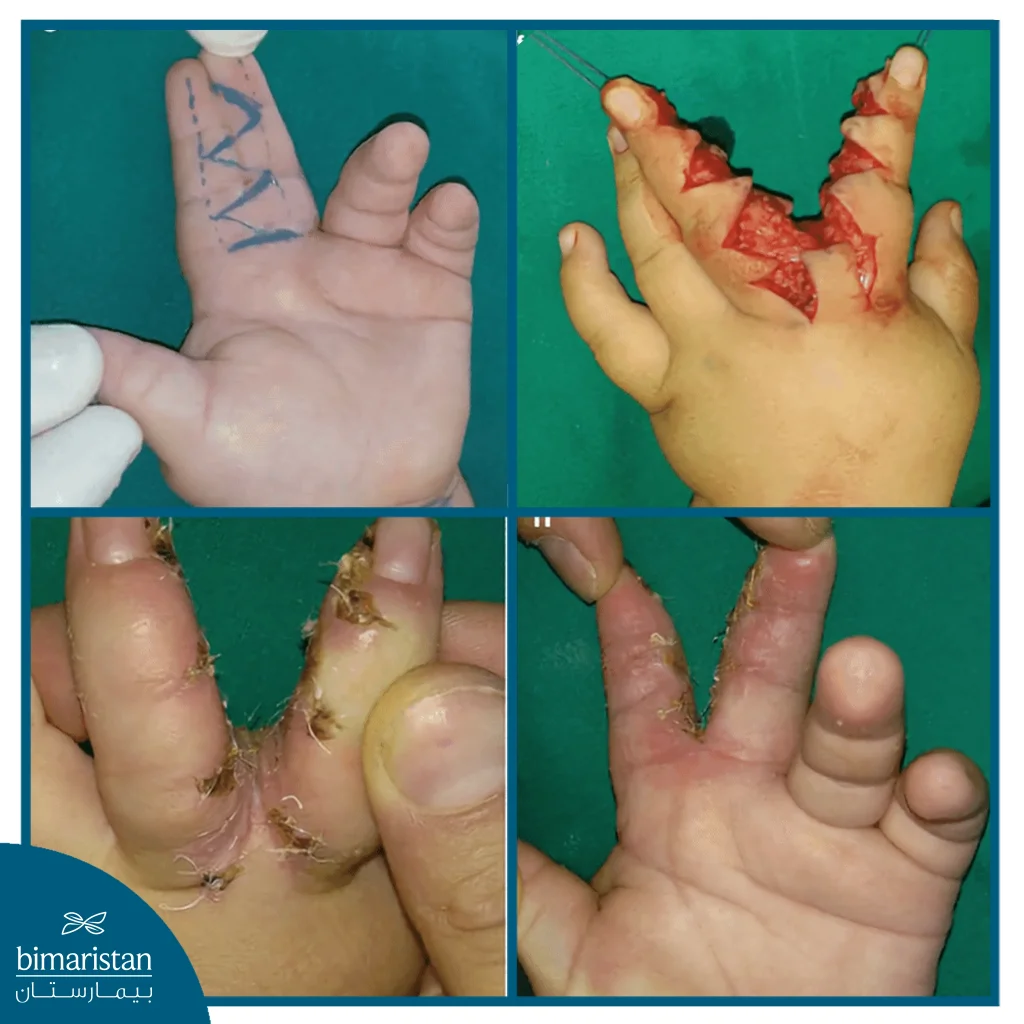
The treatment of finger deformities in children depends on the type and severity of the condition, and aims to restore the normal form and full function of the hand or foot. In case of fused fingers, surgical treatment is the primary option, usually performed when the child is around 1 year old. The surgeon makes a Z-shaped incision to separate the fused fingers, with skin grafts taken from the wrist or thigh to cover the exposed area after separation, as the original skin is not sufficient. In simple cases where the fusion is limited to the toes and does not affect movement, surgery may not be necessary.
In cases where a child has extra fingers, the treatment involves removing the additional finger or duplicate structure while preserving the surrounding tissue to keep it functional and intact. The treatment method varies depending on how the extra finger is attached. The following types of treatments are commonly used to address finger deformities in children:
- Electrocautery: Used to remove little finger remnants (usually on the hand), the child receives local anesthesia, and the doctor uses a safe electric current at the base of the extra finger to destroy the attached tissue. Cautery also helps close blood vessels, reduce bleeding, and speed up skin healing.
- Ligature: A compression band is used to cut off the blood supply to the extra finger. This procedure is only done if the finger has no bone or connective tissue, the procedure is painless for the child, and the extra finger usually falls off after about two weeks.
- Surgery: In complex cases involving bones and blood vessels, the extra finger is removed surgically. The specific type of surgery is tailored to each child’s anatomy, and the child may require a splint or cast during recovery.
- Physical and occupational therapy: Following surgery, some children may require physical or occupational therapy to improve finger movement and strength and restore normal function to their hand or foot.
After any of these procedures, occupational therapy (OT) is an essential part of the recovery plan, especially in cases of fused fingers, as it helps the child move the fingers separately and regain strength and flexibility in each finger. Physical therapy can also improve range of motion and help prevent joint stiffness. Parental involvement in the implementation of home exercises is an essential step to ensure better results and accelerate recovery, helping the child regain full normal use of the hand or foot.
Finger deformities in children outcomes and long-term follow-up
The results of treatment for finger deformities in children usually show significant improvement in appearance and motor function after surgery, especially when treatment is performed in early childhood. Most children can use their hands or feet normally over time, gradually regaining the ability to grasp and perform fine motor movements. Although surgery is successful in most cases, sometimes additional corrective surgery may be needed, especially in complex cases or when there is a deep bony fusion. Regular follow-up with a plastic or orthopedic surgeon is essential to assess finger growth and function and to ensure that any deformity or restriction of movement does not recur.
Prevention and early diagnosis of finger deformities in children
Not all cases of finger deformities in children are preventable, but they can be detected early through pre-marital or pre-pregnancy genetic testing, which helps determine the likelihood of passing on the genetic mutations that cause the deformity. Pregnant women, especially those with a family history of such conditions, are also advised to have regular ultrasound follow-ups during pregnancy for early detection of any abnormalities in limb formation. Early detection enables appropriate surgical planning after birth and better functional and aesthetic outcomes for the child.
In conclusion, finger deformities in children are congenital conditions that can be effectively treated when diagnosed early and when a tailored treatment plan is developed for each individual case. Early diagnosis, whether during pregnancy or immediately after birth, enables timely intervention and helps prevent future functional or aesthetic complications.
Modern surgical methods and precise techniques in hand and limb surgery have proven their ability to restore normal form and motor function in most cases, enabling children to grow and rely on themselves without any restrictions. Regular follow-up care and rehabilitation therapy are essential for achieving the best outcomes and ensuring a normal life free from motor impairments.
Sources:
- Hinkley, J. R., & Fallahi, A.-K. M. (2022, September 18). * Syndactyly.* In StatPearls . Treasure Island (FL): StatPearls Publishing. Available from
- Ma, C. B. (2024, August 27). Repair of webbed fingers – series – Indications. MedlinePlus.