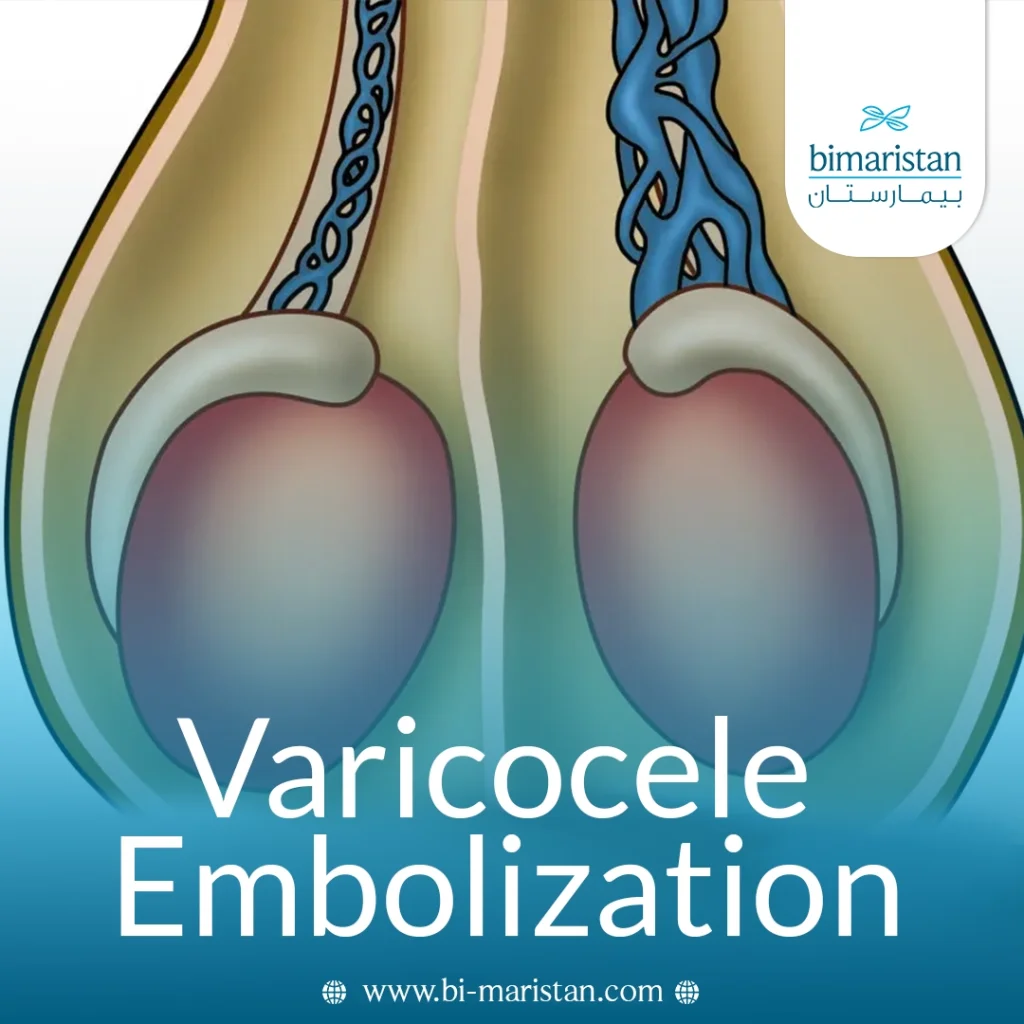
Varicocele embolization is one of the most effective non-surgical methods in recent years, with a technical success rate of more than 95% in several recent studies. The technique relies on precise closure of the affected vein without the need for an incision, minimizing pain and speeding recovery. Statistics show that more than one-third of cases of male infertility associated with varicose veins improve after venous blood flow correction. With advances in interventional radiology techniques, this treatment has become a safe and effective option for patients who wish to avoid traditional surgery.
What is a varicocele?
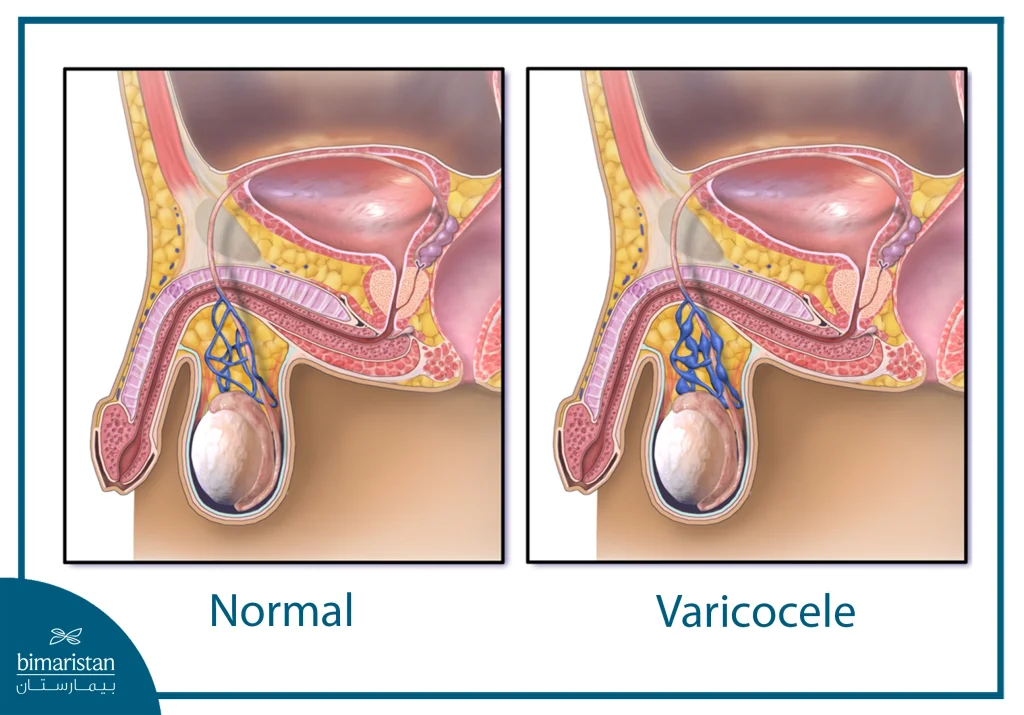
Varicoceles are a pathological enlargement of the veins surrounding the spermatic cord within the scrotum. This enlargement results from a malfunction of the venous valves that return blood from the testicle to the main bloodstream. When these valves fail, blood flow slows and pools within the veins, leading to increased pressure and, over time, stretching of the vein walls until the enlargement becomes visible or palpable.
Varicoceles are a common cause of male infertility, as they can negatively affect sperm concentration, motility, and morphology. They may also present with intermittent pain or a feeling of heaviness that worsens with prolonged standing or strenuous activity. Diagnosis typically relies on a physical examination, supplemented by Doppler ultrasound when needed to determine the severity of the enlargement and the pattern of venous flow.
When the enlargement affects fertility or causes symptoms, treatment options are considered. These options aim to close the affected veins and redirect blood flow through healthy pathways while preserving testicular function. Surgical and non-surgical approaches differ in the level of intervention, the precision of vessel access, and the speed of recovery. Laparoscopy is a modern method that provides a clear view of the abdomen and enables the surgeon to deal with the affected veins more accurately, while some cases are moving towards less invasive treatment options through internal access to the blood vessels, with techniques based on radiography, which allows for the treatment of varicoceles without the need for large surgical incisions.
Indications for varicocele embolization
Indications for varicocele embolization include:
- Varicose veins affecting fertility and might be painful: If the patient wants an effective treatment with a short recovery period.
- Having varicose veins on the sides: The testicles can be treated in one session without the need for two surgical incisions.
- Proper venous anatomy demonstrated by imaging: This allows for easy, safe catheter access to the testicular vein.
- High risk of general anesthesia: Preferred in patients with cardiac, respiratory, or allergic reactions to anesthesia.
- Relapse after previous surgery: Effective in treating recurrent varicose veins, as the causative vein can be accessed directly.
- Patient’s desire to avoid surgery: Suitable for those seeking a less invasive option with a faster recovery and no surgical scar.
Contraindications to varicocele embolization
Contraindications for varicocele embolization include:
- Patient’s inability to lie down or lack of cooperation during the procedure
- Uncontrolled clotting disorders may increase the risk of bleeding or clots
- Severe infections or high fever must be treated before any endovascular intervention
- A thrombus in the desired venous route, making it unsafe for the catheter to pass
- Inadequate venous anatomy prevents catheter access or increases the risk of the procedure
- Severe allergic reactions to contrast agents used during vein imaging, if safe alternatives are not available
Preparation before varicocele embolization
Before undergoing varicocele embolization, a patient needs a series of preparatory steps to ensure the procedure’s safety and increase its success rate. These preparations vary depending on the clinical case, but most are essential parts of the varicocele embolization protocol, such as:
- Check for allergies to the contrast agent used during the procedure and prepare safe alternatives for prophylaxis in case of previous allergies
- Stopping blood-thinning medications, such as blood thinners or aspirin, as recommended by your doctor to minimize the risk of bleeding during or after catheter insertion
- A thorough clinical evaluation, including physical examination, symptoms, and the impact of varicose veins on fertility, with Doppler images or venograms ordered when needed to determine the appropriate vein route for catheterization
- It is essential to obtain clear informed consent that explains to the patient the procedure details, the risks associated with limited radiation exposure, and the possibility that the procedure may not succeed on the first attempt or might require additional interventions later
Varicocele embolization procedure
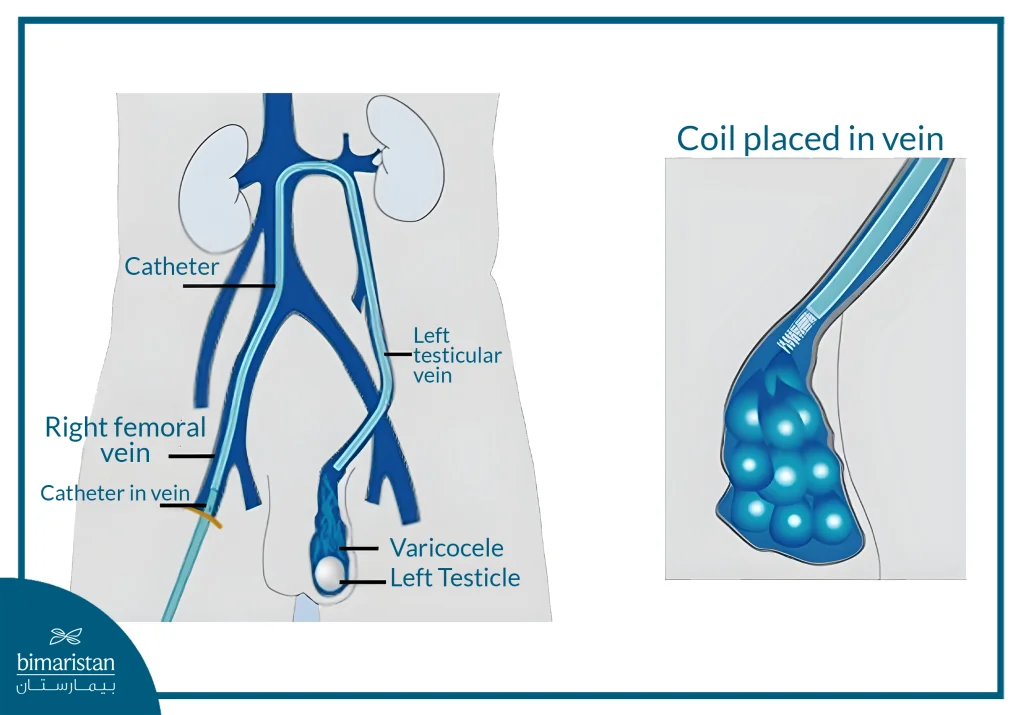
Treatment of varicocele with catheterization (varicocele embolization) is a delicate procedure that relies on the expertise of the interventional radiologist and their ability to handle diverse venous anatomy. The procedure is often performed without general anesthesia and allows direct access to the testicular vein, enabling treatment from within without surgical incisions.
- Application of local anesthesia in the area of catheter insertion, whether in the groin or neck, to ensure patient comfort, with the possibility of using mild sedatives if necessary
- Inserting a needle and an initial catheter into the internal jugular vein or femoral vein, which serves as the channel for fine instruments to access the testicular vein
- Progressively guide the radioactive catheter through the venous system until it reaches the origin of the testicular vein, with continuous monitoring of the shape and course of the vessels
- Intravenous contrast is injected into a vein to pinpoint the exact anatomy and show any side branches or secondary pathways that may be causing persistent varicose veins
- Choosing the appropriate embolization material, such as metal coils, adhesives, or a combination of both, depends on the nature of the vein, its diameter, and the anatomy of its branches.
- Place the embolization material precisely within the venous reflux site and then repeat the imaging to make sure the vein is completely closed and the varicose veins are no longer fed
- Carefully pull out the catheter and apply pressure to the insertion site for a few minutes to ensure that the bleeding stops and the small opening closes without the need for suturing
- The patient is briefly monitored in the recovery unit and is often allowed to go home the same day unless there are exceptional circumstances that require a longer stay
Varicocele embolization: success rates and follow-up
- Clinical success:
- The effectiveness of the treatment is assessed by observing symptom improvement within the first few weeks, specifically a reduction in pain and heaviness. Additionally, semen parameters, including count, motility, and normal morphology, are evaluated after 3 to 6 months. Most patients exhibit a gradual response to treatment, and semen analyses are typically repeated at the third and sixth months to monitor any improvements.
- Success and relapse rates:
- Recent studies indicate a high technical success rate of 90-96% when appropriate techniques and supplies are used, especially for multipoint embolization with treatment of the side branches. Relapse is typically 10-15% in older series.
Complications of varicocele embolization and how to manage them
- Access Failure or Technical Failure:
- The doctor may encounter challenges in accessing the testicular vein due to abnormal venous anatomy or previous blockages. In such cases, the procedure can be attempted through another route, such as the internal jugular vein. Alternatively, if catheter closure is not feasible, the situation may require conversion to a surgical treatment.
- Allergic reactions to contrast material:
- It occurs in a small percentage of patients and can range from a mild rash to more severe reactions. They are managed by administering antihistamines before the procedure or by using alternative low-osmolarity contrast materials when a prior proven allergy is present.
- Transient abdominal or testicular pain:
- It is a common complication after the procedure and is often caused by vein irritation or embolization of small branches. This pain usually responds to conventional analgesics and disappears within a few days without the need for additional intervention.
- Varicose vein recurrence or relapse:
- It may occur in a subset of patients due to small venous branches that have not been closed or to initially invisible collateral pathways. The case is evaluated with venography or Doppler, and then the most appropriate treatment, whether varicocele embolization or microsurgery, is determined depending on the anatomy and the cause of the relapse
Advantages and limitations of varicocele embolization
Varicocele embolization is a minimally invasive procedure performed through a small skin puncture without any surgical incision. It allows for same‑day discharge and a quick return to daily activities. It is an ideal option for patients at high risk of general anesthesia or those with a history of surgery that makes conventional surgical approaches more complex. Radiographic guidance ensures highly precise targeting of the affected vein and treatment of collateral branches that may contribute to persistent venous reflux.
However, the success of varicocele embolization depends heavily on the interventional radiologist’s experience, as the technique requires considerable skill in managing variable venous anatomy. The need for re‑intervention may be higher than with microsurgery, especially when small branches or collateral pathways are difficult to close completely. The procedure may also not be suitable for all patients, particularly those with complex venous anatomy that prevents catheter access, and some patients may experience reactions to the contrast agents used.
Cost of varicocele embolization in Turkey
Varicocele embolization is considered the best non-surgical treatment for varicocele in Turkey, combining precision, speed, and rapid recovery. In Turkey, this technique is available at competitive costs compared to several European countries, making it an attractive option for patients seeking effective treatment without a large surgical incision. A table comparing the prices of varicocele embolization in Turkey and some European countries is provided below:
| Country/Center | Approximate Cost (USD) |
|---|---|
| Turkey | 1,500 – 2,000 |
| Austria | About 4,000 |
| Spain | About 2,200 |
| United States of America | 6,000 – 10,000 |
| Switzerland | 7,000 – 12,000 |
Varicocele embolization offers an advanced alternative that combines procedural precision with rapid recovery, eliminating the need for general anesthesia or surgical incisions. With significant improvements in pain relief and semen parameters for a large percentage of patients, this minimally invasive treatment has become a preferred option in many specialized centers. Turkey boasts extensive expertise in interventional radiology, giving patients the opportunity to achieve excellent results at lower costs compared to Western European countries. For those seeking comprehensive medical care and professional support at every step, access to leading centers like Bimaristan Medical Center is easily available.
Sources:
- Nabi, G., & Asterling, S. (2004). Percutaneous embolization for varicocele.
- Sinha, R. S., & Krishnamoorthy, S. (2019). Varicocele embolization: Current insights.
- Laborda, A., Medrano, J., de Blas, I., Urtiaga, I., & Carnevale, F. C. (2012). Endovascular treatment of varicocele.
- Gandini, R., Konda, D., & Reale, C. (2008). Transcatheter varicocele embolization with coils.
- Shlansky-Goldberg, R., VanArsdalen, K., Rutter, C., & Trerotola, S. (2006). Percutaneous embolization for recurrent varicocele.