Hand prosthetics are among the most prominent solutions for restoring motor functions and the ability to perform daily tasks after the loss of the hand or part of it, whether due to accident, injury, disease, or congenital deformity. Available options include cosmetic limbs resembling the natural hand, mechanical limbs activated by movement, and smart limbs that rely on nerve signals from the muscles.
The appropriate selection of hand prosthetics depends on a person’s lifestyle and specific needs, and it requires a comprehensive clinical and functional assessment. Training and rehabilitation programs are also essential to help users adapt and benefit from the prosthesis. Modern prosthetics support independence and significantly enhance quality of life, going beyond mere physical compensation.
Who needs hand prosthetics?
Hand prosthetics are recommended when a person loses part or all of the hand due to accidents such as amputation after a sports injury, traffic accidents, or diseases such as diabetes that may lead to amputation, and this technology is also utilized by people who were born with congenital hand deformities such as missing fingers or bone formation issues, including targeted cases:
- Partial amputation of fingers or thumbs
- Partial hand amputation or full hand amputation at the wrist level
- Amputation beyond the wrist involving the forearm or elbow
- Amputation up to shoulder level or further localized amputation
The absence of all or part of the hand can be caused by:
- Amputation after an accident or direct injury
- Amputations cause chronic diseases
- Congenital abnormalities affecting manual functions
In these cases, hand prosthetics are used to restore the ability to grasp, interact with the environment, and achieve greater independence in daily activities. The journey begins with a technical assessment that includes the extent of the required functions and lifestyle, until the selection of the most appropriate type of prosthesis, whether cosmetic, mechanical, or bionic, depending on the required capabilities.
Types of hand prosthetics
Hand prosthetics are designed to meet a variety of needs, ranging from aesthetic to functional. Choosing the right type depends on the type of amputation, the level of daily activity, and the person’s ability to adapt to different techniques. Here is a look at the basic types:
Cosmetic prosthesis: When is it used?
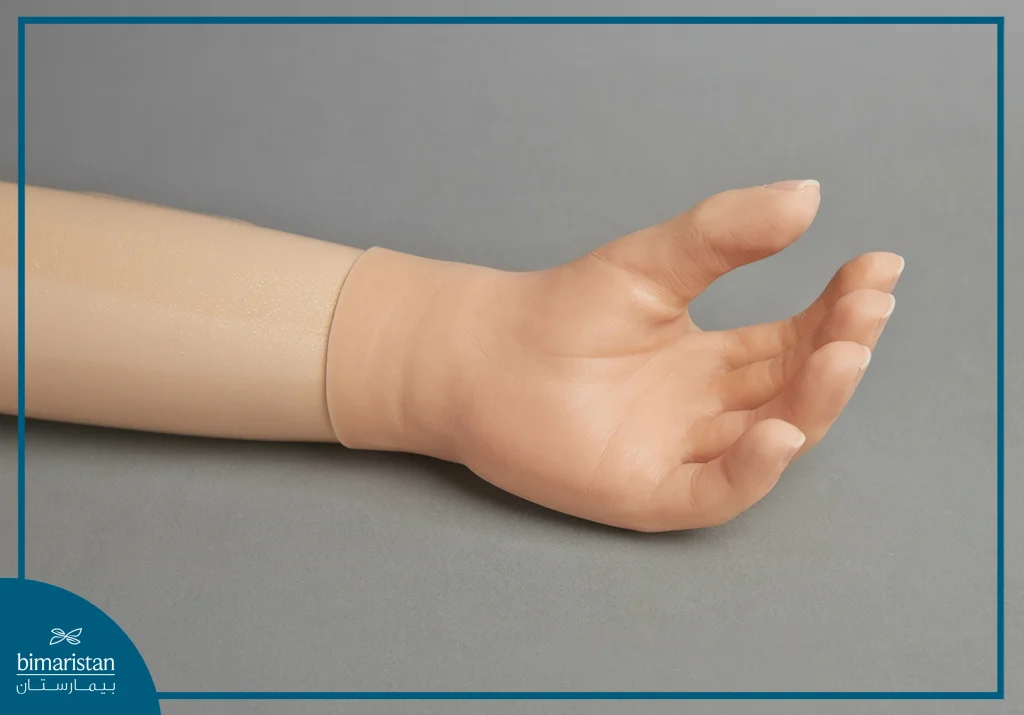
A cosmetic prosthesis is a popular choice for people who do not require functional movement in the prosthesis but prefer a natural, human-like appearance. It is often made of silicone or plastic and is painted in the color of the skin for a realistic appearance. This type is often used in cases of partial amputation of the fingers or hand and is useful for supporting psychosocial balance, but does not provide mobility or grasping capabilities.
Mechanical prosthesis: Manual motion mechanism
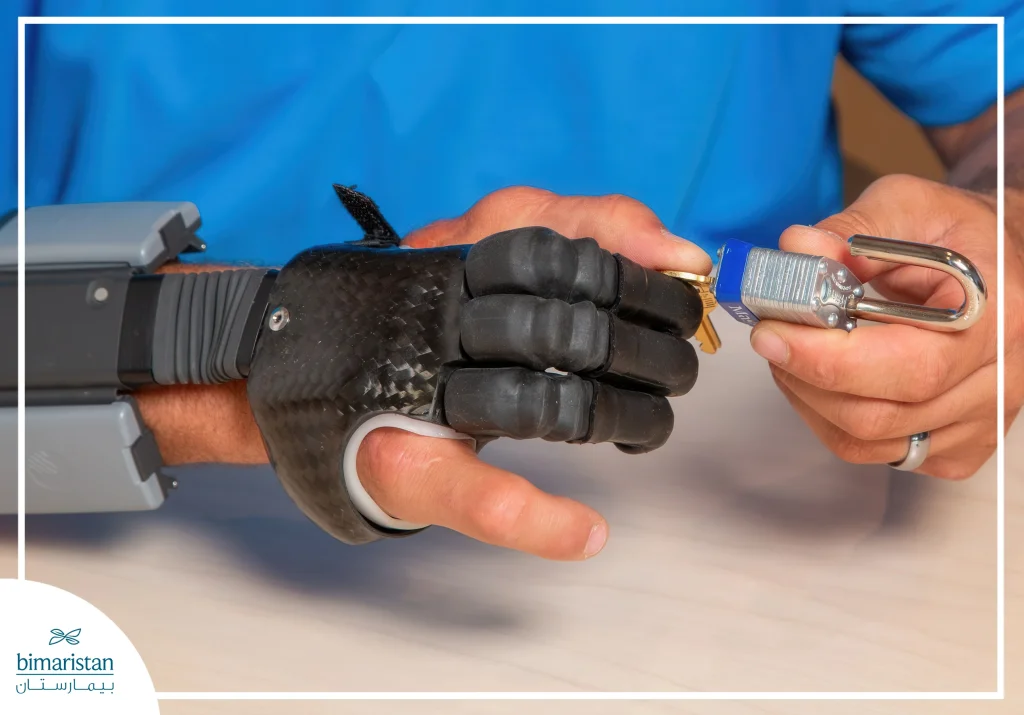
The mechanical prosthesis relies on the movement of muscles or other parts of the body, such as the shoulder or elbow, to activate the grasping mechanism. This type is characterized by rigidity and fewer failures compared to electronic types, and is suitable for individuals who engage in physical activities and require strong sports prosthetics, or those seeking a practical and effective solution at a lower cost. It is especially recommended in cases of forearm or arm amputation.
Bionic prosthesis: Neural control
The bionic prosthesis is the latest development in the field of hand prosthetics. It uses neurosensor technology and myoelectric control, where sensors attached to the skin pick up electrical signals from the remaining muscles and convert them into commands to move the fingers or prosthetic hand accurately, and provide complex functions such as dynamic grasping and programmed grasping cycles. This type may require extensive training and rehabilitation but offers the best functionality, especially for those seeking to return to an active lifestyle.
Characteristics of smart vs. mechanical prosthesis
Smart (bionic) limbs differ from mechanical ones in several aspects that affect function, responsiveness, cost, and maintenance. While mechanics rely on physical strength and direct control, smart limbs offer higher precision and better neural control but require advanced electronics and maintenance architecture.
| Criterion | Smart prosthesis | Mechanical prosthesis |
| Motion Control | With EMG sensors that pick up electrical signals, precise movement and minimal muscle effort | Via cables and torso/muscle movement, direct control, requiring muscle strength and simple control |
| Physical strength required | Low: Relies on myoelectric signaling, which minimizes physical exertion | High: Requires cable tension, which strains the muscles |
| Accuracy and responsiveness | High precision for complex tasks and multi-jointed fingers | Limited accuracy, especially for simple tasks (grip) |
| Endurance and maintenance | More sensitive to moisture and needs regular maintenance and programming | Highly durable, water and dust resistant and requires low maintenance |
| Appearance | More like a natural hand | Often less realistic |
| Cost | Highest cost | Less expensive |
How to choose the right prosthesis
The proper selection of hand prosthetics is a step based on a comprehensive evaluation that includes medical condition, type of amputation, lifestyle, and functional goals of the patient. The process begins with an assessment by a multidisciplinary team that includes a rehabilitation physician as well as a prosthetist and occupational therapist, and takes into account the level of amputation, such as finger or above the elbow, residual muscle strength, and daily activity pattern.
Some patients may prefer cosmetic hand prosthetics for psychosocial reasons, while others require complex motor functions that necessitate a mechanical or bionic prosthesis. The ability to tolerate training and maintenance affects the patient’s final decision. Cost and willingness to use technology are also important factors in choosing the right hand prosthetics.
Prosthetic training programs (an essential part of the evaluation and selection process)
Training programs are an important part of the proper selection of hand prosthetics and often begin after the wound has healed and the amputation site has been prepared for fitting, during which the patient learns how to put on and take off the limb and apply exercises to enhance control and flexibility of the new limb, especially in bionic prosthetics that rely on precise muscular signals.
The patient is trained to perform daily tasks such as grasping tools, dressing, and using the phone with the aid of hand prosthetics. The patient is encouraged to overcome potential social challenges through psychological support and ongoing functional training, which further enhances self-reliance and gradually restores daily motor activities. The patient is encouraged to overcome potential social challenges through psychological support and functional training.
Challenges and coping after hand prosthetics
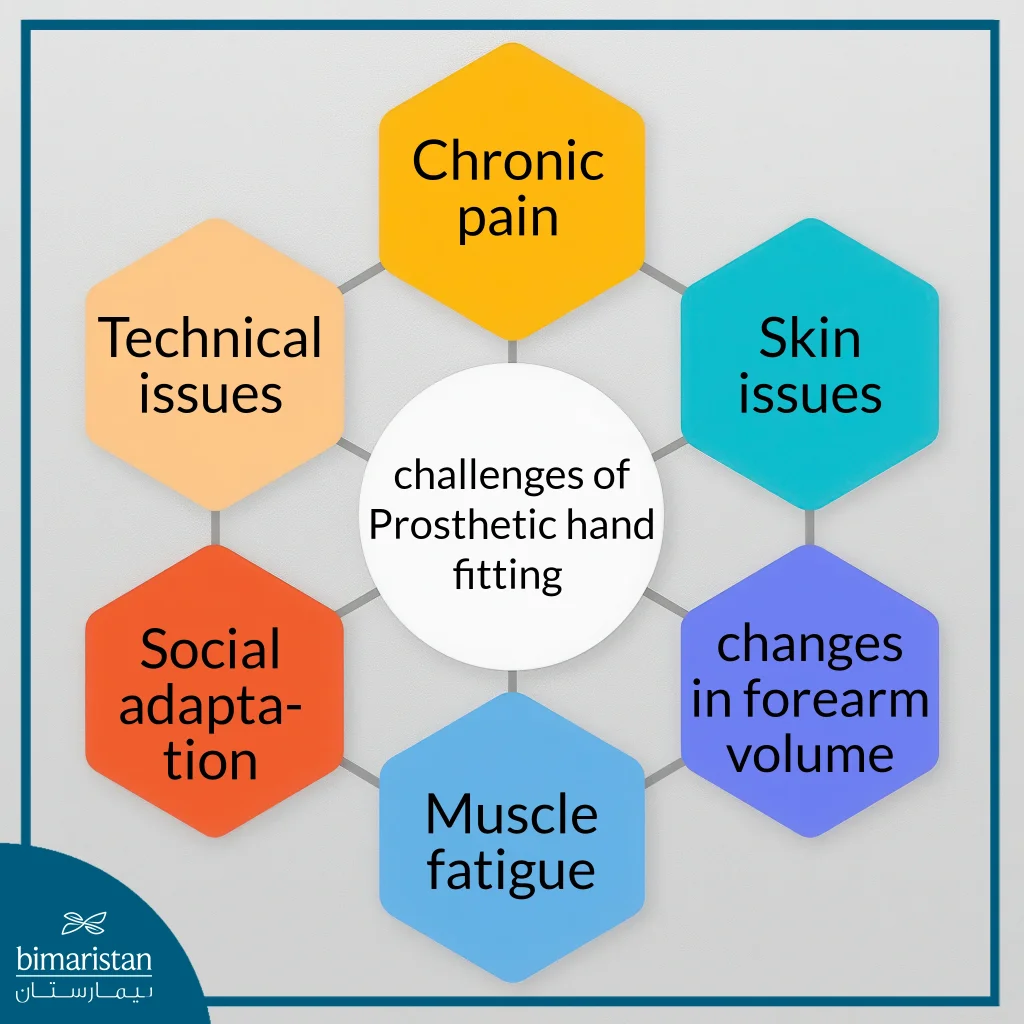
Fitting a hand prosthesis is an important step in restoring function, but it comes with physical and psychological challenges that require constant vigilance and attention:
- Skin issues and pressure around the amputation point
- Change in forearm size due to swelling or change in muscle mass
- Muscle fatigue and chronic pain caused by prolonged use
- Psychological impact on party acceptance and socialization
- Technical issues or malfunctions of electronic components
Skin issues and pressure around the amputation site
These issues are some of the most common challenges that users face after hand prosthesis fitting. Here are the most important issues and tips for dealing with them:
- Skin ulcers: The imperfect shape of the mold can cause increased pressure, leading to skin ulceration and tissue lesions. It is advisable to check the amputation site regularly and report redness or pain to an orthopedic specialist.
- Skin irritation due to sweat and moisture: Sweat buildup inside the limb can cause skin irritation; daily cleaning and drying of the skin before re-wearing the limb is essential.
- Slipping and constant friction: Repeated friction can lead to skin breaks or blisters.
- Use appropriate liners and caps: In order to minimize pressure, soft foam or silicone liners are recommended to reduce friction and mold pressure.
Tips for acclimatization and skin preservation
- Thoroughly wash and dry the leather before wearing it
- Daily monitoring for redness or sores
- Using unscented antiperspirants inside the liners
- Modify the template when inconvenience or pain occurs
- Hire a peripheral specialist to modify the template when necessary
Skin issues after hand prosthetics fitting are common but can be prevented in most cases by fitting the mold, paying attention to personal hygiene, and regular medical follow-up. This helps the user to optimize the use of the prosthesis without interruption or skin complications.
The role of functional rehabilitation in restoring the use of the hand
Functional rehabilitation is the cornerstone in enabling people who use hand prosthetics to regain their motor functions accurately and stably, this process begins immediately after the surgical wound healing and includes cooperation between the functional rehabilitation specialist and physical therapists, where rehabilitation begins with an accurate assessment of the residual limb functions such as muscle tension and the range of motion of the shoulder and forearm, and based on that a customized training program is prepared to strengthen those muscles and improve motor coordination.
The training includes teaching how to put on and take off the prosthesis, as well as performing daily living tasks such as eating, writing, and dressing independently. For smart limbs that work with muscle signals, part of the program is dedicated to teaching the use of these signals to control movements such as grasping and releasing, which requires time and supervision. This coincides with training in skin care and managing pain or allergies around the amputation site.
Rehabilitation is not limited to the physical aspect but includes psychological support and encouragement to adapt to the new limb in daily life. This gradual commitment aims to integrate the hand prosthetics into the person’s routine, compensating for the loss and enhancing the patient’s independence. In complex amputation cases or in children, the rehabilitation program extends over a long period of time to ensure normal motor development and successful integration of the child.
Today, hand prosthetics are more than just prosthetic devices; they represent an important step towards regaining functional ability and independence in daily life. By choosing the right type and adhering to functional rehabilitation programs, the patient can achieve tangible results in motor performance and social integration. Despite the dermatological or technical challenges that may arise, the continuous development of hand prosthetics technologies and rehabilitation methods makes it possible to overcome them and return to an active and effective lifestyle.
Sources: