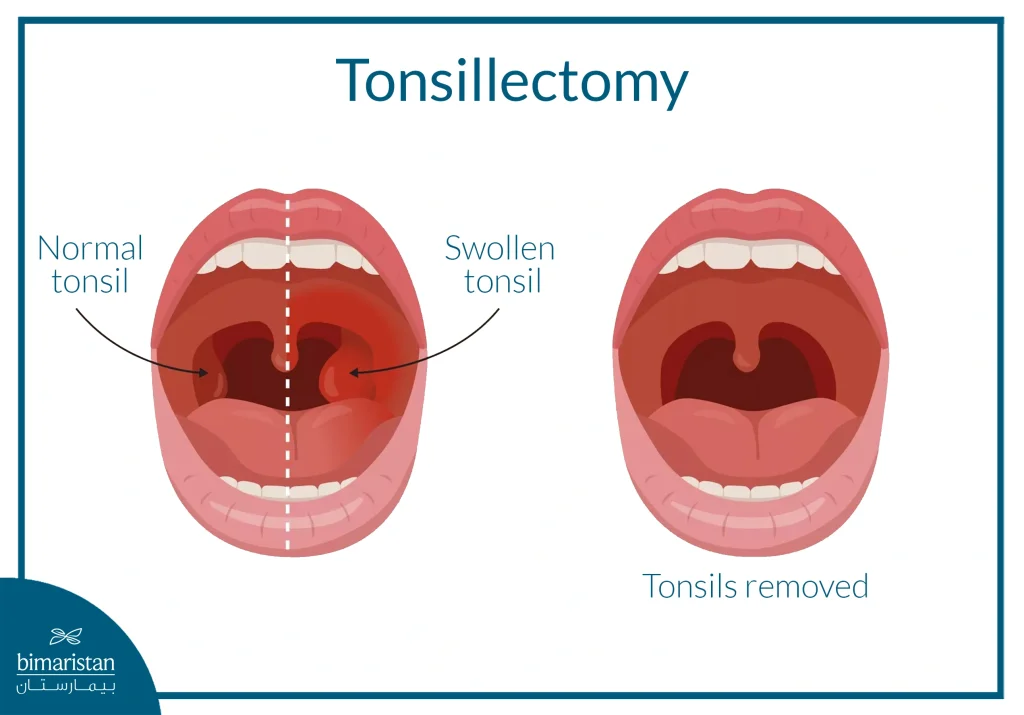
Tonsils are an important part of the immune system, located at the back of the throat, and help fight germs that enter through the mouth and nose. In some children, however, they can become a source of trouble due to frequent infections or enlarged tonsils that interfere with breathing and cause snoring and sleep disturbances. In these cases, the doctor may recommend removal as a treatment option.
With the advancement of medical technologies, an important question has arisen for parents: Laser tonsillectomy or surgery for children, which is the best and safest option? In this article, we will explain the difference between the two methods in terms of benefits, risks, and cost, to help you make the right decision for your child.
What is laser tonsillectomy for children?
Laser tonsillectomy for children is a modern technique that aims to precisely remove or vaporize tonsil tissue using laser beams, usually under general anesthesia. This method is faster than conventional surgical tonsillectomy, with less bleeding and pain after the procedure, allowing the child to quickly return to their daily activities.
One of the most important advantages of lasers is the reduction of bleeding and complications associated with the operation, pain relief after the operation, as well as a shorter recovery period compared to traditional surgery. However, this method may not be suitable for all cases, especially when there is a very severe enlargement or recurrent infections that require the complete removal of the tonsils. Its cost is often higher than conventional surgical tonsillectomy, and the lack of centers offering the technique makes its availability limited in some areas.
What is conventional surgical tonsillectomy?
Conventional surgical tonsillectomy has been the most common procedure for decades, especially for the treatment of chronic tonsillitis in children. The surgeon removes the entire tonsil using conventional surgical tonsillectomy instruments under general anesthesia. The procedure usually takes longer than laser surgery, and the child needs several days to recover before returning to normal activity. The advantages of this method are that it provides long-term results and is effective in preventing recurrent tonsil infections, it is available in most hospitals around the world, and its cost is lower compared to laser technology in many countries.
The disadvantages include more bleeding during and after the procedure, pain that requires longer use of painkillers, and a longer recovery period, as the child usually needs to rest at home for several days before regaining full activity.
When is tonsillectomy recommended for children?
Doctors usually recommend tonsillectomy in children if
- Frequent tonsil infections: If a child has a sore throat or tonsils more than 5-7 times a year, despite treatment with antibiotics.
- Enlarged tonsils that interfere with breathing or sleep: Large tonsils may cause snoring, sleep apnea, or difficulty swallowing.
- Recurrent tonsil abscess: Recurrent abscesses around the tonsils may make removal necessary.
- Comorbid health issues: Such as chronic middle ear issues or the impact of recurrent infections on a child’s development or school performance.
The decision to perform laser tonsillectomy or surgery for children depends on the size of the tonsils, the child’s health status, and the experience of the surgeon available at the hospital.
Which candidate is best suited for each method?
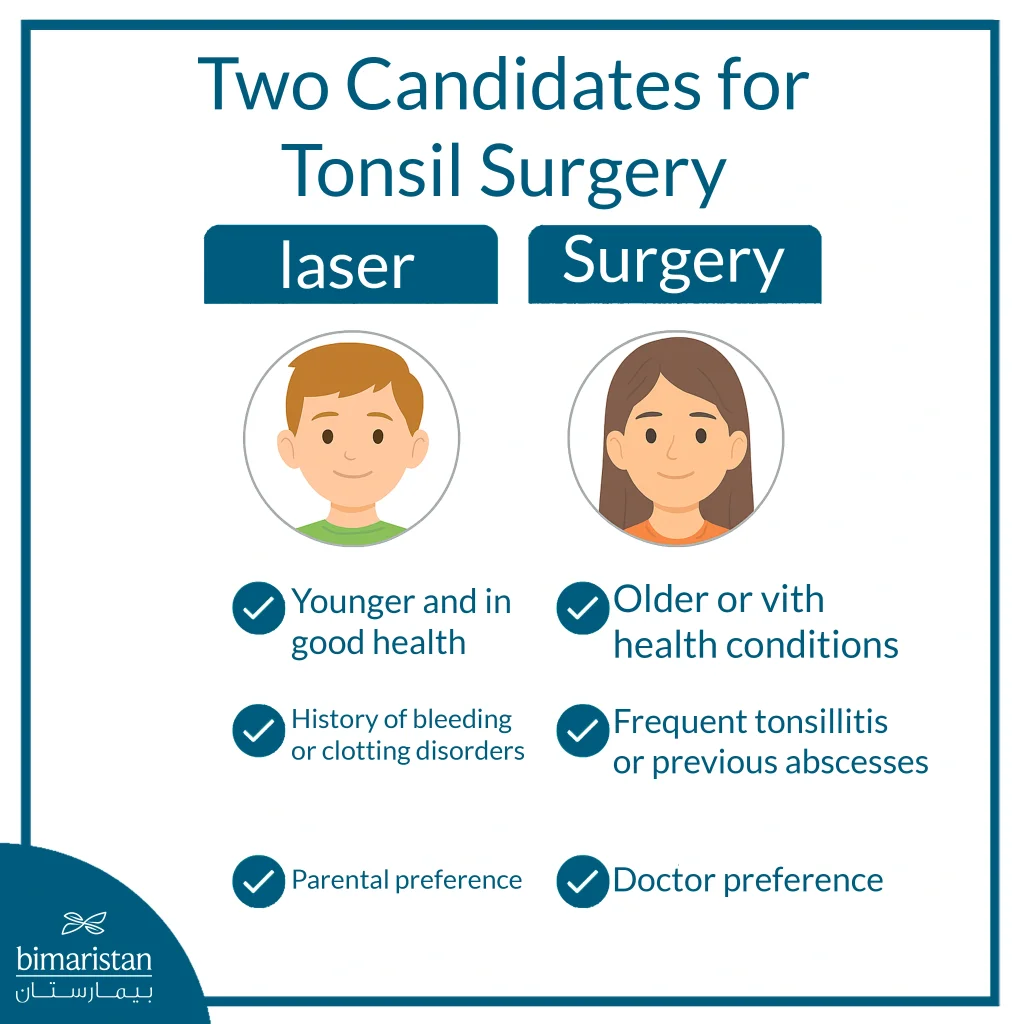
Deciding between performing laser tonsillectomy or surgery for children depends on several factors related to the child’s individual situation. Firstly, the age and health status of the child play a big role, as laser may be better for healthy children who need a quick recovery, while traditional surgery may be more suitable for older children or those with certain health issues.
Second, a history of bleeding or blood-clotting disorders may favor the use of a laser to minimize the risk of bleeding during and after the procedure. For children with recurrent tonsil infections or previous abscesses, traditional surgery may be more effective to ensure complete removal and minimize recurrence. Finally, parental and physician preference plays an important role in the final decision. After discussing the benefits and risks of each method, the doctor considers his or her experience and the available hospital or medical center, while parents are involved in choosing the method they think is best for their child.
Laser tonsillectomy or surgery for children
| Criterion | Laser tonsillectomy | Traditional surgery |
|---|---|---|
| Duration of the operation | Often shorter; the laser procedure was less time-consuming (about 4-5 minutes for laser cutting in one trial versus 15 minutes for traditional surgery). | Less pain in general, especially in the first few weeks, because the laser causes less damage to the surrounding tissues, less swelling, and less inflammation. |
| Bleeding during and after the procedure | The risk of late bleeding is much lower with a laser, and the risk of late bleeding is lower with a laser or fractional debridement technique. | More bleeding, especially in fully traditional surgery, both during the cut and from the blood vessels in the mouth and throat afterward. |
| Pain after surgery | Relatively less expensive than lasers in most cases, but varies by country, hospital, clinic, quality of doctors, and accompanying services. | The pain is more severe; throat pain occurs, pain may extend to the ear and neck, especially during the first 5 to 7 days, and sometimes the patient needs strong painkillers.3 |
| Fast recovery and return to normal life | Faster: In some cases, patients were back to work in about 4.5 days compared to 12 days for traditional surgery in a clinical study. | slower: Full recovery may take about 10-14 days for healthy children. |
| Cost | Usually higher, especially if advanced laser technologies are used, experienced doctors, and private hospital facilities. | Relatively less expensive than lasers in most cases, but varies by country, hospital, clinic, quality of doctors and accompanying services. |
When does a doctor prefer a laser, and when is traditional surgery better?
Doctors prefer to use laser tonsillectomy for children in cases where the goal is to minimize bleeding and pain and speed up the recovery period, especially when the tonsils are moderately enlarged and do not cause major health complications, or when the child needs to return quickly to daily activities after the procedure. Conventional surgical tonsillectomy is best suited for severe enlargement or recurrent infections that do not respond to medical treatments, recurrent abscesses around the tonsils, or chronic issues that require complete removal, and is preferred for cases that require long-term results and are readily available in most hospitals.
Medical recommendations suggest that the choice of method depends on a thorough assessment of the child’s individual case, including tonsil size, medical history, and general health. This raises an important question for parents: Is laser tonsillectomy or surgery the best option for children? The final decision is always a matter of consulting with a medical professional to determine the most appropriate method for each case.
Possible complications after tonsillectomy
Although tonsil removals, whether by laser or traditional surgery, are generally safe, there are some potential complications that parents should be aware of and how to deal with them:
- Bleeding after the procedure: Emergency bleeding is rare, but more common after traditional surgery than after laser surgery.
- Infection (rare): Easily preventable by following the doctor’s instructions and paying attention to hygiene after the procedure.
- Difficulty swallowing and temporary pain: This is common after any tonsillectomy, usually lasting 5-7 days, then gradually subsiding as the tissue heals.
Tips to minimize complications
- Adhere to taking the painkillers prescribed by your doctor
- Drink fluids regularly and eat soft foods to make swallowing easier
- Follow up with your doctor immediately if bleeding continues or pain increases abnormally
Laser tonsillectomy and surgery costs in Turkey and other countries
| Country | Cost |
|---|---|
| Europe | 6000-9000 USD |
| Turkey | 2000-4500 USD |
| United States | May exceed $10,000 |
Factors that affect the price:
- Type of technique used (conventional or laser surgery)
- Type of hospital
- Surgeon experience and hospital technology
- Type of anesthesia and accompanying services (stay, medications, follow-up)
Tips for parents before making a decision
- Consult an ENT doctor to accurately assess the child’s condition before any procedure.
- Discuss pediatric laser tonsillectomy versus traditional surgical tonsillectomy, explaining the benefits and risks of each method.
- Psychologically prepare the child before the procedure and explain what will happen in an age-appropriate way.
- Choose a reliable hospital or medical center.
When considering laser tonsillectomy or surgery for children, there is no one-size-fits-all solution. The best option depends on the size of the tonsils, the frequency of infections, the child’s health status, and the experience of the surgeon and hospital.
Laser tonsillectomy for children offers a quicker recovery with less pain and less bleeding, while traditional surgical tonsillectomy offers long-lasting and widespread results. Therefore, it is essential to consult an ENT doctor to discuss all options thoroughly.
For the best care and medical expertise, you can rely on specialized centers such as Bimaristan Center in Turkey, which provides full services and ensures comprehensive post-operative follow-up to ensure the safety of the child and the comfort of the parents.
Sources:
- Ishlah LW, Fahmi AM, Srinovianti N. Laser versus dissection technique of tonsillectomy. Med J Malaysia. 2005 Mar;60(1):76-80. PMID: 16250284
- Wong Chung JERE, van Geet R, van Helmond N, Kastoer C, Böhringer S, van den Hout WB, Verschuur HP, Peek FAW, Dammeijer PFM, van Wermeskerken GKA, van Benthem PPG, Blom HM. Time to Functional Recovery After Laser Tonsillotomy Performed Under Local Anesthesia vs Conventional Tonsillectomy With General Anesthesia Among Adults: A Randomized Clinical Trial. JAMA Netw Open. 2022 Feb 1;5(2):e2148655. doi: 10.1001/jamanetworkopen.2021.48655. Erratum in: JAMA Netw Open. 2022 Mar 1;5(3):e225836
- Medical Health Tests. (n.d.). Laser tonsillectomy. Medical Health Tests