
The field of prosthetics has witnessed great development in recent years, especially in Turkey, which has become one of the most prominent global destinations in this advanced medical sector, and this development includes various types of limbs, especially the above-knee prosthesis, which represents a vital solution for thousands of people who have lost their limbs due to injuries or diseases. Thanks to the combination of modern technology and medical expertise, Turkey offers advanced above-knee prosthesis options that help patients restore movement and improve their quality of life, making it a favorite destination for those wishing to receive advanced and reliable care.
What is an above-knee prosthesis?
Above-knee prosthesis is an artificial device used to replace the missing part of the thigh when the knee joint or the area above it is amputated due to medical reasons or injuries. The above-knee prosthesis aims to restore mobility, balance, and improve the user’s overall quality of life.
Components of the above-knee prosthesis
To achieve optimal function and user comfort, the above-knee prosthesis is made up of five essential components that work in harmony to replace natural functions:
- Socket: The part that attaches the prosthesis to the remainder of the thigh.
- Knee System: Simulates the natural movement of the knee during walking and sitting.
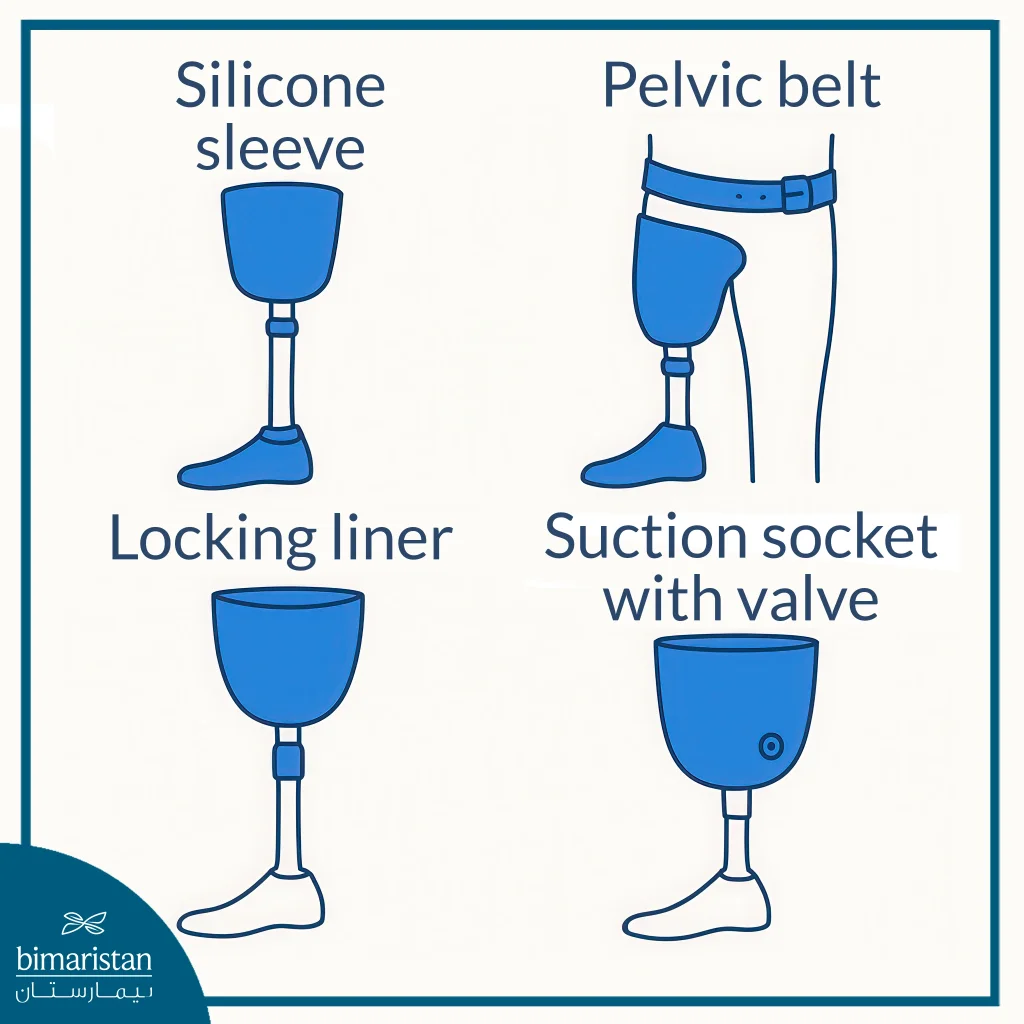
- Suspension Systems: Attach the socket to the truncated end.
- Shank: Connects the socket to the foot assembly.
- Foot-Ankle System: Enables stable standing and walking.
Socket Design Types
- Ischial Containment Socket:
It usually has a rigid frame with a flexible inner socket that is designed to trap the pelvis inside the socket. This rigid frame increases stability and enhances control while walking. - Quadrilateral Socket:
Provides a “shelf” for the pelvis to rest on, keeping the pelvis in contact with the edge of the socket. Compared to a sacral retention socket, this socket is narrower on the front and back and wider on the sides.
Knee Systems
Knee systems are designed to stabilize a person while standing by transferring weight through the prosthesis; they must also allow the knee to bend to function like a natural knee and enable the person to walk freely.
- Single-axis knee system:
It can bend and extend in only one direction. This system is less stable while standing and requires muscle strength from the person to maintain balance. - Polycentric knees:
Allows the knee to bend in several slightly different directions. This enables people to walk on uneven surfaces or run, but it depends on the person’s goals and abilities.
Suspension Systems
Suspension systems are designed to hold the socket on the remaining part of the leg (the amputated part). There are several types of them:
- Silesion bandage
- Pelvic band with joint
- Suspension sleeve silicone liner with locking mechanism
- True suction socket with valve
Each system has its own advantages and disadvantages, and user preference is taken into account when choosing the most appropriate system.
Shank
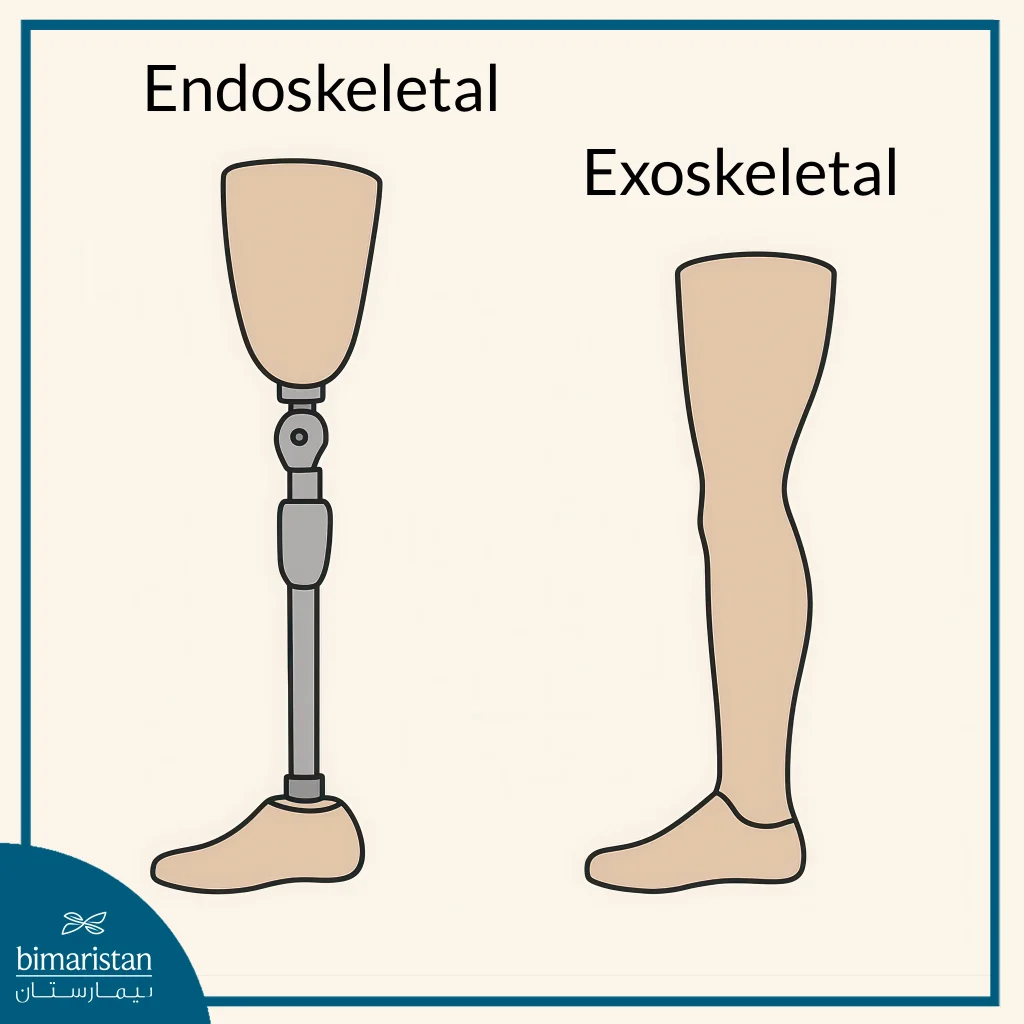
The prosthetic leg forms the lower part of the prosthesis and connects the socket to the foot and ankle assembly. There are two main designs:
- Endoskeletal design:
It has a soft foam cover to look and feel like leather; this type is lightweight, easy to adjust, and compatible with modern technologies in knee systems, but the foam cover is fragile and can be easily damaged. - Exoskeletal design:
It has a rigid and durable shell made of multi-layered materials that cannot be modified after manufacturing. This design is more durable than the internal one and can transfer weight across the entire design, so it is more suitable for people who need the prosthesis to perform heavy work.
Foot-Ankle System
The foot and ankle system is necessary to support the person while standing on the prosthesis. There are several designs of prosthetic feet, including:
- SACH (solid ankle with padded heel): Allows for only one movement, lightweight, durable, and relatively cheap.
- Single-axis foot: Allows movement of the ankle and helps stabilize the knee.
- Dynamic response feet: Designed to allow the prosthesis to bounce off the heel, making walking more energy efficient.
When is an above-knee prosthesis indicated?
When a person suffers an amputation in the thigh area or above the knee, the use of an above-knee prosthesis becomes necessary to compensate for the loss and achieve mobility and self-reliance. Below are the main cases that require the installation of an above-knee prosthesis:
- Severe injuries that cannot be treated, such as road accidents or war injuries
- Cancerous tumors affecting the bones or thigh muscles that necessitate amputation
- Chronic infections or gangrene caused by conditions like diabetes or poor blood flow
- Rare congenital anomalies affecting lower limb development
The primary goal of an above-knee prosthesis is to restore walking ability, improve patient quality of life, and support greater independence.
What is the difference between an above-knee prosthesis and a below-knee prosthesis?
To understand the basic differences, we present a simplified comparison between above-knee and below-knee prostheses, which helps to clarify the importance and role of each type.
- Above-Knee Prosthetics: When the amputation involves or is above the knee joint.
- Below-Knee Prosthetics: When the lower leg is amputated, but the knee joint remains intact.
Basic differences between the two types:
| characteristic | Above-Knee | Below-Knee |
|---|---|---|
| Amputation site | In the thigh, above the knee joint | In the leg, below the knee joint |
| Normal Knee Joint | Missing and replaced with an artificial joint | is present and helps with better stability and mobility |
| Easy to control the tip | More complex and needs intensive training | Relatively easier to use and acclimate |
| Energy required for walking | higher, because the patient relies on hip mobility | less, because the normal knee contributes to the movement |
| Acclimatization and comfort | Relatively slower | The fastest and easiest habit |
When the knee joint remains normal, limbs below the knee are simpler and more efficient, allowing for natural movement and quicker adaptation, while limbs above the knee require a complex artificial joint that mimics the movement of the knee and requires more energy and training effort to achieve balance and stability.
Types of above-knee prosthetics
Mechanical prostheses
These types are some of the simplest forms of above-knee prosthesis, relying on traditional mechanical components that provide basic movement but require more effort to control. Using systems like locking mechanisms or gears to manage joint motion, mechanical above-knee prostheses are known for their low cost compared to advanced models, ease of maintenance, and durability. They are ideal for individuals with moderate or limited activity levels. However, these prostheses offer less fluid motion and require greater effort to control, providing limited flexibility on uneven surfaces.
Hydraulic Prostheses
With the development of technology, above-knee prosthesis systems have evolved to include hydraulic mechanisms that rely on pressurized fluids to deliver smoother, more natural knee movement. Hydraulic above-knee prostheses provide enhanced shock absorption, improving balance during walking and standing. These prostheses are well-suited for most users, particularly those engaged in daily or moderate physical activity. However, these benefits come with higher costs compared to mechanical prostheses, along with the need for regular maintenance
Hydraulic prosthetics: Is it one-size-fits-all?
Hydraulic limbs are suitable for a wide range of users, because they provide an excellent balance between stability and flexibility, and are suitable for most levels of activity, whether for daily walking or some sports activities, however, compared to electronic limbs, they are simpler in terms of technology as they do not need charging or continuous electronic maintenance, which makes them a practical option for those who do not want or cannot rely on complex systems, so it can be said that hydraulic limbs are suitable for the majority of users.
Microprocessor-Controlled Prostheses
These limbs represent the latest innovations, as they are equipped with smart sensors and electronic processors that enable them to automatically adjust the movement of the joint to improve the stability of walking, electronic prosthetic limbs are characterized by achieving the best stability and control of movement, which allows the user to improve mobility on uneven terrain significantly, in addition to facilitating the ascent and descent of stairs, and this advanced technology helps reduce muscle fatigue and reduce the energy expended while walking, but these advantages come at a very high cost and require advanced technical shipping and maintenance, which may make them unsuitable for some users due to the high cost.
Exoskeletal Prostheses
The design of these limbs focuses on a rigid exoskeleton that provides high protection and durability, but comes with challenges in terms of weight and flexibility. Exoskeleton prostheses are very durable, provide strong protection for the rest of the leg, and have a very natural appearance. Despite these advantages, they tend to be heavier, less adjustable, and offer less flexible movement than endoskeletal prostheses.
Endoskeletal Prostheses
Unlike the exoskeleton, these limbs rely on a lightweight internal structure that allows for a more fluid movement and natural appearance, as it consists of a lightweight internal frame made of aluminum or carbon covered with a light outer shell, this type is lightweight and easy to adjust and has a more fluid movement and a more natural appearance, but it is less durable than the exoskeleton and may require more maintenance.
Limbs made of carbon or synthetic fibers
With advances in materials, carbon fiber limbs have become an ideal choice for those looking for lightweight yet strong limbs, as they are lightweight and highly resistant to impact, but they are expensive and may not be available in all rehabilitation centers.
How to choose the right type of above-knee prosthesis for your condition?
Choosing the right type of above-knee prosthesis is a crucial step in achieving the best possible results and requires consideration of several personal and medical factors:
- Amputation level: The higher the amputation, the greater the need for a mobile knee joint to compensate for movement.
- Physical fitness and functional ability: Muscle strength, balance, joint flexibility, and general health.
- Daily goals and activities: Does the patient want to walk indoors only or engage in a variety of sports and activities?
- General health status: Diseases such as diabetes or circulatory issues affect the choice of materials and suspension systems.
- Patient preferences and lifestyle: Limb weight, ease of maintenance, desired performance.
- Living environment: Needs vary by city, rural, or mountainous areas.
- Technical support and cost: The need for maintenance and support for the bionic devices and the patient’s budget.
The benefits of the above-knee prosthesis in restoring mobility
The use of above-knee prosthesis is not limited to physical compensation, but extends to improving the quality of life by enhancing mobility and independence. We will explain the most prominent benefits that the user receives:
- Restore basic motor functions: Walking, standing, and balancing better.
- Independence and self-reliance: Minimize the need for outside help.
- Improving psychosocial health: Participate in community activities and boost morale.
- Minimize the complications of prolonged sitting: Improve blood circulation and reduce the risk of clots.
- Return to work and sports activities: Enabling users to perform their jobs or play sports.
- Reduce fatigue: Advanced limbs reduce fatigue compared to traditional mechanical ones.
Challenges users may face after fitting an above-knee prosthesis
Despite significant advances in above-knee prosthesis technology, users face various challenges during the adaptation and use phase. In this article, we discuss the most important of these difficulties and ways to deal with them.
- Difficulties with balance and adaptation: It requires a period of rehabilitation and intensive training, and there may be a fear of falling at first.
- Amputation area pain: Users may experience phantom pain or pain caused by pressure and friction.
- Problems with the skin: Inflammation or sores due to friction and moisture inside the limb shell.
- The need for regular maintenance: Especially for electronic and hydraulic parts.
- Psychological and emotional aspects: Frustration or depression that needs psychological and family support.
- Rehabilitation and training costs: Can be lengthy and require frequent sessions with a physical therapist, sometimes requiring constant adjustments to the prosthesis.
In conclusion, the above-knee prosthesis is a key step to restoring mobility and enhancing quality of life after limb loss. Choosing the right type and undergoing proper rehabilitation ensures optimal results. If you’re considering an above-knee prosthesis or want to explore the latest technologies, visit Bimaristan Medical Center. Our specialized team offers expert advice and full support to help you achieve maximum comfort and performance. Don’t hesitate to contact us and begin your recovery journey with confidence and hope.
Sources: