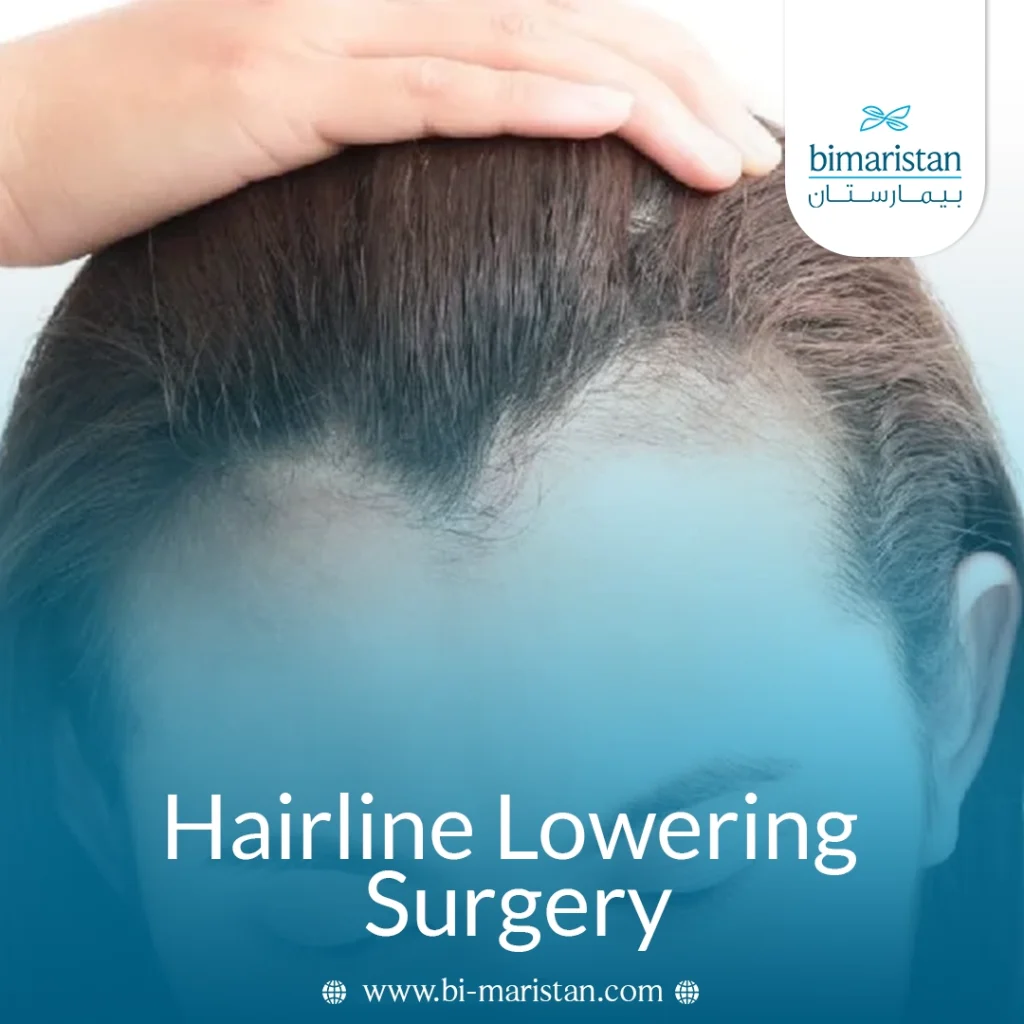
A high hairline is one of the most embarrassing cosmetic issues for women and men, as it gives the forehead a wide appearance and affects the balance and flow of the facial features. When the hairline exceeds its natural height, the forehead becomes longer than usual, prompting many to look for effective surgical solutions to restore symmetry to the face.
Many patients resort to hairline lowering surgery because it provides an immediate and permanent result, and is considered a better option than hair transplantation in cases of a wide forehead with a fixed and non-retracted hairline. With the development of cosmetic techniques in Turkey, this surgery is performed with high precision and minimal scarring, in addition to its competitive cost compared to other countries.
What is hairline lowering surgery?
Hairline lowering surgery is a common cosmetic procedure used to reduce the height of the forehead when it is noticeably wide. A large forehead can be caused by genetic factors or hair loss, which negatively affects the overall appearance and makes the forehead the most prominent point of the face at the expense of the rest of the features. Also known as forehead reduction surgery or hairline advancement, this procedure aims to shorten the length of the forehead and restore symmetry between different parts of the face, giving a more balanced and harmonious appearance.
Hairline lowering can be performed as a stand-alone procedure or combined with hair transplantation for a smoother, more natural look. This combination helps overcome the limitations of each technique and may allow the width of the forehead to be reduced by more than 3.5 cm in some appropriate cases.
Who is a good candidate for hairline lowering surgery?
Surgery is an option for people with a visibly high hairline or disproportionate forehead length:
- Men and women who have a naturally high hairline or a receding hairline and are dissatisfied with the shape of their forehead
- Men with thick, well-defined hairlines and no previous hair loss or severe receding hairline
- Those who have a wide forehead and want to shorten it for a better balance of facial features
- People who have low or heavy eyebrows and want to improve facial proportions
- Individuals with thin forehead skin and good flexibility that allows the scalp to move
- People who feel that the length of their forehead is disproportionate to their facial features
- Patients with frontal hair loss who want to improve their overall appearance
- Those who always have to wear their hair forward to hide a high forehead
- Those who have a domed or prominent forehead with a protruding frontal bone
- Those who suffer from psychological discomfort due to a high forehead
Conditions for successful hairline lowering surgery
A number of conditions must be met to ensure the success of hairline lowering surgery:
- good scalp elasticity, which is the ability of tissue to stretch without resistance
- No previous traditional brow lifts that may affect the results of the hairline reduction
- No family history of active genetic baldness, as this may lead to a receding hairline later on
- The need to have realistic expectations; people who have exaggerated expectations are advised to avoid the procedure
How is hairline lowering surgery performed?
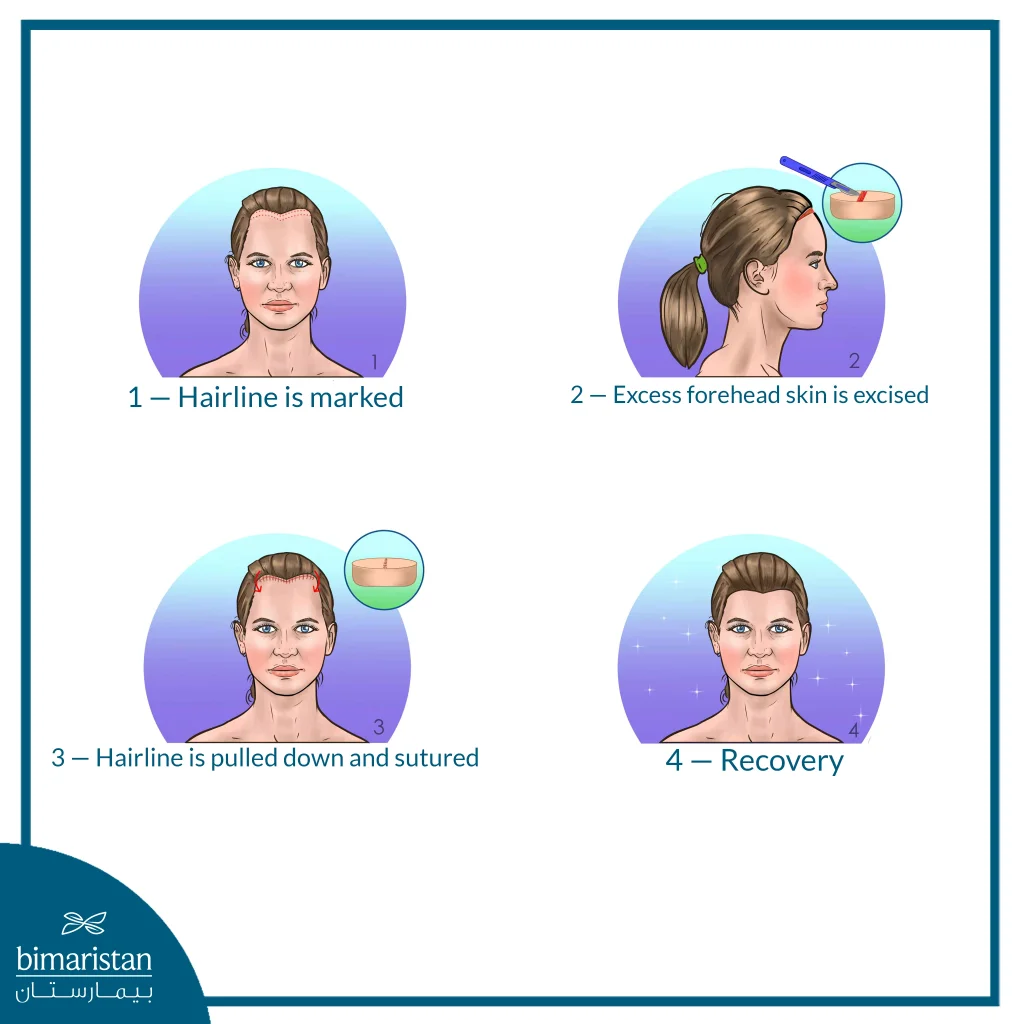
Hairline lowering surgery is performed under general anesthesia, with a local anesthetic used to reduce pain and bleeding. The procedure includes the following steps:
- Define the new hairline: The surgeon draws the hairline and the area where the skin will be removed using a surgical pen, taking care to preserve the hair follicles and nerves.
- Anesthetize the forehead area: The entire forehead is anesthetized from the hairline to just above the eyebrows.
- The incision is made: A precise incision is made along the hairline, and the incision may extend toward the temple area within the hairline to facilitate scalp mobilization.
- Separating the skin and removing excess skin: The surgeon carefully separates the skin from the underlying connective tissue, then removes the amount of skin identified during the planning.
- Pulling the scalp forward: The hairline is moved forward by pulling the top part down to meet the forehead part, effectively reducing the length of the forehead.
- Cosmetic wound closure: The scalp is sutured in such a way that the scar is minimized and becomes almost invisible after hair growth.
In most cases, hairline lowering surgery takes about two hours, but it can take up to 2-4 hours when combined with hair transplantation due to the increased steps and precision of the procedure.
Hairline lowering Surgery Techniques
Hairline lowering surgery is based on two basic surgical techniques, and the most appropriate one is chosen based on the shape of the forehead, scalp elasticity, frontal hair density, and the desired cosmetic result.
Frontal Incision Technique
This technique is used when the forehead is wide or the hairline is visibly receding:
- Removing a strip of forehead skin with an accurate calculation of how much skin should be removed
- Pull the hair-bearing scalp forward to cover the space created by the skin removal
- This progression can significantly reduce the height of the forehead and is an effective option in cases where the hairline is significantly receding
Trichophytic incision Technique
This technique is used when the forehead is moderately high, and when the main goal is to achieve a natural hairline, as this technique focuses on achieving the result without a visible incision in the forehead:
- The incision is made directly on the hairline instead of the center of the forehead
- This opens the gate to move the scalp forward without removing large amounts of forehead skin
- It is less invasive and provides a smoother, more natural hairline after recovery
Combining Hairline lowering Surgery with Hair Transplantation
In some cases, hairline lowering alone is not enough to achieve the desired result, so it is combined with hair transplantation, especially when there is a very high forehead, a high natural hairline, previous baldness, or an obvious receding hairline. In these cases, hairline lowering helps to lower the scalp forward, while hair transplantation is used to fill in the gaps, improve the shape and density of the hairline, and repair any unsatisfactory results from previous procedures. Hair transplantation is usually performed using one of two main techniques:
- Follicular Unit Transplant (FUT): Removing a strip from the back of the head and extracting follicles from it.
- Follicular Unit Extraction (FUE): Extracting the grafts one by one.
The benefits of combining hairline lowering surgery with hair transplantation:
- Covers the edges and gives a smoother hairline
- Overcomes the limitation of lowering the line alone
- The width of the forehead can be reduced by more than 3.5 centimeters if the two methods are combined
- Allows for a customized feminine or masculine hairline
Expected results of hairline lowering surgery
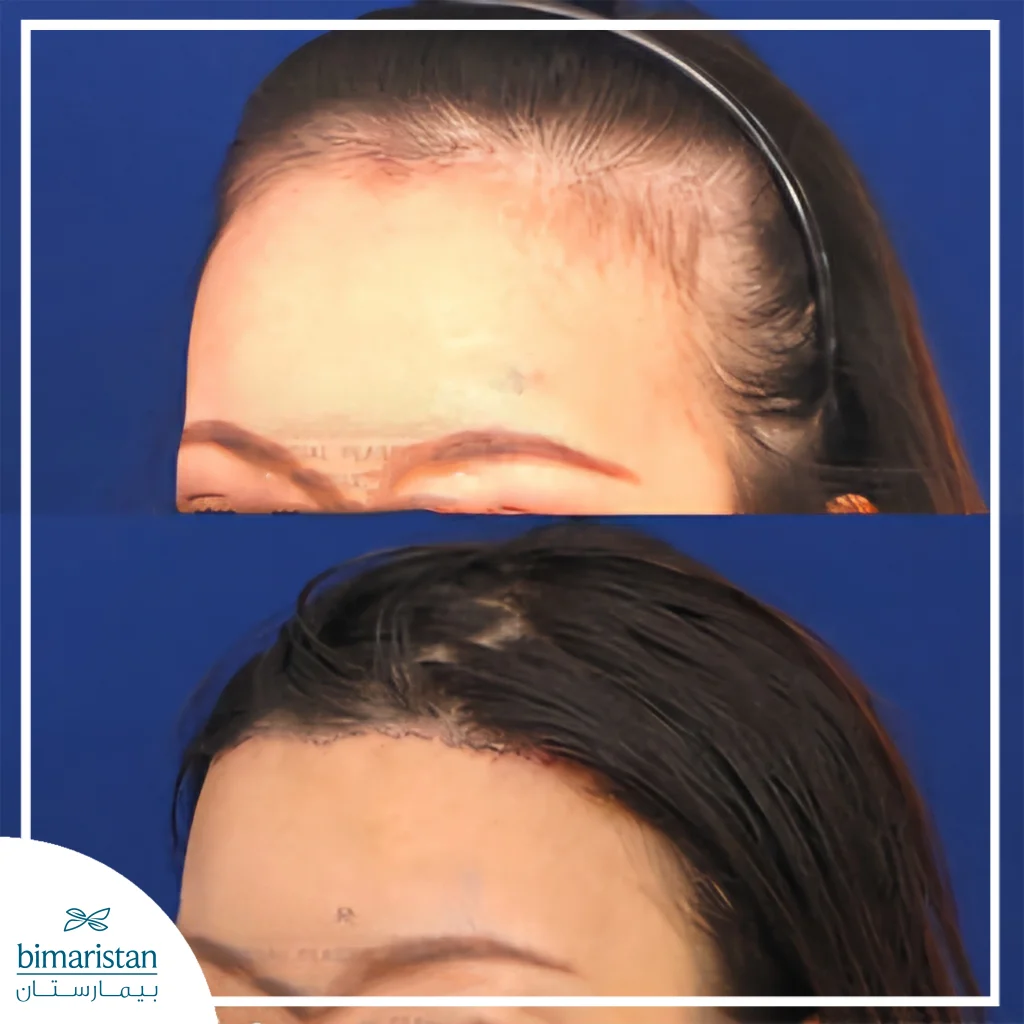
Lowering the hairline usually advances the hairline by 1.5-2 centimeters, making the forehead narrower by the same amount and giving the face more balance. Initial results are visible within the first month, while the final appearance takes 6 months to a year to fully develop as the hair grows back and the skin gradually heals. During this time, the scar gradually fades until it is almost invisible after a year.
Hairline lowering surgery is a permanent and highly effective solution for those with a high forehead or high hairline, giving women a more feminine appearance and men a more youthful and masculine hairline. When combined with advanced hair transplant techniques such as FUE, DHI, or Sapphire FUE, the results are smoother and more natural, improving the shape of the hairline, increasing its density, and harmonizing it with the rest of the face.
The success rate ranges from 85-95% and varies depending on the elasticity of the scalp, the accuracy of the technique used, and the experience of the surgeon, making choosing the right doctor a crucial step to achieve the best long-term result.
Recovery period after hairline lowering surgery
Most patients return home within a few hours after surgery and then require a rest period of 7-14 days at home. During this time, stitches and staples are used, and are usually removed between the 7th and 14th day depending on how fast the wound is healing. It is recommended to sleep with the head elevated for 3 days to minimize swelling, while constantly monitoring the incision site for signs of infection. Discomfort, swelling, and bruising can be controlled with prescribed medications and ice packs, as well as maintaining an elevated head position to ensure faster healing.
Return to activity after hairline lowering surgery
Most patients can wash their hair the day after surgery and return to work within 3-5 days or within 7-10 days, depending on the nature of the work. Social activities can be resumed in 2-3 weeks, and strenuous activities and weight lifting are prohibited for 2-3 weeks to avoid pressure on the incision area and to ensure optimal healing.
Final result after hairline lowering surgery
Initial results are visible within the first few weeks, while the final result is complete within 3-6 months, and the healing and almost complete fading of the scar can take up to a year. During this time, hair growth and skin healing are complete, and the new hairline gradually stabilizes.
Risks of hairline lowering surgery
Like any surgical procedure, hairline lowering surgery carries a range of risks and potential complications, the severity of which varies from person to person. Some of the most notable risks include
- Bleeding during or after the procedure
- Infection at the incision site
- Side effects of general anesthesia or an allergy to local or general anesthesia
- Abnormal sensation or temporary numbness in the forehead or scalp
- Hair loss around the incision area due to temporarily weakened follicles
- The appearance of a scar after the skin has healed, the degree of visibility may vary from person to person
- Swelling or fluid buildup in the area of the operation
- Pain or discomfort during recovery
- Torn stitches or a small opening in the incision area
- Subcutaneous hematoma
- Dissatisfaction with the final shape or irregular forehead ridges
- Facial nerve injury, which may cause mild or temporary weakness
- Delayed wound healing or more visible scarring in some people
While these risks are numerous, they are rare when the surgery is performed by an experienced medical team with extensive experience in this type of procedure, as is the case at specialized centers in Turkey known for their high precision, such as Bimaristan. When the surgery is performed to the correct standards and the recovery protocol is strictly followed, the likelihood of a visible scar or long-term issue is very low, making the procedure a safe and effective option for most patients.
Comparison between hairline lowering surgery and hair transplantation
Hairline lowering surgery differs from hair transplantation in purpose, mechanism, and outcome, but many patients need to combine the two procedures for the best result. Some may opt for hairline lowering when the forehead is naturally high or when there is an obvious receding hairline. While hair transplantation is used in cases of baldness or lack of density, or when previous transplants did not achieve satisfactory results, the following table shows a comparison between hairline lowering surgery and hair transplantation:
| Element | Lowering the hairline | Hair transplant | Combine them |
|---|---|---|---|
| Primary goal | Reduce forehead length | Increase hair density | Lowering the forehead + covering voids |
| Amount of change | Up to 2 cm | 1.5-2 cm | May exceed 3.5 centimeters |
| Number of bulbs | – | Up to 4000 bulbs | Planting that covers the edges and the line |
| the presence of a scar | Yes, on the edge of the hairline | Often there is no visible scar | The scar is hidden by implants |
| Result time | Almost instantaneous | Up to 12 months | Optimized and natural result |
| Suitable for | High forehead or high hairline | Baldness or frontal bald spots | Cases that need a big change and a natural look |
| Restrictions | Does not create a full face frame | Slow hair growth + long session | Depends on the elasticity of the scalp and the density of the donor area |
| Basic feature | Immediately shorten the forehead | improving density and shape | The best possible result in terms of naturalness and balance |
Hairline lowering Surgery Cost in Turkey
Turkey is one of the most chosen destinations for hairline reduction surgery thanks to the expertise of surgeons, the development of aesthetic centers, and competitive prices compared to other countries. The average cost of hairline reduction surgery in Turkey in 2025 ranges from $2,500 to $4,500, depending on several factors including:
- The surgeon’s experience and skill in delicate facial surgeries
- Medical center reputation and equipment level
- The degree of line reduction required (the higher the amount of reduction, the higher the cost)
- Adding ancillary procedures such as hair transplants or hairline enhancement
Comparing the cost of hairline lowering surgery in Turkey and other countries
The following table shows a comparison of the cost of hairline reduction surgery in Turkey and other countries.
| State | Cost in dollars |
|---|---|
| Turkey | 2500 – 4500 |
| America | 8000 – 15000 |
| Europe | 6000 – 12000 |
| The Arab gulf | 5000 – 8000 |
In conclusion, hairline lowering surgery is an effective and permanent solution for people with a high forehead due to genetics or hair loss. The procedure is performed under local anesthesia, allowing the patient to go home the same day, and can be combined with other procedures, such as a brow lift or hair transplant, to achieve better facial symmetry. The procedure helps women create more feminine features and gives men a more youthful hairline. When combined with advanced transplant techniques such as FUE or Sapphire FUE, the results are exceptionally natural and balanced, boosting self-confidence and significantly improving the appearance of the face.
Sources: