
Restless legs syndrome (RLS) is a common neurological disorder that affects the quality of sleep and daily life for millions of people around the world, with an estimated prevalence of 5-10% of adults, with higher rates in women and the elderly. The condition is characterized by an unpleasant sensation in the legs that increases at rest and decreases with movement, leading to difficulty falling asleep and chronic sleep disturbances. Although RLS is common, it is often diagnosed late or its symptoms are misunderstood.
What is Restless Legs Syndrome?
Restless legs syndrome, also known as Willis-Ekbom disease, is a neurological disorder characterized by a strong and uncomfortable urge to move the legs that occurs at rest, lessens with movement, and worsens in the evening or at night. The condition is characterized by an unpleasant sensation in the legs that is usually accompanied by a sense of urgency to move to relieve the feeling.
What are the symptoms of Restless Legs Syndrome?
The symptoms of Restless Legs Syndrome are mainly centered around the compulsive urge to move the legs, but this symptom itself includes several other side effects, such as:
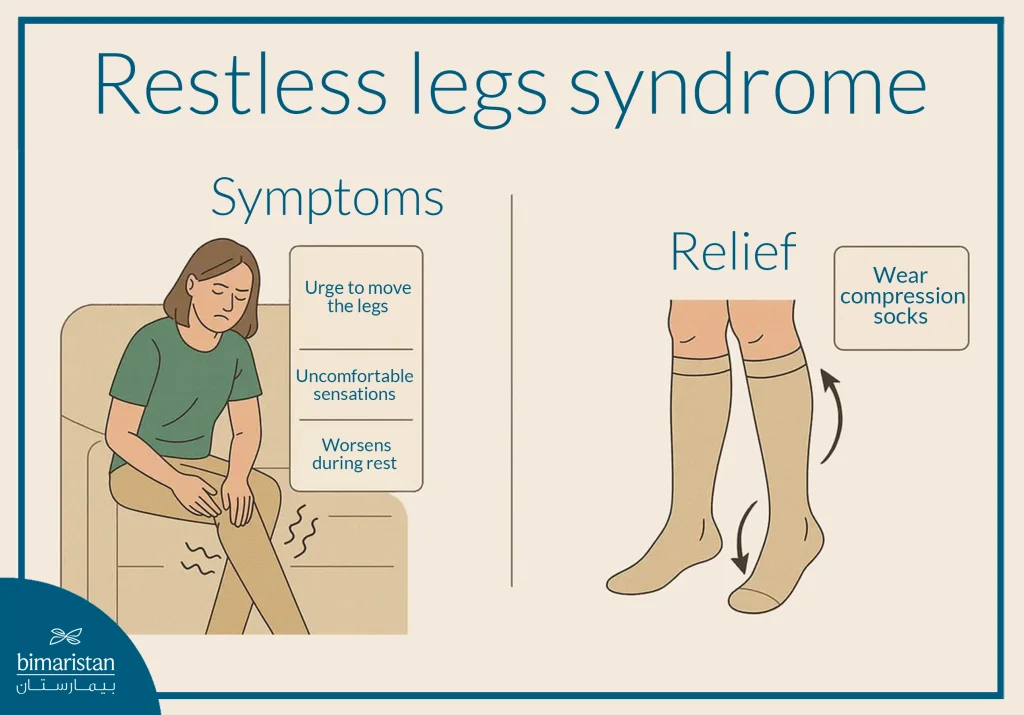
- A compulsive desire to move your legs: The compulsive urge to move your legs is the primary symptom of RLS and is often associated with an uncomfortable or unpleasant sensation.
- Symptoms occur during rest or inactivity: Research shows that symptoms appear or increase when a person is in a resting position, such as sitting or lying down.
- Symptoms improve with movement: Moving your legs or walking can partially or completely relieve your symptoms as long as you keep moving.
- Symptoms increase in the evening or at night: All references state that symptoms have a clear daily pattern, being more severe in the evening and at night than during daylight hours.
- Symptom-related sleep disturbances: Research confirms that RLS commonly leads to difficulty initiating or maintaining sleep due to the frequent need to move the legs.
- Disturbing sensory descriptions in the legs: Studies report that patients describe an abnormal sensation in the legs, without identifying a clear muscular pain.
In addition to the above, sufferers of this syndrome may suffer from depression, anxiety and fatigue as a result of lack of sleep, so this condition requires diagnosis and follow-up to reach an appropriate solution.
What are the causes of restless legs syndrome?
Restless legs syndrome is associated with a number of factors that may be direct or indirect, as the condition may be caused by an imbalance in brain chemistry:
- Dysfunction of the dopamine system in the central nervous system: Research states that RLS is associated with a disturbance in the function of dopamine in the brain, a neurotransmitter responsible for regulating movement.
- Iron deficiency in the blood or brain: Studies clearly indicate that iron deficiency, even without obvious anemia, is an important cause of RLS, due to its role in dopamine metabolism.
- Genetic factors: Studies show that RLS has a clear genetic component, especially in cases that start at a young age.
- Association with certain chronic diseases: Research suggests that RLS may be secondary to other diseases, such as chronic renal insufficiency or pregnancy.
Although RLS can occur for other rare causes, these causes are thought to be the main culprits in the development of RLS.
Who is most likely to develop Restless Legs Syndrome?
This syndrome can occur at any age, so although it is more common in older ages, it is not uncommon for it to appear in childhood, and is related to a number of factors, the most important of which are:
- People with a family history of the disease: Having a family history is an important factor, especially in cases that start at a young age.
- People with iron deficiency: Studies suggest that iron deficiency, even without overt anemia, increases the risk of this syndrome.
- Pregnant women: Research shows that this syndrome is relatively common during pregnancy and is often temporary.
- Patients with chronic renal insufficiency: In these patients, this syndrome is categorized as a secondary condition associated with the underlying disease.
These factors are the most important causes of the syndrome, but they are not the only ones, as there may be some rare causes that lead to the onset of the syndrome.
How is Restless Legs Syndrome diagnosed?
Diagnosing Restless Legs Syndrome involves determining the cause of the condition, because knowing the cause is the key to finding the right treatment.
Clinical diagnosis
The diagnosis of RLS is primarily based on the clinical symptoms described by the patient, and there is no laboratory or imaging test that directly confirms the diagnosis.
Adopting specific diagnostic criteria
Diagnosis is made when key diagnostic criteria are met, including:
- An urge to move your legs
- Symptoms at rest
- Symptoms improve with movement
- Increased symptoms in the evening or at night
Exclude other similar cases
Research suggests that other disorders that may mimic the symptoms, such as muscle spasms or peripheral neuropathies, should be ruled out.
Assessing iron deficiency as part of the diagnosis
Studies suggest that assessing iron stores is an important part of the evaluation, especially when secondary RLS is suspected.
How to treat restless legs syndrome
Treatment depends on the cause, as treating the cause that led to the onset of the syndrome will cure the condition.
Treatment of iron deficiency when present
Correcting iron deficiency is an essential step in treating RLS, whether the patient is anemic or not.
Drug therapies that affect dopamine
Research suggests the use of medications that affect the dopaminergic system as an effective treatment option to relieve symptoms.
Other non-dopaminergic medications
Studies show that alternative medications are used in some cases, especially when dopaminergic therapy is not tolerated or there are side effects.
Treating Secondary Restless Legs Syndrome by treating the cause
Research emphasizes that treating the underlying cause in secondary conditions, such as kidney failure or pregnancy, is part of the treatment plan.
In conclusion, Restless Legs Syndrome (RLS) is a neurological condition that can be diagnosed and treated with the right medical approach. A thorough understanding of the symptoms and causes helps to develop an effective treatment plan that minimizes the impact on sleep and daily life, and with specialized neurological evaluation and modern therapies, most patients can achieve significant improvement. This is where advanced medical centers like Bimarestan Medical Center come into play, combining clinical expertise with careful follow-up to provide comprehensive care according to the latest medical standards.
Sources:
- Allen, R. P., Picchietti, D. L., Auerbach, M., Cho, Y. W., Connor, J. R., Earley, C. J., García-Borreguero, D., Kotagal, S., Manconi, M., Winkelman, J. W., & International Restless Legs Syndrome Study Group. (2021). Evidence-based and consensus clinical practice guidelines for the management of restless legs syndrome.
- Winkelman, J. W., Armstrong, M. J., Allen, R. P., Chaudhuri, K. R., Ondo, W., Trenkwalder, C., & Zee, P. C. (2021). Practice guideline summary: Treatment of restless legs syndrome in adults.
- Chai-Coetzer, C. L., & Antic, N. A. (2023). Restless legs syndrome. Australian Journal of General Practice, 52(9), 643-648.