
Mitral valve diseases affect the heart’s efficiency; mitral stenosis or regurgitation can disrupt blood flow between the heart chambers and cause symptoms that vary in severity from patient to patient. The mitral valve is also known as the coronary valve, and in its advanced stages, mitral valve disease requires careful evaluation to select the appropriate treatment.
Transcatheter mitral valve replacement has emerged as a modern treatment option for certain mitral valve diseases, particularly in patients for whom traditional surgery may not be the most appropriate choice. This procedure combines cardiac catheterization techniques with recent advances in valvular disease treatment, making it a viable option in specific cases following a thorough evaluation of the patient’s condition.
What is Transcatheter Mitral Valve Replacement (TMVR)?
Transcatheter mitral valve replacement (TMVR) is a modern, minimally invasive procedure used to replace a damaged mitral valve without the need for open-heart surgery. The procedure involves inserting a flexible, hollow tube called a catheter through a blood vessel to reach the heart, then placing a new valve in place of the old one, so that the new valve can take over the function of the damaged mitral valve.
The new valve may be an artificial valve or one made from human or animal biological tissue. This procedure is used to treat certain cases of mitral valve disease when the valve is not functioning properly and is affecting heart function. Catheter-based mitral valve replacement is a less invasive alternative to open-heart surgery for patients who are suitable candidates for this type of treatment.
The Difference Between Catheter-Based Mitral Valve Repair and Catheter-Based Mitral Valve Replacement
Catheter-based mitral valve repair differs from catheter-based mitral valve replacement in its goal and approach to treating the damaged valve. In repair, the doctor attempts to restore the function of the original valve and preserve it as much as possible; an example is the MitraClip procedure, which helps the valve leaflets close more effectively in cases of mitral regurgitation. Transcatheter mitral valve replacement (TMVR), on the other hand, involves implanting a new valve to take over the function of the damaged valve; therefore, it is used when valve repair is not appropriate or sufficient, based on the patient’s condition and the medical team’s assessment.
Which patients are suitable candidates for transcatheter mitral valve replacement?
Transcatheter mitral valve replacement is not suitable for all patients with mitral valve disease; rather, it is offered as a treatment option in specific cases following an assessment of the valve, the heart, and the patient’s overall health. Among the most common cases for which this procedure may be appropriate are:
- Patients with severe mitral valve regurgitation, in which the valve does not close properly, allowing blood to flow backward
- Patients with severe mitral valve stenosis, in which the valve becomes narrowed or blocked and does not allow sufficient blood to flow forward
- Patients who are not suitable candidates for open-heart surgery or for whom the risks of surgery are high, such as the elderly or those with comorbidities
- Patients in whom severe mitral valve disease has caused complications or cardiac problems such as atrial fibrillation, pulmonary hypertension, or heart failure
The final decision depends on the medical team’s assessment of the extent of valve damage, the impact of the disease on heart function, and whether transcatheter mitral valve replacement is appropriate for the patient’s condition.
How is a transcatheter mitral valve replacement performed?
Preparation Before transcatheter mitral valve replacement
Preparation for transcatheter mitral valve replacement begins with a thorough assessment of the heart and valve, which may include tests such as an echocardiogram and a CT scan. These tests help the medical team plan the procedure and determine the most appropriate method for performing it. The patient also meets with an anesthesiologist to determine the appropriate type of anesthesia—whether general anesthesia or conscious sedation—based on the patient’s condition and the medical team’s assessment.
Before the procedure, the patient receives specific instructions, such as showering the night before and refraining from food and drink on the day of the procedure, as directed by the doctor. Patients are not advised to shave the hair on their chest, arms, legs, or groin area before the procedure, as the medical team will do so at the hospital if necessary.
The doctor may ask you to stop taking certain medications a few days before the procedure or to continue taking others, depending on your situation; Therefore, patients are advised to bring a list of their current medications or the medication packaging so the doctor can review them and assess whether any adjustments are needed before the procedure. Patients should also arrange for someone to accompany them home after discharge.
Steps for Replacing the Mitral Valve with a Catheter
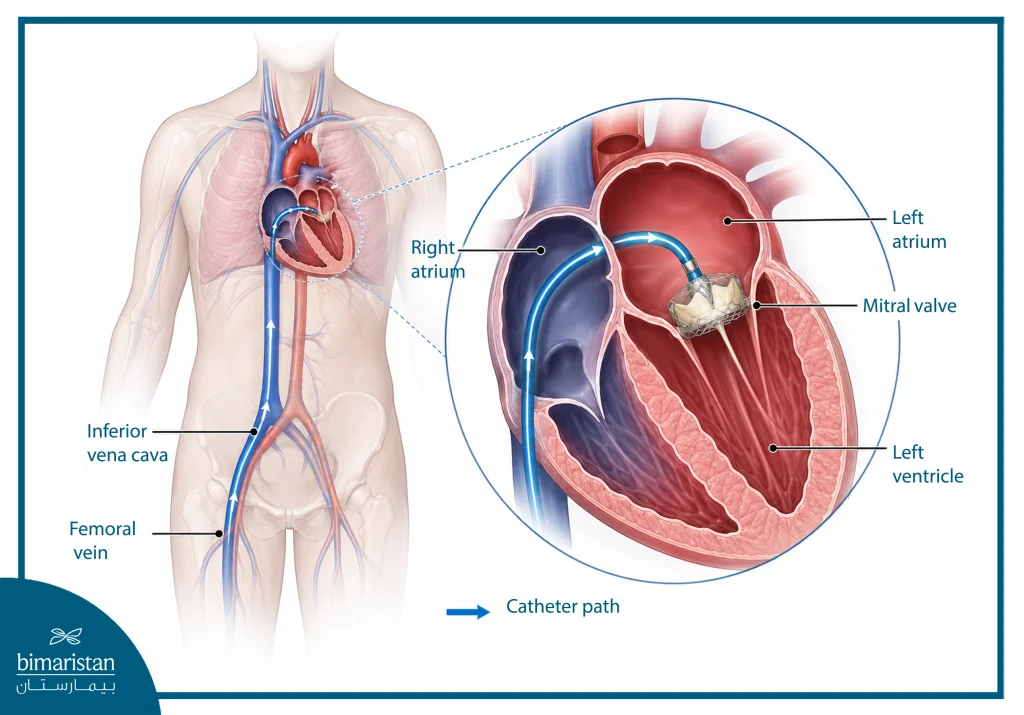
The transcatheter mitral valve replacement procedure is performed in a cardiac catheterization lab and typically takes between two and three hours. A specialized team, which may include an interventional cardiologist, a cardiac surgeon, a cardiac imaging specialist, and an anesthesiologist, participates in the procedure. Once preparations are complete, the procedure typically proceeds through the following steps:
- Inserting an IV line in the arm to administer medications and fluids
- Administer appropriate anesthesia and monitor vital signs such as blood pressure, oxygen saturation, respiration, and cardiac activity
- Make a small incision in the groin or chest area, depending on the approach used
- Insert the catheter into a blood vessel and guide it toward the heart using imaging techniques
- Delivery of the new valve, which is compressed, through the catheter to the mitral valve site
- The new valve was installed to replace the damaged one
- Expand the new valve and secure it in the proper position
- Verify valve function and monitor the heart with echocardiography during the procedure
- Removal of the catheter and closure of the incision after the procedure is complete
What happens after a transcatheter mitral valve replacement?
After the transcatheter mitral valve replacement is complete, the patient is transferred to the recovery room or a cardiac ward, where the medical team monitors the patient’s condition until the effects of anesthesia wear off. Some patients may need to stay in the intensive care unit for a short time, while most patients remain in the hospital for several days to ensure their overall stability following the procedure.
The doctor who performed the procedure checks the patient after they have recovered from anesthesia and explains the results. The patient can usually eat and drink when able, and the catheter insertion site is examined and covered with an appropriate bandage. An echocardiogram is also performed to ensure that the new valve is functioning properly. If the patient’s condition is stable and the test results are satisfactory, the doctor will discharge the patient.
What are the advantages of transcatheter mitral valve replacement?
Catheter-based mitral valve replacement offers several advantages for suitable patients, as it helps treat mitral valve disease and alleviate its symptoms while reducing the need for open-heart surgery in cases where surgical risk is high. Among the most notable benefits of transcatheter mitral valve replacement are:
- A less invasive procedure, as it is performed through a catheter inserted via a small incision rather than by opening the chest, as in traditional surgery
- Helps improve symptoms of mitral valve disease, such as shortness of breath and fatigue associated with heart failure
- It may reduce the risk of serious health problems associated with the progression of mitral valve disease
- It offers a treatment option for some older adults or patients with comorbidities that make open surgery high-risk
- It may be more effective at reducing mitral regurgitation than some catheter-based valve repair techniques
- It allows for a faster recovery compared to open-heart surgery options, with less pain and a quicker return to normal activities for some patients
What are the risks of transcatheter mitral valve replacement?
Although transcatheter mitral valve replacement is a less invasive procedure than open-heart surgery, it may carry risks, as with any cardiac procedure. Many of these complications are uncommon or rare, but it is important to mention them so the patient is aware; therefore, the medical team carefully assesses the patient’s condition before making a decision. Complications may be related either to the method of accessing the mitral valve or to the process of securing the new valve. The most significant potential risks include:
- Obstruction of the left ventricular outflow tract, which may affect blood flow from the heart
- The new valve moves or shifts out of position after installation
- Blood clots form that may cause a stroke
- Excessive bleeding requires additional treatment
- Cardiac arrhythmia and the need for additional treatment to control it
- Damage to certain heart tissues or blood vessels, such as a perforation of the left ventricle or injury to one of the coronary arteries
- Blood accumulates around the heart, and in some cases it needs to be drained
Other rare complications may occur depending on the patient’s condition and the procedure used, and some complications may be serious in limited cases. Therefore, transcatheter mitral valve replacement is performed only after a careful assessment of the benefits and risks, with continuous monitoring throughout the procedure to address potential complications early.
Recovery After Transcatheter Mitral Valve Replacement
After returning home, the patient can gradually resume daily activities but should avoid strenuous exercise and heavy lifting for 1 week following the procedure. It is also recommended to refrain from driving for 72 hours. The area where the catheter was inserted in the groin must be kept clean and dry. A small scab will form over the wound, which is expected to heal in about a week. Contact your doctor if redness, itching, swelling, or discharge from the wound site occurs.
The recovery time after transcatheter mitral valve replacement varies depending on the patient’s overall health; many patients may return to work and their usual activities within a few weeks, while full recovery may take two to three months. The doctor will determine when the patient can resume normal activities and return to work, recommend appropriate medications and follow-up appointments, and may advise the patient to participate in a cardiac rehabilitation program to help strengthen the heart, speed up recovery, and improve quality of life after transcatheter mitral valve replacement.
A follow-up visit is usually scheduled about six weeks after the procedure, during which an echocardiogram is performed to ensure that the new valve is functioning properly. Seek immediate medical attention if you experience symptoms such as severe shortness of breath, chest pain, a fever of 38 degrees or higher, signs of a stroke, such as sudden weakness in the face, arm, or leg, or difficulty speaking; signs of a blood clot, such as pain, swelling, or discoloration of the leg; or signs of heart failure, such as sudden weight gain or swelling of the legs and ankles.
In conclusion, transcatheter mitral valve replacement represents a modern treatment option for some patients with mitral valve disease, particularly when open-heart surgery is not appropriate or carries a high risk. This procedure helps improve valve function and alleviate symptoms in carefully selected patients, but it is not suitable for all cases; therefore, a thorough evaluation of the patient’s heart, valve, and overall health remains essential before making a decision. In addition, adherence to postoperative instructions and regular follow-up after transcatheter mitral valve replacement help monitor the function of the new valve and achieve the best possible outcome.
Sources: