
There are many multiple sclerosis symptoms because it is a disease that affects the central nervous system (brain and spinal cord), so symptoms appear throughout the body. Follow us to learn more.
Multiple sclerosis symptoms are very annoying to the patient, preventing him from practicing his daily life normally and pushing him into depression and isolation. The worst of them is that they are progressive and increase in severity over time.
These symptoms occur in different parts of the body, but how does this happen and how are all these different symptoms related to one disease and what is MS basically? Here is the answer.
What are multiple sclerosis symptoms?
The question about multiple sclerosis symptoms prompts us to first find out the answer to a more comprehensive question—to explain how the symptoms occur in the first place—which is: What is the definition of multiple sclerosis?
What is multiple sclerosis?
Multiple sclerosis (MS) is a chronic autoimmune disease that affects the central nervous system (brain and spinal cord). The central nervous system contains nerve fibers surrounded by sheaths (similar to the principle of an electrical wire surrounded by an insulating layer).
In this disease, the body’s immune system malfunctions, attacking the sheaths of nerve fibers in the brain, spinal cord, and optic nerve (myelin sheath). Sometimes, the nerve fibers themselves (axons of nerve cells) may be attacked.
This leads to a slowdown or interruption of nerve signals that travel through these fibers between areas of the nervous system. Many symptoms appear according to the affected area in the patient’s nervous system, which affects the system’s performance.
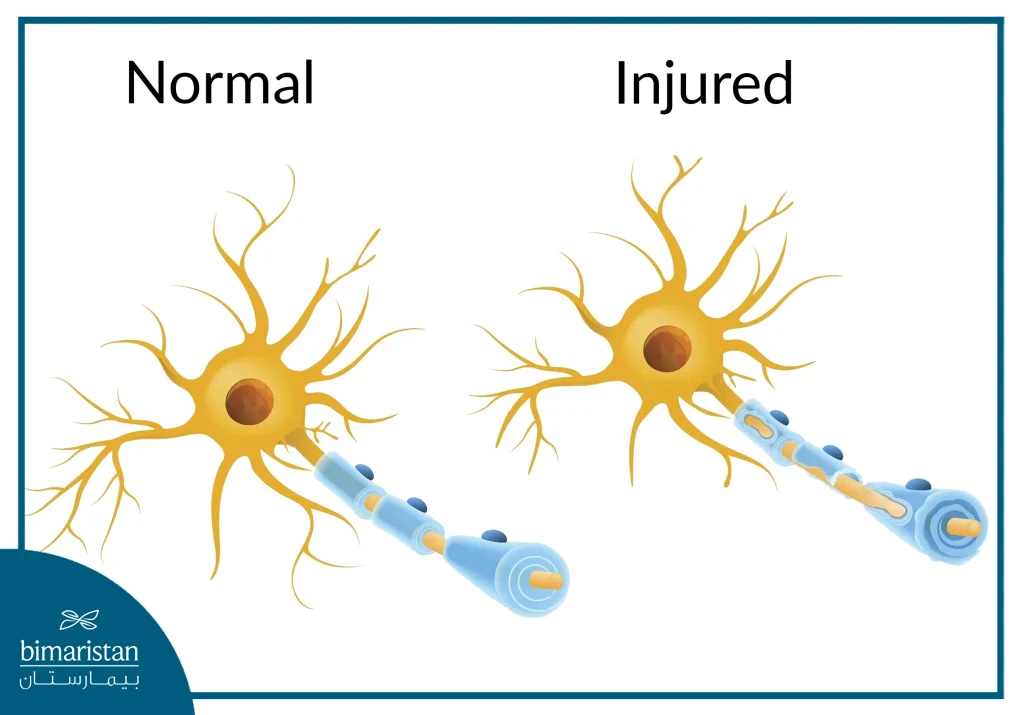
Multiple Sclerosis (MS) is a chronic disease, so multiple sclerosis symptoms will last a lifetime, and the onset, development, and remission of symptoms vary depending on the pattern the patient has. It most commonly affects people between 20 and 40 and is more common among women.
What are multiple sclerosis symptoms?
Since multiple sclerosis (MS) affects the central nervous system (the brain, optic nerve, and spinal cord), we expect the multiple sclerosis symptoms to be comprehensive to the entire body or according to the affected area. First, we will mention the symptoms of multiple sclerosis and then detail them.
Early multiple sclerosis symptoms
MS often begins with the following symptoms:
- Blurred and double vision
- Eye pain and vision loss
- Difficulty walking
- Numbness, tingling, and sensory impairment (pins and needles sensation in the hands or legs)
Other MS symptoms
- Generalized fatigue and weakness
- Dizziness and vertigo
- Hearing loss or impairment
- Problems controlling urine and stool
- Muscle spasms and stiffness
- Disturbances in memory, thinking, concentration, and attention
- Disturbances in the patient’s thinking and planning
- Depression
- Sexual disturbances
- Difficulty speaking and swallowing
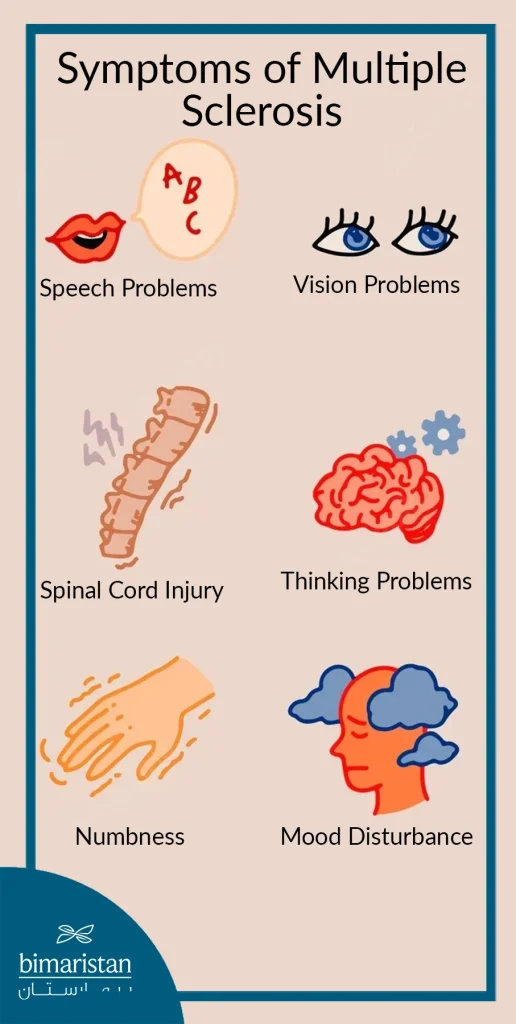
Multiple sclerosis symptoms details
We will now discuss the symptoms of multiple sclerosis in some detail.
Fatigue and exhaustion
The patient’s most annoying symptom is his inability to perform the simplest tasks. His weakness increases at the end of the day, in hot weather, after exercise and effort, and during illness.
Vision problems
Vision disturbances are the first symptoms to appear among the multiple sclerosis symptoms, appearing in a quarter of those infected with the disease (especially optic neuritis). In addition, there are:
- Eye pain, especially when moving it
- Color blindness
- Vision loss that lasts for several days or weeks
- Seeing flashes of light
- Double vision
- Involuntary eye movements
Muscle spasms and movement disorders
Multiple sclerosis causes spasms in the body’s muscles, which become stiff and rigid. It is difficult for the patient to perform normal movements. Walking also becomes difficult with tremors in the hands and difficulty with balance.
Pain and sensory disturbances
A patient with multiple sclerosis (MS) experiences numbness in the limbs and trunk that lasts for several days. This is in addition to pain, which is either due to damage to the nervous system (the patient feels a stabbing sensation in the face) or muscle spasms.
Memory, learning, and planning disorders
These symptoms occur in many diseases other than MS, such as Alzheimer’s or Parkinson’s. However, they may be a symptom of MS and are known as cognitive dysfunction. These symptoms include:
- Lack of attention
- Short-term memory loss (the patient’s long-term memory is not affected in multiple sclerosis)
- Learning problems
- Inability to understand the information he sees, such as a map
- Difficulty solving problems, puzzles, and mathematical problems
Symptoms of psychological illness
Multiple sclerosis patients commonly suffer from depression. It is not known whether multiple sclerosis itself is the cause of depression in the patient or whether the patient’s feeling of helplessness causes depression due to his suffering from a chronic disease.
Multiple sclerosis patients also suffer from other psychological symptoms such as anxiety or mood swings (sometimes they laugh a lot, and sometimes they are sad or angry for no reason).
Sexual problems in multiple sclerosis
(Multiple sclerosis and sexual intercourse) Since multiple sclerosis affects the nerve centers randomly, the areas responsible for sexual desire or sexual performance may be affected, whether in the brain or the spinal cord.
In men, this results in erectile dysfunction in addition to delayed ejaculation, and sometimes, they may lose the ability to ejaculate completely. In contrast, in women they may lose desire or suffer from vaginal dryness.
Disorders of urine and stool control
Multiple sclerosis, due to its effect on the nerves controlling the bladder, causes neurogenic bladder disease, which is a disease that includes many symptoms of lack of control over urination, such as urinary urgency or inability to empty urine.
People with multiple sclerosis also suffer from constipation. Because the immune system may affect the areas in the central nervous system responsible for the movement of the large intestine, causing a decrease in its movement and constipation.
Difficulty speaking and swallowing difficulty
Multiple sclerosis may affect the areas innervated by the muscles of the larynx and pharynx in the central nervous system (brain and spinal cord), leading to inconsistent contractions, which can make speaking and swallowing difficult.
Multiple sclerosis symptoms during pregnancy
Multiple sclerosis symptoms improve during pregnancy and become much less severe, especially in the last trimester of pregnancy (the last three months of pregnancy), but symptoms relapse after childbirth. Therefore, a mother with multiple sclerosis is covered with corticosteroids as a preventive measure for three months after childbirth.
Types of multiple sclerosis
Multiple sclerosis (MS) is classified into several types according to the pattern of onset or remission of MS symptoms. In this article, we will discuss the three main types.
Relapsing-remitting multiple sclerosis
In this type of multiple sclerosis, symptoms regress and heal for a certain period of time that may last months or even years, then the disease relapses and the patient’s symptoms return to the way they were or worse.
The periods of remission may gradually become closer and shorter, meaning that relapses become more frequent and frequent until we reach the second type of multiple sclerosis.
Secondary progressive multiple sclerosis
This type of multiple sclerosis follows the previous type (which has remission and relapse). After the patient’s many periods of remission and relapse, the periods of remission disappear (i.e., the temporary recovery disappears), and the disease becomes progressive (its severity increases and its symptoms worsen) without the patient improving for some time.
Primary progressive multiple sclerosis
In this type of multiple sclerosis, the progression of symptoms begins immediately, and the patient’s condition worsens day after day without periods of remission or noticeable improvement.
Causes of multiple sclerosis
Research is still ongoing to find out the main cause of multiple sclerosis, as there must be a trigger for the immune system to form antibodies that attack the myelin sheaths in the central nervous system (brain and spinal cord). However, some factors are accused of inciting the disease, which: (What is the cause of multiple sclerosis?)
- Genetics
- Lack of exposure to the sun and vitamin D deficiency
- Countries located in the far north
- Smoking
- Obesity in adolescence
- Infection with the Epstein-Barr virus

Follow us—we are the Bimaristan Medical Center—in the following article to learn about treating multiple sclerosis using the latest methods, controlling its symptoms, and diagnosing this chronic disease.
Sources:
- NHS
- Johns Hopkins