
.floating_btn{ display:none !important; } .println-contact-form-button-element{ display:none !important; }
Ankle fractures are common injuries that can occur due to falls, sports accidents, or traffic-related incidents. The severity of these fractures ranges from simple cracks to complex fractures that may involve tearing of the surrounding ligaments. Many patients have essential questions when faced with this injury, such as: Can ankle fractures heal without a cast? Is it possible to walk with a fractured ankle? How do I know if my ankle fracture is severe? In this article, you’ll find detailed and accurate answers to these questions, along with reliable scientific information to help you understand the nature of ankle fractures and how to manage them properly.
Treatment options depend on the type of fracture, its location, and the extent of damage to the bones or surrounding ligaments. The goal of treatment is to restore the bones to their proper position, alleviate pain, prevent complications, and enable the patient to return to their everyday life as quickly as possible. In this article, we will explore the types of ankle fractures, their common causes, symptoms, diagnostic methods, treatment options, and essential care recommendations during the recovery period.
What are ankle fractures?
Ankle fractures are common injuries that typically occur due to joint twisting in older adults or direct impact to the ankle in younger individuals. Treatment aims to promote bone healing, achieve joint stability during movement and rest, and reduce the risk of developing post-traumatic osteoarthritis following the injury.
Anatomy of the ankle joint
The ankle joint is one of the moving joints in the body. It is known as a synovial joint, and it contains a special fluid that facilitates movement and reduces friction. The joint is shaped like a pulley, allowing the foot to move up and down along a single axis.
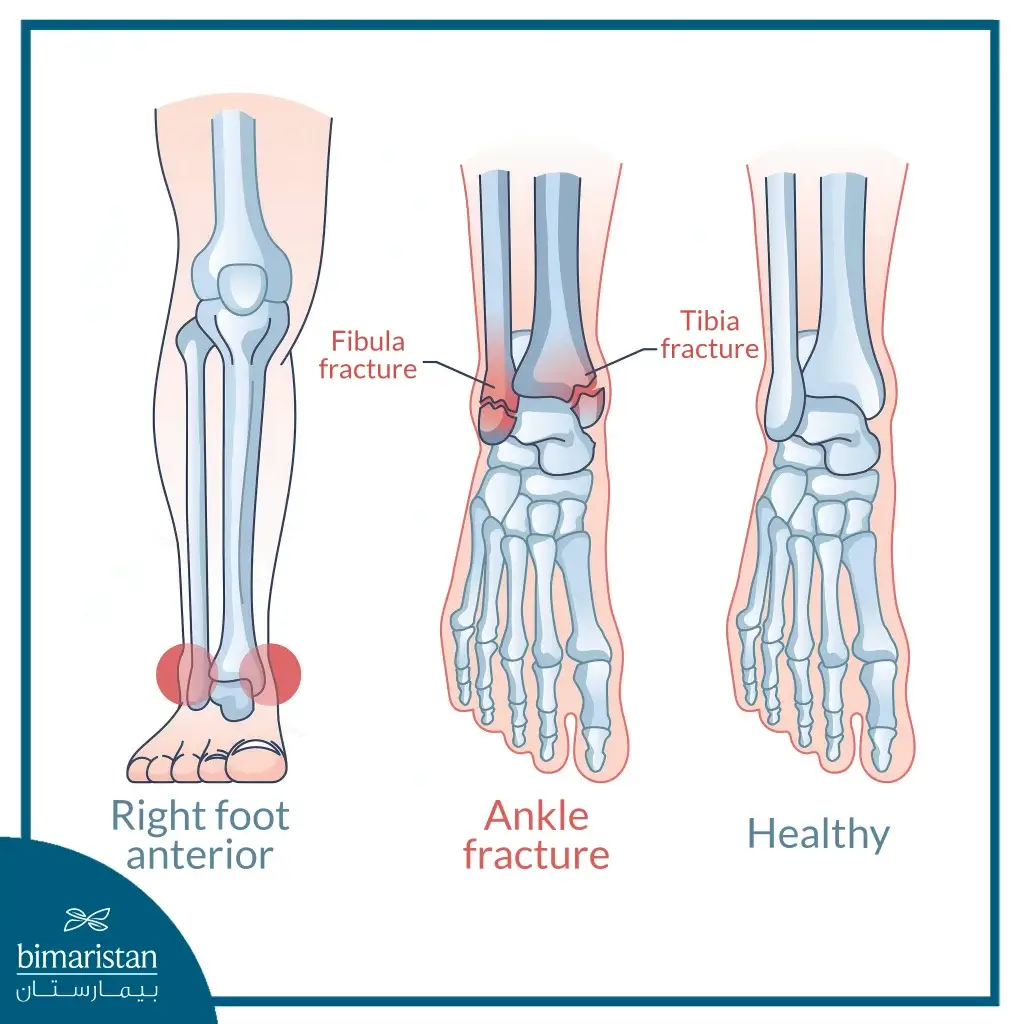
The ankle joint consists of three prominent bones that connect to form the joint: the tibia (the more prominent bone in the lower leg), the fibula (the smaller, lateral bone in the leg), and the calcaneus (also known as the heel bone).
The tibia and fibula fuse to form a cavity where the calcaneus sits, and this structure is called the “mortise.” It is important to note that the ankle has three bony prominences called “malleoli,” not just one, as some may assume. These are:
- Lateral malleolus (outer ankle)
- Medial malleolus (inner ankle)
- Posterior malleolus (back of the ankle)
Causes of ankle fractures
Ankle fractures can result from various causes and impacts, the most common being accidents that lead to a severe twist or crush injury to the ankle, such as falls, tripping while walking or running, or car accidents.
It is essential to recognize that the severity of the fracture is directly related to the force of impact; the stronger the force, or the more consecutive impacts, the greater the risk of the fracture and the depth of the damage to the ankle joint.
The ankle comprises bones and ligaments that form a closed loop around the joint, stabilizing it. When this loop is broken in multiple places, the joint’s stability is significantly compromised, leading to instability and disrupted normal ankle movement.
Types of ankle fractures
Ankle fractures are classified based on the location of the break, with the most common types being:
- Medial (inner) fracture: This occurs when a blow is delivered to the inner side of the ankle. It is commonly seen in athletes following a collision or improper movement.
- Lateral (outer) fracture: One of the most common fractures, occurring from twisting the ankle and often accompanied by a “pop” sound.
- Bimalleolar fracture: Affects two bones in the ankle and is typically more serious, often requiring surgery.
- Trimalleolar fracture: This fracture involves all three bones of the ankle. It often occurs in severe car accidents, and its treatment depends on the extent of damage to the ligaments and tendons.
Additionally, doctors use specific types of fractures, such as Maisonneuve, Pilon, and Bosworth fractures, to determine treatment methods.
Complications of ankle fractures
Suppose an ankle fracture is neglected or not treated adequately for an extended period. In that case, the condition may deteriorate progressively, leading to severe complications that affect foot function and the patient’s quality of life. Some of the major complications include:
- Ankle stiffness: Results from insufficient movement during the healing period or the formation of scar tissue and fibrous tissue within or around the joint, leading to loss of flexibility and difficulty moving the ankle.
- Blood clots and thrombosis: When the foot remains immobile for a long period, blood flow in the veins, particularly in the leg, slows down, increasing the risk of blood clots that can travel to the lungs and cause a life-threatening pulmonary embolism.
- Skin ulcers over the ankle: Due to reduced movement or abnormal pressure on the skin above the fracture site, especially if there is swelling or continuous friction from improper positioning or an ill-fitting cast.
- Delayed or improper bone healing: If the fracture is not correctly aligned, healing may be delayed or result in malunion, which changes the shape of the ankle and foot, possibly requiring surgical intervention later.
- Foot deformities: Improper healing can lead to significant deformities in the alignment of the foot or ankle, making it difficult to walk and affecting balance, potentially causing long-term mobility issues.
- Osteoarthritis is a common long-term complication in which improper joint healing or frequent bone friction leads to the wear and tear of joint cartilage, causing chronic pain, stiffness, and functional impairment of the ankle.
Symptoms of ankle fractures
The symptoms of ankle fractures are often similar to those of sprains, though they are usually more severe. Ankle fractures are extremely rare and cause a complete dislocation when the ligaments are intact.
You may observe blue or black bruising in the affected area, along with potential foot deformity and bone misalignment. An experienced physician can clinically diagnose these signs through visual examination alone without the need for radiographic imaging.
The most common symptoms of ankle fractures we encounter in clinical practice include sudden, severe pain, in addition to:
- Severe sudden pain
- Swelling around the ankle
- Bruising around the ankle
- Inability to put weight on the broken ankle
- Deformation of the foot, especially if there is a dislocation of bones within the joint
- Numbness and tingling in the injured foot
Diagnosis of ankle fractures
A systematic evaluation is performed according to the Advanced Trauma Life Support (ATLS) guidelines when a patient presents with an ankle injury. This includes ensuring the airway is clear, breathing is adequate, and circulation is stable, followed by a quick neurological exam.
Once the overall stability is ensured, a detailed clinical examination of the ankle and foot is conducted. If a dislocation is present along with the fracture, a quick manual reduction of the dislocation may be performed to alleviate pain and pressure on surrounding tissues.
Suppose clear signs of a fracture are present (such as severe pain, swelling, deformity, or inability to move the foot). In that case, an X-ray is ordered to precisely identify the location of the fracture and the affected bones.
In some instances, where deeper evaluation is needed before surgery to stabilize the fracture, a CT scan may be performed, as it provides a clearer picture of the joint surface and fracture patterns.
An MRI is used to assess the condition of the ligaments and soft tissues surrounding the joint, ensuring there are no tears or associated injuries that may not be visible on standard X-rays.
Non-surgical treatment for ankle fractures
The goal of treating ankle fractures is to restore joint stability during movement, which is essential for the patient’s return to daily life without pain or functional disability. This can be achieved either through conservative treatment (non-surgical) for stable fractures or through surgical fixation if the fractures are unstable or associated with bone displacement.
Non-surgical treatment of ankle fractures is appropriate if the ankle injury is isolated, unilateral, stable, and without significant displacement of the bones, particularly the calcaneus. This option is also preferred if the patient is not fit for surgery due to medical reasons, if they refuse surgical intervention, or if they have chronic diseases that increase surgical risks.
Conservative treatments include:
- Applying a cast below the knee stabilizes the fracture in place.
- Manual reduction of the fracture (if simple) and then applying a small cast.
- Using a special medical shoe for mild ankle injuries.
- Taking strong painkillers to alleviate pain and manage inflammation.
Surgical treatment for ankle fractures
Surgical intervention for ankle fractures may be required when conservative treatment is not viable or sufficient. Cases that typically need surgery include:
- Fractures of one malleolus with displacement on X-ray
- Fractures of the two malleoli
- Fractures of all three malleoli
- Specific fractures like Maisonneuve, Pilon, and Bosworth fractures
Types of surgical ankle fracture procedures
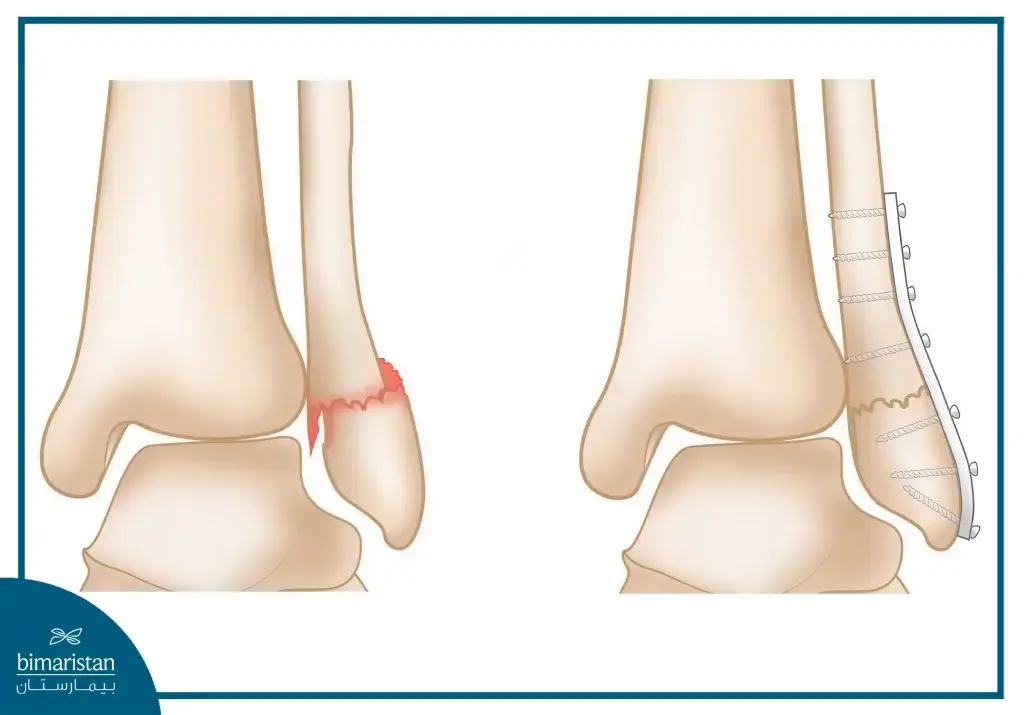
Open reduction and internal fixation (ORIF)
When manual reduction fails or a concurrent injury to the nerves or blood vessels occurs, open reduction with internal fixation (ORIF) is performed as an emergency procedure, typically within the first 24 hours after the fracture. In cases of severe swelling preventing safe surgery, the procedure may be delayed for several days until the skin and tissues improve.
Plates and screws are used to stabilize the bones, particularly in the fibula, and nails are added in cases of severe bone fragmentation to ensure precise anatomical reconstruction.
External fixation
External fixation is a temporary measure used when the fracture is open or accompanied by severe swelling that prevents immediate surgical intervention. This method maintains ankle stability, keeping the anatomical structures in place until the condition improves, after which an ORIF procedure can be performed.
Results of surgical fixation procedures
Ankle fractures that do not require surgery often result in excellent long-term outcomes, whereas patients who undergo ORIF typically need 6 to 8 weeks before the foot can bear weight again. However, complete healing may take longer depending on the case.
A Spanish study found that several factors significantly influence surgical outcomes, including:
- The patient’s occupational demands before the injury.
- The presence of ligamentous injuries or damage to bone-to-bone attachment sites.
- The number of malleoli involved in the ankle joint.
- The timing of surgical intervention, as delays can negatively impact the outcome.
Postoperative phase of ankle fracture surgery
A study conducted at a university hospital in New York City found that, in the short term, most patients achieved good functional mobility, accompanied by mild to moderate pain. However, younger patients tended to have faster recovery and better mobility outcomes. In contrast, women generally require longer healing times due to lower bone density, which may lead to slower bone consolidation.
It is essential to recognize the potential postoperative complications and to contact a physician immediately if any of the following occur:
- Surgical site infection: Often manageable with medication, although a second surgical procedure may be necessary to address the issue in some cases.
- Delayed wound healing: Healing of the incision may be slow and require medical management or minor surgical correction.
- Hardware failure (plates or screws): If the bones are weak or excessive pressure is applied to the joint post-surgery, the implants may break. In such cases, revision surgery is required to remove and replace the broken components.
- Malunion or delayed union: If the bone fails to heal correctly, the underlying cause must be identified and treated to ensure complete recovery.
Ankle fractures care: do’s and don’ts.
Recovering from ankle fractures requires special attention and strict adherence to medical advice to ensure proper bone healing and to avoid complications. A few simple practices can significantly accelerate recovery, while others should be avoided as they may hinder the healing process. Below are key recommendations:
Recommended Practices:
- Keep your ankle elevated as much as possible and rest whenever you can.
- Take the prescribed pain medications, such as paracetamol (acetaminophen), to manage discomfort.
- Move your toes and flex your knee periodically while wearing the cast or medical boot to promote circulation and reduce muscle stiffness.
Practices to Avoid:
- Avoid exposing the cast to water, as this may weaken or damage it, potentially compromising treatment.
- Do not carry heavy objects, which can place undue stress on the healing ankle and delay recovery.
- Refrain from excessive ankle movement, especially in the early stages of healing, to prevent complications.
- Do not insert any objects into the cast to scratch the skin, which may cause abrasions or infections beneath the cast.
Summary of the post-treatment phase of ankle fractures
Although foot and ankle fractures may appear concerning, they rarely pose a life-threatening risk if properly managed. Nevertheless, patients must follow general guidelines to ensure proper healing and complete recovery, regardless of whether the fracture is treated surgically or conservatively:
- Medication adherence: Patients should take all medications and pain relievers as prescribed and not discontinue them abruptly. Pain medications help reduce discomfort but do not eliminate it completely, so they should be taken regularly to prevent the escalation of pain.
- Avoid strenuous activities: High-impact or risky sports should be avoided until complete healing is confirmed. Light exercise and physical therapy may be initiated after surgery to restore mobility.
- Seek medical attention for complications: If symptoms such as severe pain, numbness in the foot, or fever occur, prompt medical evaluation is essential to prevent serious complications.
In conclusion, ankle fractures are among the most common injuries, requiring thorough assessment and structured management to avoid complications and ensure full functional recovery. While these fractures are generally not life-threatening, neglecting or delaying treatment can lead to long-term issues such as joint stiffness, malunion, or even post-traumatic osteoarthritis.
This highlights the importance of specialized and precise medical care, whether through conservative treatment in stable cases or surgical intervention in more complex fractures. Adherence to a structured rehabilitation program is also crucial to achieving the best mobility and quality of life outcomes.
In this context, Bimaristan Center in Turkey stands out as a leading medical center for managing ankle and foot injuries. The hospital combines expert medical teams, advanced surgical technologies, and specialized physical therapy and rehabilitation departments. Bimaristan has demonstrated exceptional capabilities in treating various types of ankle fractures, including complex cases requiring highly precise interventions, making it a trusted destination for patients both domestically and internationally.
Attention to detail, comprehensive evaluation, and meticulous follow-up care are key elements in the recovery journey of ankle fracture patients. Bimaristan Center sets an exemplary standard for achieving these with the highest level of medical excellence.
References: