
Hair loss is a widespread concern, affecting men and women of all ages. It impacts not only appearance but also self-confidence and social life. When considering solutions, the debate of hair transplant vs medication stands out: surgical hair transplants offer long-lasting results, while pharmaceutical treatments like minoxidil and finasteride aim to slow hair loss and encourage gradual regrowth.
What is a hair transplant?
Hair transplant is a medical procedure performed by a plastic surgeon or dermatologist in which hair is transferred from abundant areas, such as the back or sides of the head, to bald areas on the front or top of the head. Hair transplant is usually performed in specialized medical centers under local anesthesia to ensure the patient’s comfort throughout the procedure.
Techniques used in hair transplant
Hair transplant techniques vary depending on the patient’s condition and the type of hair loss they are experiencing. Selecting the appropriate method is essential for the procedure’s success and for ensuring natural, permanent hair growth. The specialist doctor must perform a thorough scalp examination to determine the optimal technique for each case. Currently, three main techniques are used in hair transplantation: FUT, FUE, and DHI.
Follicular Unit Transplant (FUT)
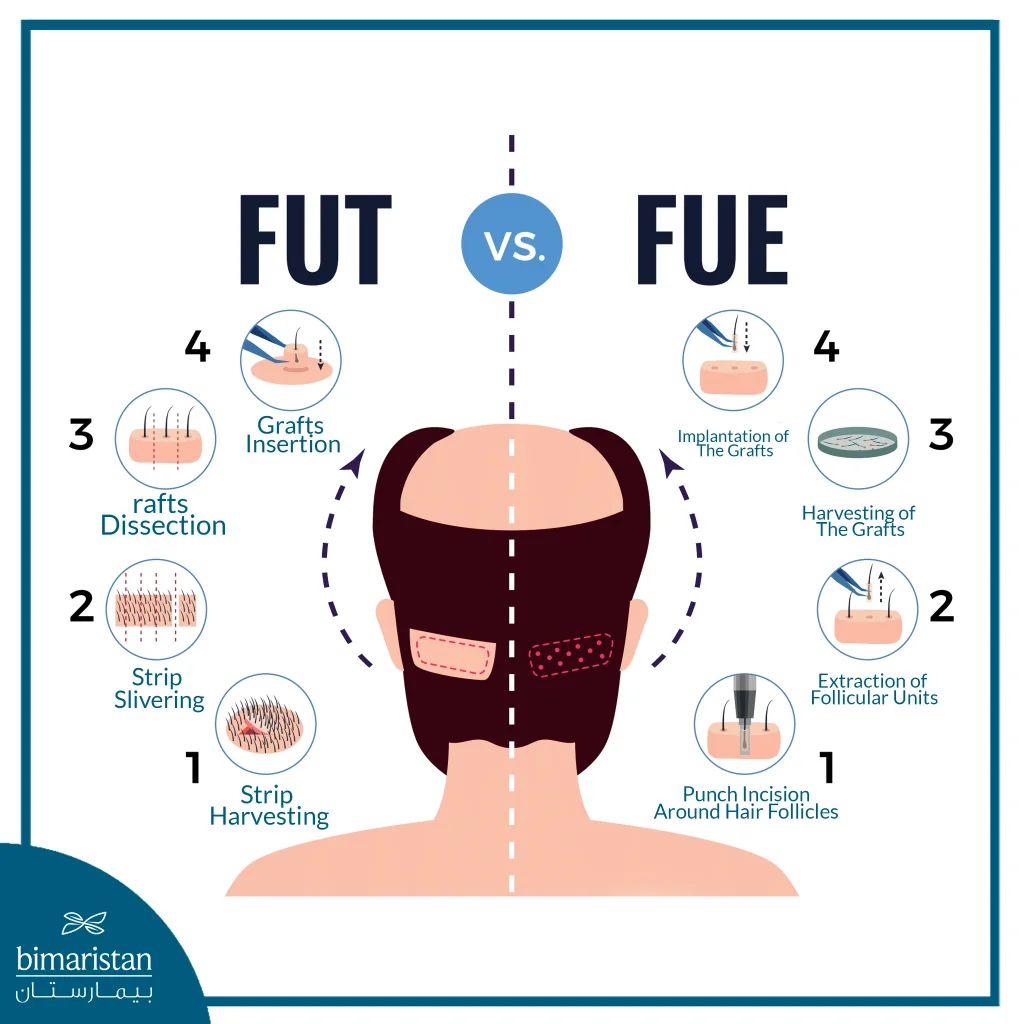
FUT (Follicular Unit Transplant) is one of the oldest hair transplant techniques, used since the 1990s. This method involves removing a strip of skin from the back of the head that contains hair follicles, separating the follicles, and transplanting them to the bald area. Although this method allows the procedure to be performed quickly and at low cost, it requires a surgical incision and suturing in the area where the strip was taken, which may result in permanent scars. It is performed under local anesthesia, and the session takes 4 to 8 hours.
Follicular Unit Extraction (FUE)
The process begins with shaving and sterilizing the scalp, identifying bald areas, and extracting hair follicles one by one from the donor area using precise instruments. The grafts are collected in sterile cups and sorted according to the number of roots, then the front hairline is accurately drawn, and small channels are opened in the recipient area, taking into account the direction of hair growth to ensure natural results.
Direct Hair Implant (DHI)
It is a further development of the FUE method, as a special tool called a Choi Implanter is used to extract and transplant hair follicles directly, eliminating the need to open channels in advance. What distinguishes this method is that it does not require shaving, making it ideal for women or those who wish to maintain their current hairstyle. This type of transplant is performed under local anesthesia, and the follicles are implanted immediately after extraction, which improves the chances of a successful transplant and the quality of the results. This technique is precise, highly efficient, and produces a very natural appearance.
What are medication treatments?
Many medications help treat hair loss, but there are two FDA-approved medications that can help treat hair loss:
Minoxidil
Over-the-counter minoxidil is available as a liquid, foam, and shampoo. For optimal effectiveness, the product is applied to the scalp once daily for women and twice daily for men. Products containing minoxidil help stimulate transplanted hair follicles and increase blood flow to the scalp, thereby promoting the growth and maintenance of transplanted hair. Regular use of minoxidil after transplant helps minimize future hair loss and enhances hair transplant longevity, while maintaining the natural results of the procedure.
Finasteride
A medication that often requires a prescription and is available in tablet form, taken daily. It reduces the impact of the hormone DHT, which is responsible for hair loss, helping protect both native and transplanted hair from future shedding. Continued use of finasteride as directed by a physician supports hair transplant density and promotes natural hair growth, thereby enhancing hair transplant longevity and maintaining results for a longer period.
Advantages of medication treatments
The combined benefits of both medication treatments include:
- Often lower costs
- Non-invasive procedure
- Gradual changes, subject to change if side effects arise
Disadvantages of medication treatments
Common disadvantages of both medication treatments include:
- It takes longer to see results, as it can take up to six months or more of continuous use to see visible results
- The results may be less intense or less sustainable compared to hair transplant
The following table shows a comparison of the advantages and disadvantages of minoxidil and finasteride:
| Treatment | Advantages | Disadvantages and side effects |
|---|---|---|
| Minoxidil | Used topically to increase blood flow to the hair follicles, over-the-counter, it is effective in stimulating hair growth for many users. | Scalp irritation, unwanted hair growth in other areas of the body, dizziness or heart palpitations in rare cases, requires continued use to maintain results, results may take 3 to 6 months to appear, temporary hair loss may occur at the beginning of treatment. |
| Finasteride | Taken orally, it reduces DHT levels, slows down hair loss, and is effective at stimulating hair growth in many men. | Low libido and erectile dysfunction, increased breast size in men, depression, suicidal thoughts in rare cases, must be used continuously to maintain results, not recommended for women, especially pregnant women, and may not be effective for men over 60 years of age. |
Advantages of hair transplant
- A relatively permanent or long-term solution with a very high success rate (approximately 90-97% in most cases).
- Natural growth of the transplanted hair, improving overall density.
- Significant changes may be faster than some medication treatments after the initial period.
- Modern technologies such as DHI provide accurate results.
Risks and disadvantages of hair transplant
- The cost is significantly higher compared to pharmaceutical treatments because it includes additional factors, including:
- Surgery
- Post-operative Care
- Travel if the surgery is performed in a clinic abroad
- Potential surgical risks, such as:
- Uneven or abnormal hair growth
- Scarring and ulceration in the extraction area
- Follicle or graft failure
- Post-operative problems
- Bleeding and infection
- Requires a dedication to following post-operative care instructions and ensuring careful medical follow-up
- Not suitable for everyone, especially those who have:
- A very weak donor area
- Very extensive hair loss
- Health issues preventing surgery
When is medication therapy recommended?
Patients should be aware that medication therapy preserves existing hair and slows down hair loss, but it does not guarantee full hair density or full restoration of lost hair. So it is suitable for:
- Young patients
- Minor to moderate shedding
- When there is a medical contraindication to surgery
- Desire for a non-surgical solution with continued adherence to medication use
- The patient who is committed, as medication therapy needs long-term use with regular follow-up with the doctor
- Patients who cannot afford the high cost of a hair transplant, as medication therapy is less expensive in the short term
Minoxidil or finasteride typically takes 3-6 months to see initial results, and it may take up to 12 months to reach the best effect.
When is a hair transplant recommended?
Hair transplant provides permanent results and better density, but it does not prevent genetic baldness from progressing in areas that are not transplanted. Hair transplant is recommended in the following situations:
- Advanced hereditary baldness
- Ability to tolerate the surgical procedure and post-operative care period
- When medication therapy fails to slow down hair loss or regrow hair
- The patient who can afford the high financial cost of hair transplant
- Those who want a permanent solution and natural hair density without the need for daily medication therapy
The transplanted hair begins to fall out temporarily within 2-3 weeks after the procedure. New hair growth usually begins after 3-4 months, and final growth is complete in 8-12 months.
Can the two methods be combined?
In most cases, combining medication therapy with hair transplant proves an effective approach to enhance transplant results and preserve natural hair, particularly in cases of hereditary baldness. These two methods can be used together, either before or after the transplant procedure.
- Before hair transplant: Medication therapy, such as minoxidil or finasteride, is used to improve hair follicle health and minimize hair loss, creating a better environment for transplantation.
- After hair transplant: Continued medication therapy to support transplanted hair growth
- Minoxidil: Dilates blood vessels in the scalp, improving blood flow to the transplanted hair follicles. This promotes hair growth and stimulates new follicles to grow faster and stronger.
- Finasteride: Inhibits the enzyme 5-alpha-reductase, reducing levels of the hormone DHT, which is responsible for hair loss. Its role is to protect both transplanted and natural hair from the effects of DHT, reducing the likelihood of future hair loss.
Hair transplant vs medication: Cost comparison in Turkey
The following table shows a cost comparison between medication therapy and hair transplant in Turkey
| Option | Annual Cost (USD) | Additional notes |
|---|---|---|
| Medication therapy | 24 to 72 USD | It requires a long-term commitment to maintain results. |
| Hair transplant (once) | 2,000 to 4,000 USD | You may need follow-up sessions or adjunctive treatments to maintain results. |
In conclusion, selecting the appropriate hair loss solution depends on factors such as severity, age, overall health, and personal goals. When weighing hair transplant vs medication, pharmacological options like minoxidil and finasteride are effective for mild to moderate cases but require continuous use to sustain results. In contrast, hair transplant offers a long-term solution with natural density, especially for advanced genetic baldness or when medications prove ineffective. Consulting a qualified medical professional is essential to determine the most suitable approach and achieve safe, optimal outcomes.
Sources:
- MedlinePlus. (2024, October 14). Alopecia areata. U.S. National Library of Medicine.
- National Institute of Arthritis and Musculoskeletal and Skin Diseases (NIAMS). (2024, August 28). Alopecia areata-Hair loss symptoms, types, & causes. National Institutes of Health.
- How long does it take for the results of hair transplant and medicationoption to appear?