
Some mitral valve disorders affect the valve’s ability to close normally, which can reduce blood flow efficiency; in some cases, repair may be needed to improve and preserve function rather than replacing the whole valve.
Mitral annuloplasty is a valve-repair procedure that aims to restore support to the annulus surrounding the valve, helping restore its shape and improve valve closure. The doctor determines whether this procedure is appropriate based on the nature of the defect and the patient’s condition.
What is mitral valve annuloplasty?
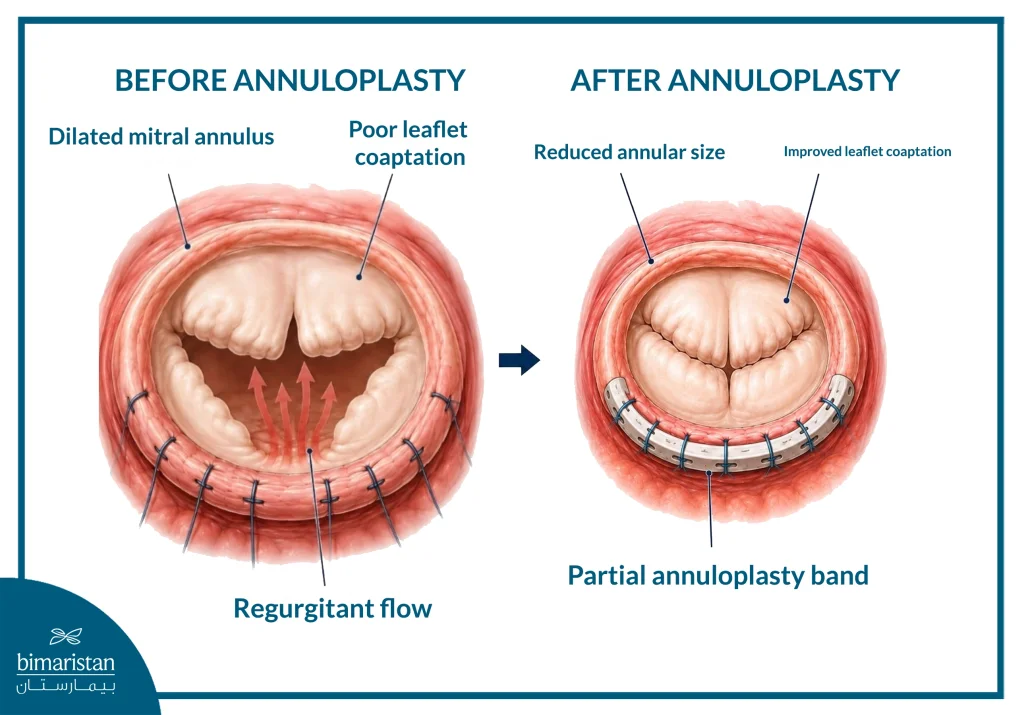
Mitral annuloplasty is a surgical procedure used as part of mitral valve repair; it tightens, reshapes, and strengthens the ring around the valve to improve closure. The annulus is the ring-shaped structure that surrounds and supports the valve; changes in its shape or widening may prevent the valve leaflets from closing properly, allowing blood to leak backward.
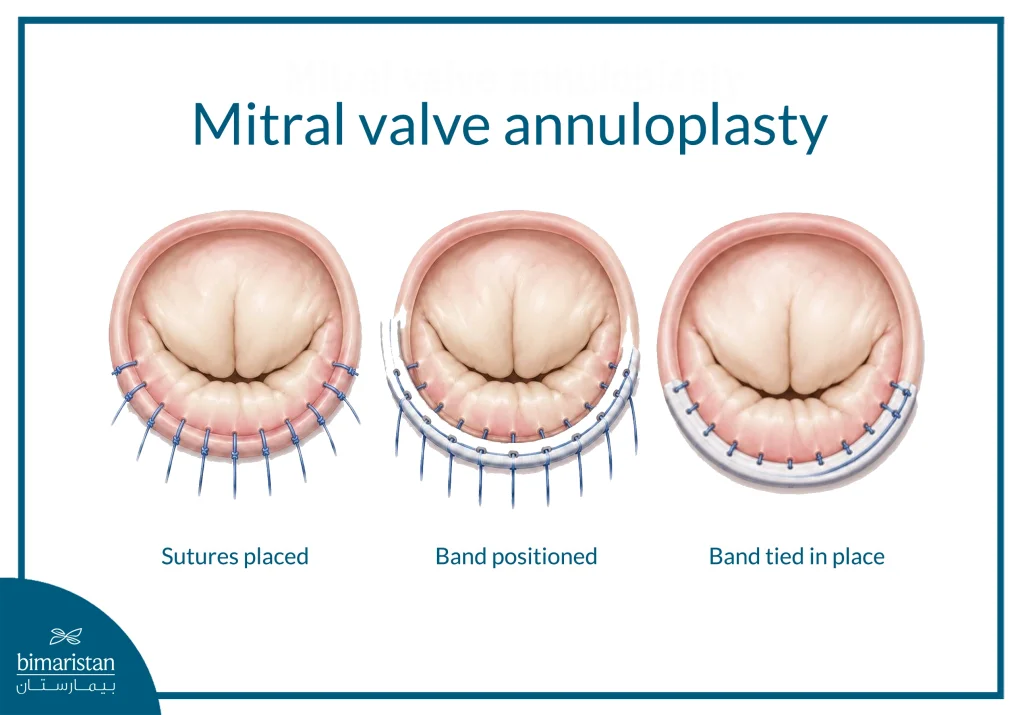
During the procedure, the surgeon places a special ring or band around the valve’s natural annulus to provide additional support and improve leaflet closure. The repair ring may be made of mesh, metal, or plastic, and it remains in place permanently to help the valve open and close more effectively.
When is mitral valve annuloplasty performed?
Mitral annuloplasty is typically performed when mitral regurgitation occurs because the mitral annulus enlarges or deforms, preventing the leaflets from closing properly. This alteration may be associated with either valvular disease or cardiac dilation.
Annuloplasty is typically performed as part of mitral valve repair and may be combined with other techniques to repair the leaflets or the valve’s supporting structures. The decision to proceed depends on the severity of regurgitation, symptoms, and how much the condition affects heart function.
When is mitral valve annuloplasty alone insufficient?
Mitral valve annuloplasty alone is often inadequate when the issue extends beyond just annular dilation and involves other components of the valve. For instance, in cases of leaflet prolapse or torn chordae tendineae, the surgeon may need to repair the leaflets, remove excess tissue, or replace the damaged chordae tendineae. In these situations, annuloplasty supports and stabilizes the overall repair.
Types of mitral valve annuloplasty rings
Mitral valve annuloplasty rings come in various designs, and the surgeon selects the appropriate type based on the nature of the defect, the ring’s shape, and the extent of reshaping needed. The most common types include:
- Rigid rings: Provide strong annular support and superior ability to reshape and maintain dimensions.
- Semi-rigid rings: Combine structural support with a degree of flexibility, thereby allowing some natural movement of the valve annulus.
- Flexible rings: Designed to better preserve the natural dynamic motion of the valve annulus throughout the cardiac cycle.
The ring may fully encircle the valve annulus or be partial, supporting only a portion of it; it is also available in flat or three-dimensional saddle-shaped designs. No single type suits all patients, as the choice depends on the valve’s characteristics and the specific condition being repaired.
Preparation before mitral valve annuloplasty
Preparation for the procedure begins with an assessment of the patient’s overall health, a review of their medical history and current medications, and the necessary tests to evaluate the condition of the valve and heart function. The most important preparation instructions include:
- Pre-operative tests: These may include blood tests and an echocardiogram, along with other examinations determined by the doctor based on the patient’s condition.
- Fasting: Patients usually must abstain from food and drink before the procedure, in accordance with the medical team’s instructions; this often begins the night before.
- Medication review: The doctor must be informed of all medications being taken, particularly anticoagulants and drugs that may increase the risk of bleeding.
- Anticoagulant adjustment: It may be necessary to temporarily stop taking certain medications or adjust their dosages before surgery, but only as instructed by the doctor.
- Informing the medical team of significant health issues: Conditions such as bleeding disorders or drug allergies must be reported, as they may affect preparations for the procedure.
How is mitral valve annuloplasty performed?
Mitral valve annuloplasty is conducted under general anesthesia. Surgeons can access the heart through open-heart surgery or through smaller incisions using minimally invasive techniques. While these approaches differ, the fundamental steps for repairing the valve’s annulus remain consistent. In conventional open-heart surgery, a heart-lung bypass machine provides the surgeon with optimal conditions to work on the valve.
Once the preparation is complete, the process typically proceeds through the following stages:
- Accessing the mitral valve: The surgeon accesses the heart through a chest incision during open surgery, or through small incisions on the right side of the chest with minimally invasive techniques. The left atrium is then opened to access the mitral valve and clearly visualize the annulus and leaflets.
- Examining the valve and identifying the defect: The surgeon examines the valve leaflets, the annulus, and the supporting structures to pinpoint the problem and determine the extent of any additional repair procedures required. Annuloplasty may be performed alone or in conjunction with the repair of leaflets or supporting cords, depending on the nature of the defect.
- Measuring the valve annulus: The surgeon measures the native annulus and selects an annuloplasty ring of the appropriate size and design for the specific case. The goal is to restore the annulus to a shape and size that facilitate better leaflet coaptation (meeting) during closure.
- Securing the annuloplasty ring: Sutures are placed around the native valve annulus and then passed through the selected annuloplasty ring. The ring is then lowered into position and secured with the sutures; it supports and reshapes the native annulus while maintaining the repaired dimensions.
- Testing valve competence: After securing the ring, the surgeon tests leaflet coaptation to ensure the valve closes properly and leakage is reduced. An initial test may be performed by filling the ventricle with fluid and observing valve closure; the repair is subsequently evaluated using transesophageal echocardiography after heart function is restored.
- Completing the procedure: After verifying the effectiveness of the repair, the atrium is closed and normal blood circulation is gradually restored; the surgical incisions are then closed according to the method used.
The procedure generally takes about two to four hours, although the duration varies depending on the surgical technique, the condition of the valve, and whether annuloplasty is performed alone or in combination with other repair procedures.
What happens after mitral valve annuloplasty?
After the procedure, the patient remains in the recovery room for several hours for monitoring and follow-up after anesthesia and surgery. The length of the hospital stay varies by procedure; for minimally invasive surgery, the patient may return home within one to two days, while a stay after open-heart surgery may last about a week. Before leaving the hospital, the medical team provides instructions on caring for the surgical incision, signs of normal healing, and situations that warrant contacting a doctor.
Recovery after mitral valve annuloplasty
Recovery time varies depending on the surgical technique used and the patient’s overall health; recovery may be faster after minimally invasive surgery than after open surgery. The most important guidelines during this period include:
- Physical activity: It is recommended to gradually resume movement and avoid strenuous activities initially, while increasing walking and activity levels according to the doctor’s instructions.
- Surgical incision care: Patients must follow instructions for cleaning the incision and monitor for signs of infection or other abnormalities during healing.
- Returning to work: Some patients may be able to return to work within one to two weeks after annuloplasty, while those with physically demanding jobs will need more time.
- Driving and lifting: The doctor will determine when it is safe to resume driving and heavy lifting based on the type of surgery and the patient’s recovery progress.
- Cardiac rehabilitation: Some patients may be advised to participate in a cardiac rehabilitation program to help safely increase activity levels during recovery.
- Follow-up: Monitoring valve function after the repair is necessary; follow-up care may include echocardiography as determined by the doctor.
Benefits and outcomes of mitral valve annuloplasty
Mitral valve annuloplasty reshapes and supports the annulus, enhancing leaflet closure and minimizing backward blood flow. It also stabilizes the outcomes of valve repair and preserves valve function over time. Its main advantages include:
- Reducing mitral valve regurgitation and improving valve closure
- Preserving the native valve, when repair is feasible, rather than replacing it
- Enhancing repair stability and minimizing the risk of recurrent annular dilation
- Achieving favorable long-term outcomes in suitable patients, with a reduced need for reoperation in many cases
Risks and complications of mitral valve annuloplasty
Mitral valve annuloplasty is generally considered safe, but like any surgery, it may carry risks that vary depending on the patient’s health, heart condition, and the type of surgery performed.
The most common potential complications include:
- Bleeding: May occur from the incision site or during the procedure.
- Infection: It can affect the surgical site or the surrounding tissues.
- Mitral valve stenosis: May occur if the valve annulus is narrowed excessively during the repair.
Having the procedure performed by an experienced heart valve surgeon helps reduce the likelihood of these complications.
In conclusion, mitral valve annuloplasty is a vital technique used in valve repair. It supports the annulus, improves leaflet coaptation, and reduces regurgitation while preserving the native valve whenever possible. The success of this procedure, along with the choice of annulus type and surgical technique, depends on the specific defect and the patient’s condition. Therefore, a comprehensive evaluation by a team specializing in heart valve surgery is essential to determine the most appropriate treatment plan.
Sources:
- Vaidya, Y., Sharma, S., & Widrich, J. (2026). Mitral valve repair. In StatPearls. StatPearls Publishing.
- Rausch, M. K., Bothe, W., Kvitting, J.-P. E., Swanson, J. C., Miller, D. C., & Kuhl, E. (2012). Mitral valve annuloplasty: A quantitative clinical and mechanical comparison of different annuloplasty devices. Annals of Biomedical Engineering, 40(3), 750–761.