
Cataract removal is one of the most common surgical procedures in ophthalmology, designed to restore clear vision after the eye’s natural lens becomes opaque. With the advancement of cataract surgery techniques, the goal is no longer limited to removing the cloudy lens; enhancing visual quality after the operation has become a key part of the treatment plan. In this context, multifocal lenses after cataract surgery have emerged as an advanced option that provides vision correction at multiple distances while reducing dependence on eyeglasses.
What are cataracts?
Cataracts are a condition in which the natural lens of the eye gradually darkens, leading to blurred and impaired vision over time. It is often caused by aging and may be associated with symptoms such as blurry vision, photophobia, and difficulty seeing at night. As the condition progresses, surgery becomes the only effective treatment option, during which the cloudy lens is removed and replaced with an artificial intraocular lens.
What are multifocal lenses after cataract surgery?
Intraocular lenses (IOLs) are clear artificial lenses that are implanted inside the eye after the cataractous natural lens has been removed. These lenses focus light properly on the retina, allowing clear vision to be restored. Intraocular lenses are available in different types, which differ in their ability to correct vision, including monofocal and multifocal lenses. However, the most suitable type is chosen based on the condition of the eye and the patient’s visual needs.
What are multifocal lenses?
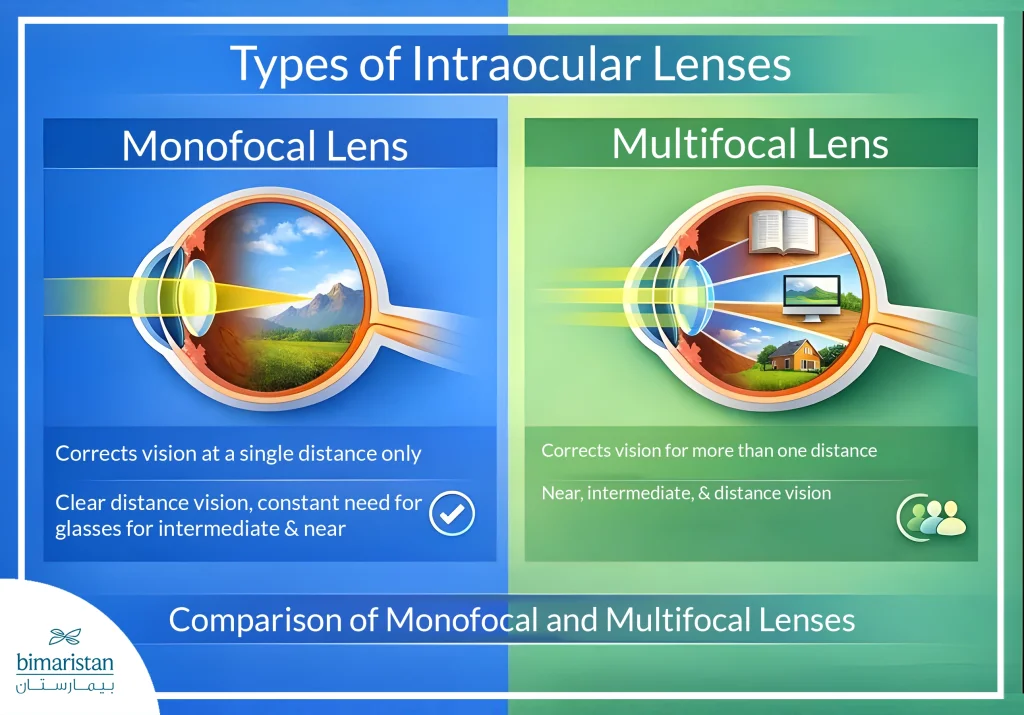
Multifocal lenses are a type of intraocular lens implanted during cataract surgery to provide clear vision at more than one distance. Unlike monofocal lenses that only correct vision at one distance, multifocal lenses allow the patient to see near, intermediate and far, minimizing the need for eyeglasses after surgery. These lenses were developed in response to increasing patient expectations for high visual independence after cataract surgery, while maintaining a satisfactory quality of vision.
How do multifocal lenses work?
Multifocal lenses are based on a special optical design that incorporates concentric rings that bend light into multiple foci as it enters the eye. This mechanism allows light rays to be directed to the retina from different distances, to be interpreted as near, intermediate and far vision. This splitting of light alters the physiology of normal vision, which in some cases can cause visual symptoms such as glare, halos, or reduced contrast sensitivity.
Recent research has focused on optimizing the optical design of these lenses to achieve a more physiological light distribution, improve visual quality and minimize side effects, while maintaining high rates of postoperative patient satisfaction.
What are the types of multifocal lenses after cataract surgery?
Several types of multifocal lenses after cataract surgery (IOLs) can be implanted in the eye, and the most suitable type is selected based on the condition of the eye and the patient’s visual expectations. These include:
- Trifocal lenses: Commonly used after cataract removal, they are among the most popular options today because they provide near, intermediate, and far vision and help minimize reliance on glasses for most daily activities.
- Extended Depth of Focus (EDOF) lenses: Also used after cataract removal, these are preferred for patients who want high-quality far and intermediate vision with fewer visual symptoms, with the potential need for glasses for accurate near vision.
- Diffractive lenses: One of the most commonly used designs in multifocal lenses after cataract surgery, and forms the optical basis for many modern trifocal lenses.

- Refractive lenses: Used after cataract removal but less commonly than diffractive lenses, because their performance is affected by factors such as pupil size and lens centering.
- Hybrid refractive-diffractive (RD) lenses: Used in some cases after cataract removal, they aim to combine the advantages of the two designs to achieve a better balance of vision.
- Aspheric lenses with astigmatism correction: Widely used after cataract surgery, they are often combined with multifocal lenses to improve vision quality and minimize visual aberrations.
The final decision in choosing the type of lens is based on a thorough eye examination, patient expectations and lifestyle

Suitable candidates for multifocal lens implant
Multifocal lenses are a suitable option for certain patients after cataract surgery. Eligibility is based on visual status and the patient’s daily needs, and is done after a thorough medical evaluation. The following are suitable candidates for multifocal lenses after cataract surgery:
- Patients with blurred vision caused by cataracts
- Patients with age‑related near‑vision decline who rely on reading glasses
- Patients who want to reduce dependence on glasses or contact lenses after surgery
- Patients who regularly use progressive glasses or multifocal contact lenses
- Patients with farsightedness, nearsightedness, or astigmatism, along with cataracts
- Situations in which the ophthalmologist determines that the implantation of multifocal lenses can provide better visual correction based on the patient’s lifestyle and vision needs
Advantages of multifocal lenses after cataract surgery
- Clear vision at all distances: Multifocal lenses correct near, intermediate, and far vision, unlike monofocal lenses that focus on only one distance, minimizing the need for glasses after surgery.
- Reduced dependence on glasses and contact lenses: With improved vision at all distances, you may no longer need to use reading glasses or everyday glasses for most activities.
- Better comfort and quality of life: Going glasses-free eliminates the hassle of losing or damaging glasses and offers greater freedom while traveling or doing daily activities.
- Permanent visual improvement: Implanted lenses are stable and do not change over time, ensuring long-term stability in vision correction results.
- A safe and effective surgical procedure: Cataract surgery with multifocal lens implants is a quick and safe procedure with a relatively short recovery period.
- Greater flexibility in the use of sunglasses: The patient can use ready-made sunglasses without the need for a prescription.
Disadvantages of multifocal lenses after cataract surgery
- Possible nighttime glare or halos: Some patients may experience glare or halos around light sources in low light conditions, and these symptoms often improve with visual adaptation over time.
- The need for better lighting for reading: Reading in dimly lit areas may require some patients to have additional lighting.
- The occasional need for reading glasses: In certain cases, reading glasses may still be needed for very fine lines.
- Not suitable for all patients: Not all patients are suitable candidates, especially those with ocular diseases such as macular degeneration or glaucoma.
Comparison of monofocal and multifocal lenses after cataract surgery
| Comparison Aspect | Monofocal Lenses | Multifocal Lenses |
|---|---|---|
| Number of corrected distances | Corrects vision for only one distance | Corrects vision for multiple distances |
| Distant vision | Excellent when chosen for this purpose | Good within the range of multiple focal vision |
| Intermediate vision | Often requires glasses | Available to varying degrees |
| Near vision | Always requires reading glasses | Available in most cases |
| Dependence on glasses | High after surgery | Low for many daily activities |
| Common use | Standard option in cataract surgery | Advanced option for those seeking reduced dependence on glasses |
| Astigmatism correction | Available through toric lenses | Available through toric multifocal lenses |
| Patient suitability | Suitable for most patients | Requires careful patient selection |
Steps to implant multifocal lenses after cataract surgery
Multifocal lens implantation is performed as part of the same cataract surgery and is not a separate procedure. The procedure begins with the removal of the opaque natural lens that caused the vision impairment, which is the primary step in cataract treatment. After this lens is removed, an artificial lens is implanted in the same location as the natural lens.
If multifocal lenses are chosen, a specially designed lens is implanted to focus light at more than one distance, rather than a conventional monovision lens that focuses at only one distance. The steps and procedure are no different from standard cataract surgery; only the type of intraocular lens implanted differs. The procedure aims to improve both near and far vision and minimize the need for glasses after surgery.
Recovery period after multifocal lens implantation following cataract surgery
The recovery period after multifocal lens implantation is similar to that after conventional cataract surgery. During the first few days and weeks after surgery, the patient may notice gradual changes in vision quality as the lens stabilizes within the eye.
At this stage, the visual system adapts to the new lens, and the patient may feel a difference in the way they see compared to before surgery. Follow-up care is important to assess vision improvement and monitor any visual symptoms that may arise during the recovery period. Over time, vision becomes clearer and more stable in most patients.
Expected results of Multifocal lenses after cataract surgery
In the short term, multifocal lens implantation aims to restore clarity of vision after cataract removal, with a gradual improvement in the ability to see at different distances. The patient may need a period of acclimatization to the new lens, as the final results are not immediate in all cases.
In the long term, the results are characterized by visual stability, as the characteristics of the implanted lens remain constant and do not change over time. Neuroadaptation occurs as the brain learns to process the image created by the new light distribution, improving vision quality and reducing the perception of visual symptoms over time, and, in many cases, leading to a high level of visual satisfaction after surgery.
Comparing the cost of multifocal lens implantation in Turkey and other countries
The comparison between countries shows a clear difference in costs, with some destinations maintaining advanced levels of medical care.
| State | Approximate average cost per eye |
|---|---|
| Turkey | 2,000 – 3,500 USD |
| Germany | 4,000 – 6,000 USD |
| United States | 5,000 – 7,000 USD |
| Canada | 4,500 – 6,500 USD |
In conclusion, multifocal lenses after cataract surgery have become an advanced option for patients who want to improve vision at multiple distances and minimize dependence on eyeglasses after surgery. While these lenses provide important visual benefits, their success depends on careful patient selection, a thorough ophthalmic examination, and an understanding of realistic expectations for outcomes. Making the decision in collaboration with your ophthalmologist is an essential step in ensuring the best possible visual outcome in the short and long term.
Sources:
- Salerno LC, Tiveron MC Jr, Alió JL. Multifocal intraocular lenses: Types, outcomes, complications and how to solve them. Taiwan J Ophthalmol. 2017 Oct-Dec;7(4):179-184. doi: 10.4103/tjo.tjo_19_17. PMID: 29296549; PMCID: PMC5747227.
- National Institute for Health and Care Excellence. (2008). Treating cataracts by implanting multifocal lenses (Interventional procedures guidance IPG264). NICE.
- Federal Aviation Administration. (n.d.). Cataracts and lens implants: Frequently asked questions. U.S. Department of Transportation.