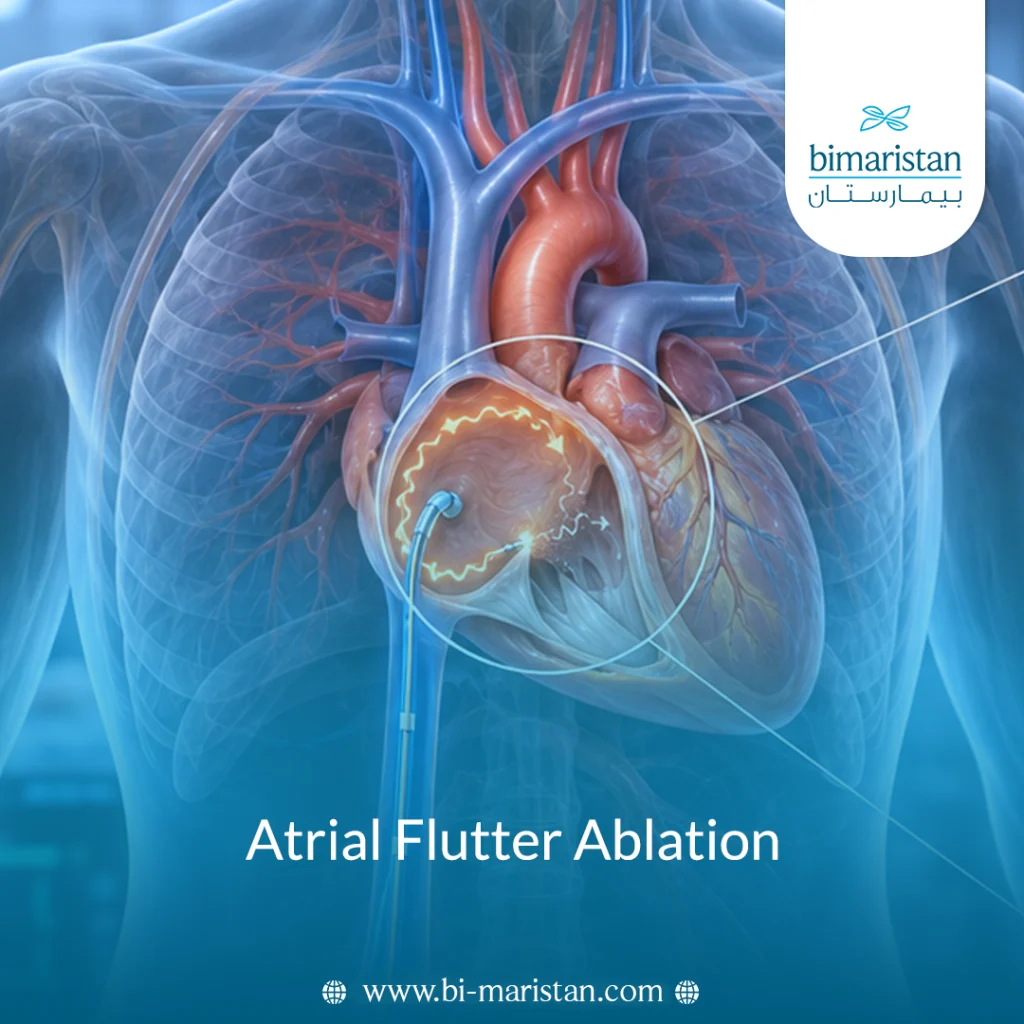
Cardiac arrhythmias are conditions that disrupt the regularity and efficiency of the heartbeat. Managing these arrhythmias depends on their type, severity, and the individual patient’s condition. One specific type of arrhythmia is atrial flutter, which necessitates careful evaluation to identify the most appropriate treatment.
With advances in minimally invasive cardiac procedures, atrial flutter ablation has become a treatment option in certain cases, aiming to address the source of the electrical disturbance in a targeted manner appropriate to the condition.
What is atrial flutter ablation?
Atrial flutter ablation is a minimally invasive procedure designed to disable the cardiac tissue that sends abnormal electrical signals causing atrial flutter. During the procedure, radiofrequency energy is typically used to heat a small area of tissue and create scar tissue that blocks the passage of these abnormal signals. In some cases, cryoablation may also be used to achieve the same goal.
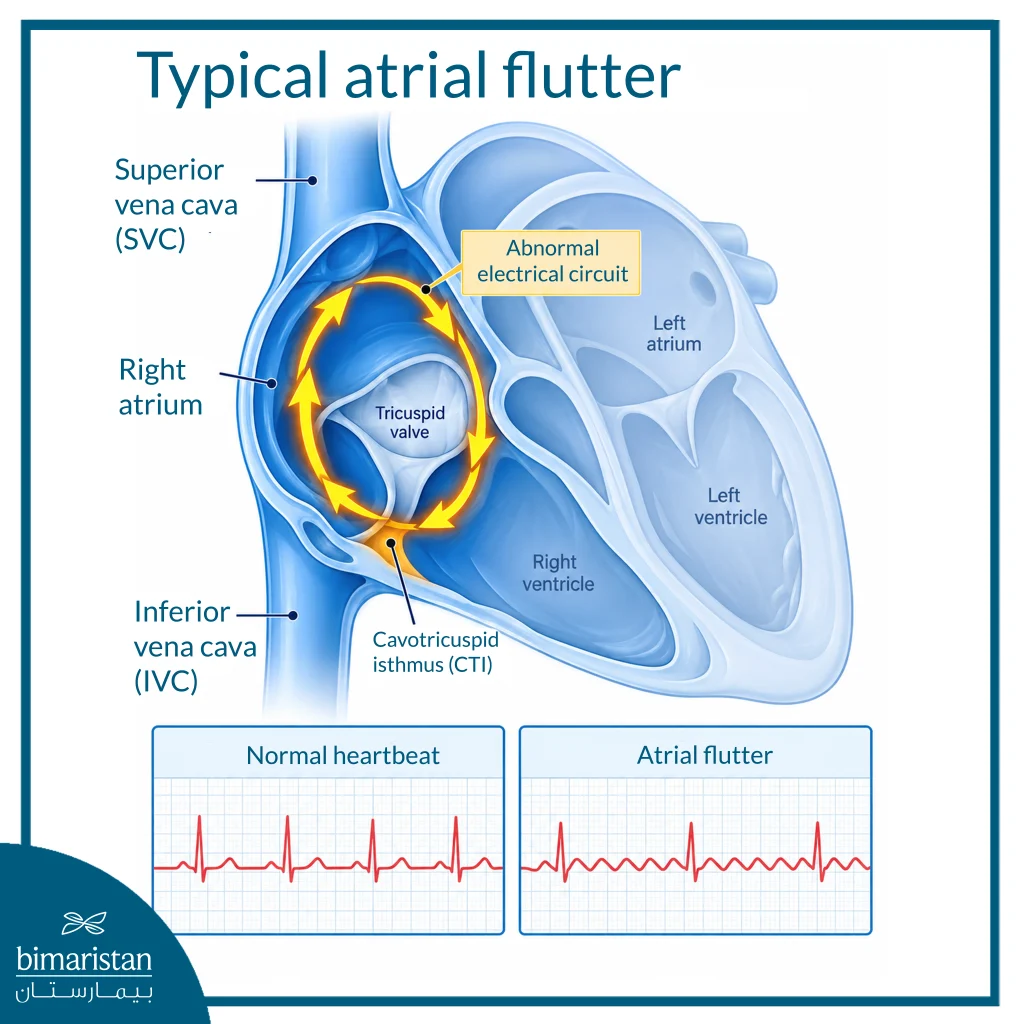
Atrial flutter occurs as a result of an abnormal electrical circuit in the atria that causes them to contract very rapidly instead of functioning normally and in a coordinated manner. Ablation helps to interrupt this circuit or isolate the area responsible for it, thereby preventing the continued electrical signals that cause the arrhythmia.
What types of atrial flutter can be treated with ablation?
Atrial flutter is primarily divided into two types, which differ based on the pathway of the electrical circuit causing the arrhythmia:
- Typical atrial flutter: It involves an electrical circuit that passes through the cavotricuspid isthmus (CTI) between the tricuspid valve and the inferior vena cava. The circuit may travel counter-clockwise (the most common form) or clockwise; both forms can be treated by ablation of the CTI region.
- Atypical atrial flutter: Its electrical circuit does not rely on the CTI, and it may originate in the right or left atrium via different pathways. It may also be associated with atrial scarring, prior cardiac surgery, or catheter ablation for atrial fibrillation, and it is more complex and less amenable to ablation than typical flutter.
When is atrial flutter ablation performed?
Atrial flutter ablation may be recommended in the following cases:
- Presence of significant symptoms: Such as palpitations, shortness of breath, dizziness, and fatigue that affect the patient’s quality of life.
- Failure of other treatments: When the flutter cannot be controlled with medication, or when cardioversion fails to restore or maintain a normal rhythm.
- Recurrent symptomatic atrial flutter: Including certain cases of non-CTI-dependent flutter, particularly after the failure of anti-arrhythmic drug therapy.
- Certain recurrent asymptomatic cases: Ablation may be considered based on the physician’s assessment and a balance of the procedure’s benefits and risks.
How do you prepare for an atrial flutter ablation?
Preparation for atrial flutter ablation begins with reviewing medications and fasting instructions and confirming the patient is ready for the procedure. The most important preparations include:
- Fasting before the procedure: Patients are typically required to fast for at least six hours and must follow specific instructions regarding fluid intake.
- Medication review: The physician determines which medications to continue and which to pause temporarily, including certain antiarrhythmic drugs and other medications.
- Anticoagulant management: Patients must strictly adhere to the electrophysiologist’s instructions; anticoagulants should not be stopped, nor doses missed, unless specifically directed by the physician.
- Review of allergies and medication history: The patient is asked about current medications and any allergies to drugs, contrast agents, or dressings.
- Informed consent: The physician explains the purpose, benefits, risks, and available alternatives of the ablation procedure, and answers the patient’s questions before the consent form is signed.
- Preparation on the day of the procedure: An intravenous (IV) line is established, and ECG electrodes are placed to monitor electrical activity, while blood pressure and oxygen levels are monitored as needed.
How is atrial flutter ablation performed?
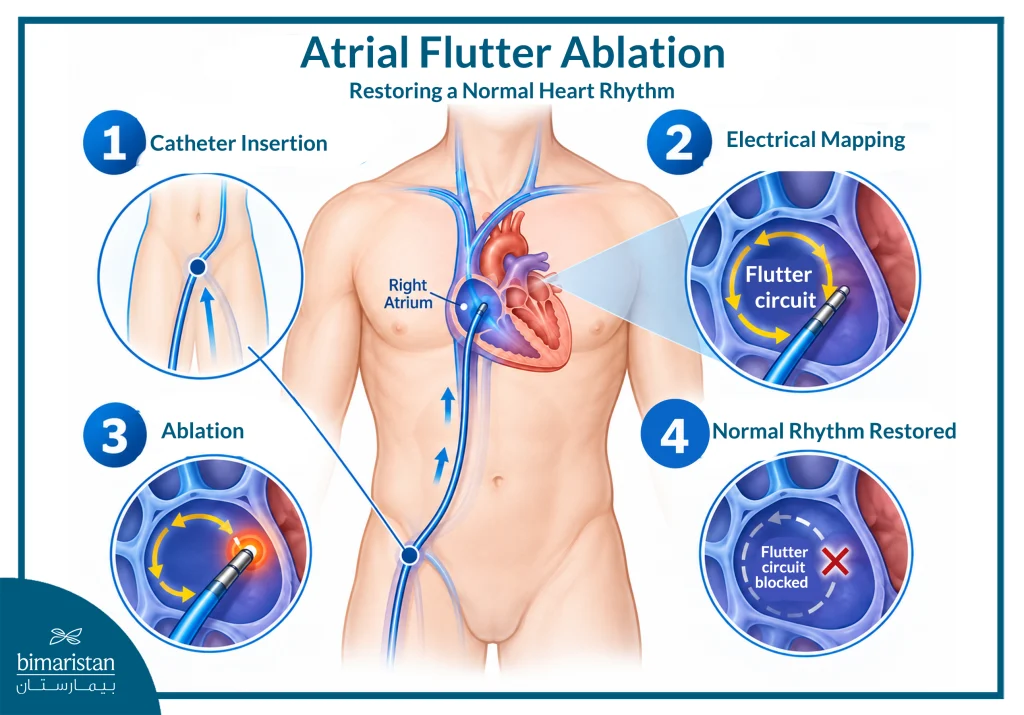
Atrial flutter ablation is performed in the cardiac catheterization laboratory and does not require open-heart surgery. The patient may be under sedation with local anesthesia or under general anesthesia, depending on the nature of the case and the medical team’s plan. Once the patient is prepared, the procedure begins with the following steps:
- Catheter insertion: Small sheaths are inserted into a vein in the groin area, and several catheters are passed through them into the right atrium under X-ray guidance.
- Recording cardiac electrical activity: Electrodes on the catheters record electrical signals within the heart; the physician analyzes these to identify the circuit responsible for atrial flutter. A 3D mapping system may be used to obtain more detailed information.
- Identifying the ablation site: In typical CTI-dependent atrial flutter, the cavotricuspid isthmus is identified as part of the targeted electrical circuit.
- Performing the ablation: Radiofrequency energy is typically used to heat specific areas of tissue and create a line of ablated tissue that interrupts the electrical circuit, thereby preventing the continuation of flutter-inducing signals.
- Verifying ablation success: Following energy delivery, electrical signals are monitored to ensure that conduction across the treated area does not recur, and about 30 minutes may be waited to check for the stability of the result.
- Concluding the procedure: The catheters and sheaths are removed from the vein, and pressure is applied to the insertion site to help stop any bleeding.
Atrial flutter ablation typically takes about 2 to 4 hours, though the duration may vary depending on the nature of the case and the procedure required.
Care and monitoring after atrial flutter ablation
After the procedure, the catheters and dressings are removed, and pressure is applied to the insertion site to minimize bleeding. The patient is then transferred to the recovery area for monitoring during the first few hours. The patient may be asked to keep the leg extended for several hours, while monitoring the catheter insertion site and watching for any unusual bleeding, pain, swelling, or changes in skin color. If the patient’s condition is stable, they may be discharged after about 4–6 hours, with instructions on medications, catheter-site care, and returning to daily activities.
Recovery after atrial flutter ablation
During the first few days, the patient may experience some chest discomfort, and brief palpitations or irregular heartbeats may occur over the following weeks; these symptoms usually subside over time. To ensure a proper recovery, the following is recommended:
- Avoid driving for 48 hours after the procedure due to the lingering effects of anesthesia or sedation
- Avoid activities requiring physical exertion or full concentration and attention during the first 24 hours
- Return to work within a week, provided the job does not involve heavy lifting or significant physical exertion
- Begin light exercise one week after the procedure
- Continue taking anticoagulants for at least one month, as instructed by the cardiologist
- Attend the follow-up appointment, typically scheduled one to three months after the ablation
It is important to follow these instructions and consult your doctor if you experience any unusual symptoms during your recovery, especially if they are severe or persistent.
What are the risks and complications of atrial flutter ablation?
Atrial flutter ablation is generally considered a low-risk procedure, with an overall complication rate of less than 1% according to some sources; however, some rare complications may occur, including:
- Bleeding at the catheter insertion site
- Infection
- Clot formation or embolism
- Cardiac perforation and accumulation of blood around the heart
- Heart block resulting from interference with the natural electrical conduction system
- Stroke
Severe complications, such as death or myocardial infarction, are very rare; overall, the risk of them occurring is less than 0.5%.
In conclusion, atrial flutter ablation is an important treatment option for controlling this arrhythmia and restoring the regularity of the heart’s electrical signals, especially when the flutter causes bothersome symptoms or does not respond to other treatments. Advances in catheterization techniques and electrocardiography now make it possible to precisely target the pathway responsible for the flutter; however, an electrophysiologist must evaluate each case to determine the appropriate treatment plan and follow-up.
Sources:
- Hanna, G., & Kim, E. (2023). Electrophysiology study and ablation of atrial flutter. In StatPearls. StatPearls Publishing. National Center for Biotechnology Information.
- Imperial College Healthcare NHS Trust. (May 2022). Atrial Flutter Ablation: Information for Patients, Family Members, and Caregivers.