
Intraocular vision correction technologies have evolved significantly in recent years, especially in the area of lenses designed to address age-related farsightedness and reduce dependence on glasses after surgery. Among these newer technologies, the Extended Depth of Field (EDOF) intraocular lens has emerged as a balanced solution that aims to improve the quality of everyday vision without causing the common visual issues associated with some advanced lenses.
This lens is designed to meet the needs of patients looking for normal and stable vision, especially for distance and intermediate vision, with minimal distortion or light artifacts.
What is an extended depth of field (EDOF) lens?
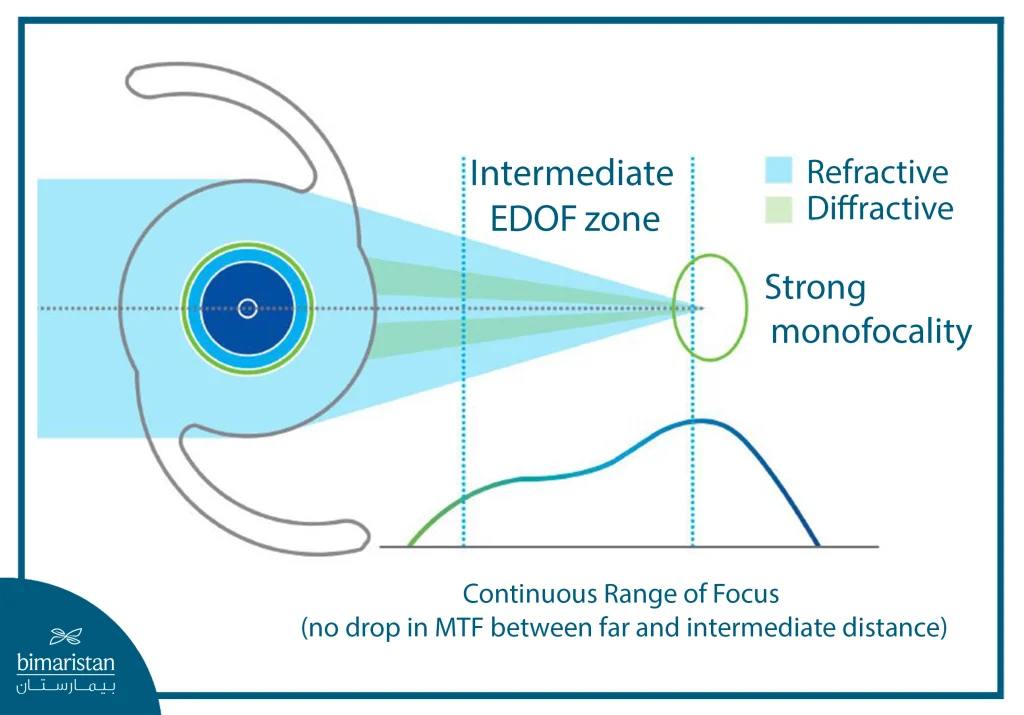
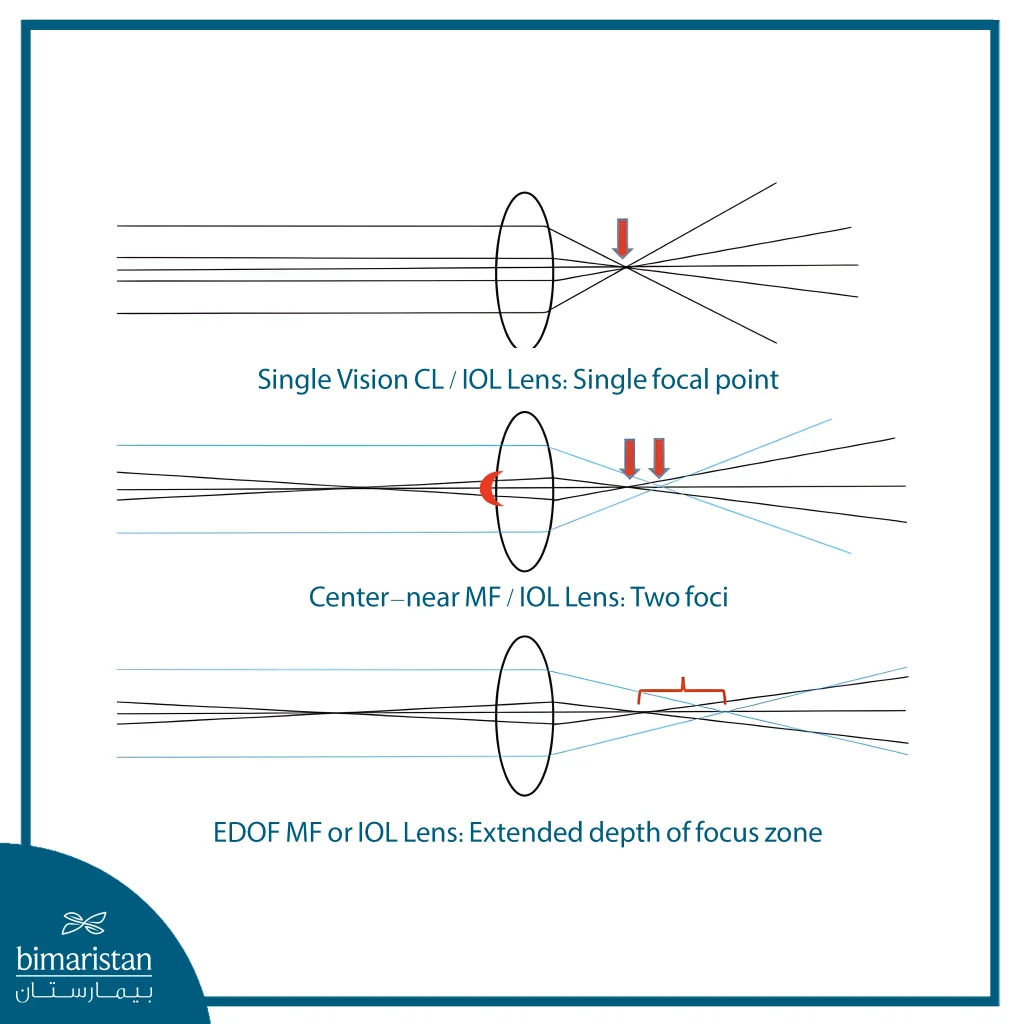
An extended depth of focus (EDOF) lens is an advanced type of intraocular lens designed to correct age-related farsightedness and improve the range of vision after cataract surgery or refractive lens exchange. Unlike monofocal lenses that focus light into a single point, or multifocal lenses that divide light into several separate foci, an EDOF lens creates a single, elongated focus that allows for a continuously expanding field of vision. This design improves visibility at multiple distances, especially medium distance, while maintaining the quality of distance vision and minimizing image interference that can cause halos or nighttime glare.
How does an extended depth of field (EDOF) lens work?
An extended focal depth lens is based on a different optical principle than multifocal lenses, in that it does not split light into multiple focal points, but rather lengthens the single focal point within the eye. This extension of the focal point increases the depth of field, allowing for clear and progressive vision over a wider range of distances. This technique helps minimize the superimposition of near and far images, which is the main cause of halos and light artifacts in some multifocal lenses.
As a result, the EDOF lens provides a smoother, more stable vision, with better contrast quality and comfortable optical performance, especially when driving at night or using digital displays. While expanding the depth of field could theoretically be accompanied by a slight decrease in image quality, recent EDOF lens designs have shown a good balance between clarity and quality of vision, with a clear advantage in medium vision over conventional lenses.
Why is an extended depth of field (EDOF) lens an advanced option?
The Extended Depth of Focus (EDOF) lens is classified as an advanced option because it is designed to provide a more natural and stable optical experience compared to traditional multifocal lenses. It doesn’t rely on splitting light into separate foci, but rather expands the field of focus continuously, improving the quality of everyday vision and minimizing unwanted optical phenomena.
Improved distance vision
The EDOF lens provides a clear and stable long-distance vision, close to the quality of vision achieved by mono lenses, while maintaining detail and visual contrast. This makes it suitable for everyday activities such as driving, walking, and watching TV without distortion or loss of image clarity.
Excellent optical performance for medium vision
One of the main strengths of extended focal depth lenses is intermediate vision, which allows for comfortable viewing at distances such as using a computer, cell phone, or reading a car’s screen. This is the most commonly used range of vision in everyday life, giving patients a practical sense of freedom from glasses.
Minimize light phenomena
Thanks to its single elongated focal design, the EDOF lens significantly reduces halos and nighttime glare compared to multifocal lenses. This is especially important for patients who drive at night or are sensitive to low-light vision disorders.
Higher contrast quality and better visual comfort
The extended focal depth lens maintains good contrast quality, helping to distinguish fine details and colors more clearly. It also provides higher visual comfort with less visual fatigue, which has a positive impact on patient satisfaction and long-term vision stability.
Does an extended depth of field (EDOF) lens replace glasses?
In most cases, an extended depth of focus (EDOF) lens significantly reduces dependence on glasses, especially for distance and intermediate vision. Many patients are able to go about their daily activities, such as driving or using digital devices, without the need for glasses after surgery.
However, light glasses may still be needed for fine reading or very close work, such as reading small fonts or fine manual labor, especially in patients who require high concentration at very close distances. It depends on the nature of the eye, pre-operative measurements, and the patient’s post-operative visual expectations.
Comparison of monofocal, multifocal, and extended focal depth lenses
Below is a table outlining the basic differences between monofocal, multifocal, and extended depth of field (EDOF) lenses, to help understand the characteristics of each type and choose the most appropriate lens based on the patient’s visual needs.
| Criterion | Monocular lenses | Multifocal lenses | Extended Depth of Field (EDOF) lens |
|---|---|---|---|
| Scope of vision | Clear vision for only one distance (often far away) | Near, medium, and far vision through separate focal points | Continuous far to intermediate vision with functional support for near vision |
| Visualization Workflow | Focusing light into a single point | Split the light into two or three separate foci | An elongated single focal point expands the depth of field |
| Far-seeing quality | Very good | Good to excellent | Excellent and close to mono lenses |
| Medium vision | limited | Good | Excellent (highlights) |
| Nearby vision | Weak – need glasses | Often excellent without glasses | Medium – you may need glasses for accurate reading |
| Auras and night glare | Very Rare | Relatively common, especially at night | Significantly lower |
| Optical contrast quality | Very high | Relatively less | Good to High |
| Adjustment period after surgery | Very Short | Longer and may take weeks or months | Shorter and easier compared to multifocal lenses |
| Relying on glasses | High (especially for reading) | Very low | Low for daily visibility, may remain for accurate reading |
| Correction of astigmatism | Limited (by type) | Available in special editions | Available in Toric versions |
| Suitable for whom? | Patients prefer stable distant vision and don’t mind glasses | For those who want to go almost completely without glasses | Looking for a balance between visual quality and visual comfort |
| Daily visual comfort | High | Medium | Very high |
Tests needed before implanting an extended depth of focus (EDOF) lens
Before deciding to implant an Extended Depth of Field (EDOF) lens, a series of rigorous tests must be performed to ensure eye safety and help select the most appropriate lens for each patient. These tests are not only meant to determine the strength of the lens, but also to evaluate the entire eye and rule out any factors that may affect the quality of vision after surgery. Key tests include the following:
- Measuring refraction and lens power to accurately determine the required optical power
- Corneal imaging and convexity measurement to assess the shape of the cornea and detect any abnormalities or astigmatism that may require a special lens
- Measurement of eye length and optical axis, a key factor in accurately calculating the power of the implanted lens
- Examine the retina and fundus to make sure the retina is healthy and there are no diseases that may limit the use of the EDOF lens
- Optic nerve evaluation to rule out neurological diseases that may affect the quality of vision
- Measuring eye pressure for early detection or preparation for glaucoma
- Evaluate pupil size in different lighting, as it plays a role in minimizing postoperative photopigmentation
The results of these tests play a pivotal role in determining whether an extended focal depth lens is the best choice, or if another type of lens is more appropriate for the patient’s condition.
Extended Depth of Focus (EDOF) Lens Implant Steps
Extended focal depth lens implantation is a simple and quick procedure when performed in a specialized center and relies on precise surgical techniques to minimize recovery time and achieve stable visual outcomes. The procedure goes through several basic steps:
- Preparation and local anesthesia using eye drops to avoid pain during the procedure
- Removal of the natural lens through a very small incision without the need for stitches in most cases
- Inserting the folded EDOF artificial lens through the small incision and fixing it in its normal position inside the eye
- Checking lens centering and stability to ensure the best possible quality of vision after surgery
After the procedure is completed, the patient remains under observation for a short period of time, then can go home the same day with clear instructions for eye care during the recovery period.
Short- and long-term results of extended depth of focus (EDOF) lens implantation
Most patients’ vision begins to improve within the first 24 to 48 hours after implantation of the extended focal depth lens, noticing better clarity in distance and intermediate vision with a gradual improvement in visual comfort.
Expected results include the following:
- Rapid improvement in quality of vision in the first few days after surgery
- Stable long-term vision while maintaining image clarity and contrast quality
- Reduced need for glasses for most daily activities
- High patient satisfaction due to reduced halos and nighttime glare compared to multifocal lenses
Long-term follow-up shows that extended focal depth lens results are stable and safe when following the doctor’s instructions and regular follow-up after the procedure.
Extended Depth of Focus (EDOF) Lens Implant Cost
The cost of an extended depth of field (EDOF) lens implant varies significantly between countries, depending on several factors, such as the level of medical centers, surgeon experience, the type of lens used, and operational costs within each health system. In general, some countries offer comparable medical quality with significant differences in price, making comparison important for patients looking for the best balance between quality and cost.
| State | Average cost per eye | What is usually included in the price |
|---|---|---|
| Turkey | 2,000 – 3,500 USD | Pre-operative tests, EDOF lens, surgical fees, medications, and follow-up |
| United States | 4,500 – 7,000 USD | Lens, surgery, part of the tests, and often does not include full follow-up |
| Gulf States | 4,000 – 6,500 USD | Surgery and lens, with the coverage of tests and follow-up varying by center |
In conclusion, the Extended Depth of Focus (EDOF) lens is an advanced option that combines quality of vision and visual comfort by providing clear and stable vision at long and medium distances while minimizing disturbing light phenomena. With advances in examination and surgical techniques, it is possible to achieve accurate and safe results when the right patient is selected and the procedure is performed in a specialized center. The final decision still depends on a thorough medical evaluation and the patient’s realistic expectations, making specialized consultation an essential step to ensure the best possible visual outcome in the short and long term.
Sources:
- Kanclerz P, Toto F, Grzybowski A, Alio JL. Extended Depth-of-Field Intraocular Lenses: An Update. Asia Pac J Ophthalmol (Phila). 2020 May-Jun;9(3):194-202. doi: 10.1097/APO.0000000000000296. PMID: 32511121; PMCID: PMC7299221.
- American Academy of Ophthalmology. (n.d.). Extended depth of focus intraocular lenses (EDOF IOLs). EyeWiki.
- EuroEyes. (n.d.). EDOF lenses: Extended depth of focus lenses.